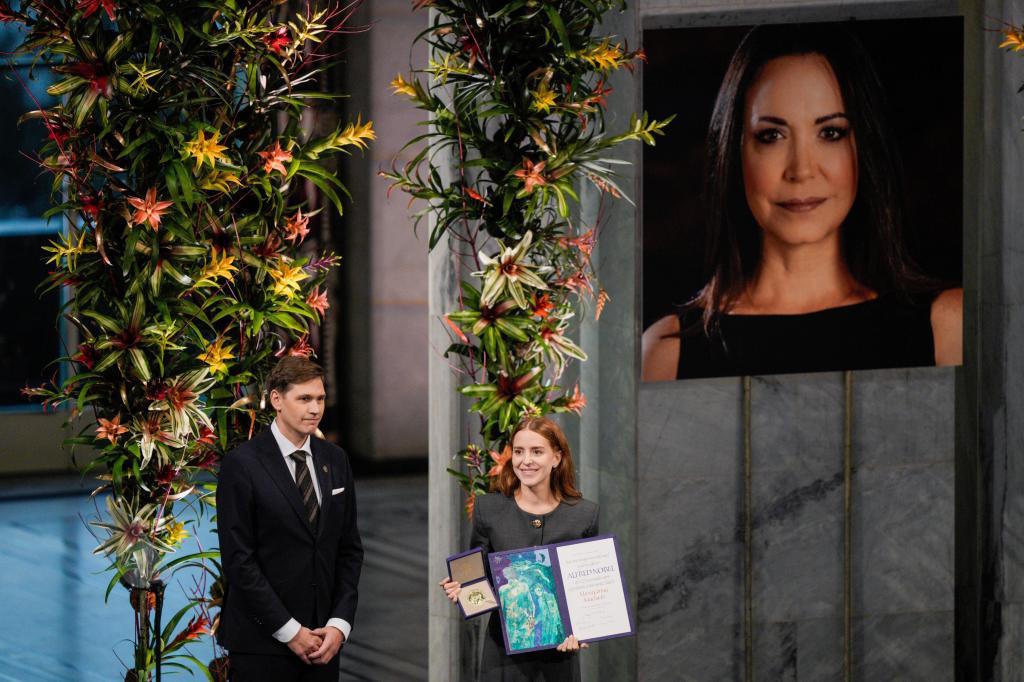
María Corina Machado did not make it to Oslo in time to receive the Nobel Peace Prize at the city hall. But her words have been conveyed through her daughter Ana Corina Sosa, who had the responsibility of delivering the acceptance speech for the recognition.
"My mom is not here to be part of this ceremony, but my mom never breaks her promises, and that is why I celebrate in my heart that, in just a few hours, we will reunite with her in Oslo after 16 months. I can't wait to see her, hug her, and kiss her after over two years," were the first words of the Venezuelan leader's eldest daughter. After making it clear that her mother will return to Venezuela, Ana Corina read the speech written by María Corina Machado.
The awardee began, through her daughter's voice, by reviewing the entire history of Venezuela until reaching the country's economic and social decline under chavismo. "The regime set out to divide us: by our ideas, by race, by origin, by way of life. They wanted Venezuelans to distrust each other, to be silent, to see each other as enemies. They suffocated us, imprisoned us, killed us, pushed us into exile."
Likewise, she highlighted the attempts to overcome that reality: "Betrayed dialogues, repressed massive protests, manipulated elections," and even mentioned that "hope collapsed, and with it, the faith that something could change. The possibility of change became naivety or madness."
Ana Corina continued to highlight all the feats of the Venezuelan civic movement to demonstrate fair results amid manipulated elections. "Edmundo González Urrutia, a calm and brave diplomat, stepped forward. The regime believed he did not pose a threat. They underestimated the determination of millions of citizens."
She also recalled the feat of July 28, 2024: "Six hundred thousand volunteers in 30,000 polling stations, applications to scan QR codes, digital platforms, and call centers from the diaspora. We deployed scanners, Starlink antennas, and computers hidden in fruit trucks to reach the most remote corners of the country." All of this demonstrated Edmundo González's victory with almost 70% of the votes.
Through her daughter, Machado remembered the repression intensified by chavismo after the elections. The same repression that forced her to remain in hiding. "During these 16 months in clandestinity, we have built new networks of civic pressure and disciplined disobedience, preparing for an orderly transition to democracy. This is how we arrived at today, where the clamor of millions of Venezuelans who already feel their freedom approaching resounds."
In her acceptance speech, the Venezuelan emphasized the significance of her award: "It reminds the world that democracy is essential for peace. And most importantly, the main lesson Venezuelans can share with the world is the lesson forged through this long and difficult path: if we want democracy, we must be willing to fight for freedom."
With the enthusiasm and optimism that characterize the 58-year-old Venezuelan leader, she sent a hopeful message to her compatriots and the world: "Venezuela will breathe again. We will open the doors of prisons and see thousands of innocents who were unjustly imprisoned finally walk out, embraced by those who never stopped fighting for them. We will see grandmothers sit their grandchildren on their laps to tell them stories, not of distant heroes, but of the courage of their own parents. We will see our students debate passionately, without fear, with their voices finally free. We will embrace each other again, fall in love again, hear our streets filled with laughter and music."
"My dear Venezuelans, the world has been amazed by what we have achieved. And soon, it will witness one of the most moving images of our time: the return of our loved ones home. I will be there, once again, at the Simón Bolívar bridge, on the border with Colombia, where I once cried among the thousands leaving, to welcome them back to the bright life that awaits us."
Machado also paid tribute to all those who have accompanied her on her journey: "To our political prisoners, the persecuted, their families, and all those who defend human rights. To those who protected us, fed us, and risked everything to take care of us. To the journalists who refused to be silenced. To the artists who brought our voice to the world. To my extraordinary team, my teachers, my political and social activist colleagues. To the world leaders who stood by us and defended our cause. To my three children, my beloved father, my mother, my three sisters, and my brave and dear husband, who have supported me throughout my life."
Her final words were for "the millions of anonymous Venezuelans who risked their homes, families, and lives for love. That same love from which peace is born, the one that sustained us when all seemed lost and that now unites and guides us towards freedom. This honor belongs to them. This day belongs to them. The future belongs to them. We continue hand in hand with God." "Peace is an act of love, and that love has already set our future in motion," she emphasized.
Among the audience, in the front row, was the emotional Machado Parisca family, unable to contain their tears: her other two children, her mother, and her husband. In the next line, the leaders of four Latin American countries (Argentina, Ecuador, Panama, and Paraguay), including her fellow fighter Edmundo González. In the front row, her most loyal friends and closest political allies, such as Antonio Ledezma, Magalli Meda, her right-hand woman and director of her campaign command; Pedro Urruchurtu, international coordinator of Vente Venezuela (VV); and Claudia Macero, VV's Communication Chief. In the center of the impressive auditorium were the kings of Norway and the executive team of the Norwegian Nobel Committee.
The event took place at Oslo City Hall. The grand hall was decorated, for the first time, with pots filled with different types of bromeliads and other plants from the Amazon rainforest, "in honor of this year's awardee." The ceremony began with emotional performances of the songs 'Alma llanera' and 'Venezuela,' performed by Venezuelan singer Danny Ocean. Likewise, the event concluded with the song 'Mi querida' (by singer-songwriter Simón Díaz), performed by pianist Gabriela Montero. The national anthem of the Latin American country, 'Gloria al bravo pueblo,' was also played.
At the end of the music, the President of the Norwegian Nobel Committee, Jørgen Watne Frydnes, delivered an opening speech that began by listing some of the thousands of cases of repression carried out by Nicolás Maduro's regime. "This regime does not even spare its children. More than 200 minors were detained after the 2024 elections. The United Nations documented their suffering as follows: plastic bags tightly over their heads, electric shocks to their genitals, body blows so brutal that breathing hurt, sexualized violence, cells so cold that they caused intense shivering, contaminated drinking water full of insects, screams that went unanswered to stop," he exemplified.
He also called on the chavista leader to resign and accept the results of June 28: "Mr. Maduro, accept the election results and resign."
"Venezuela has become a brutal and authoritarian state plunged into a deep humanitarian and economic crisis. Meanwhile, a small elite at the top, protected by power, weapons, and impunity, enriches itself," continued Watne Frydnes, providing context on the Latin American country.
In addition to recognizing María Corina Machado's fight for freedom and democracy in Venezuela, the Committee President highlighted the names of several of her Vente Venezuela party colleagues, as well as Edmundo González Urrutia, and members of her family, which sparked applause from all attendees.
Watne Frydnes reviewed all of María Corina Machado's political feats. "Although she cannot attend the ceremony or today's events, we are deeply pleased to confirm that she is well and will be with us in Oslo," he expressed.