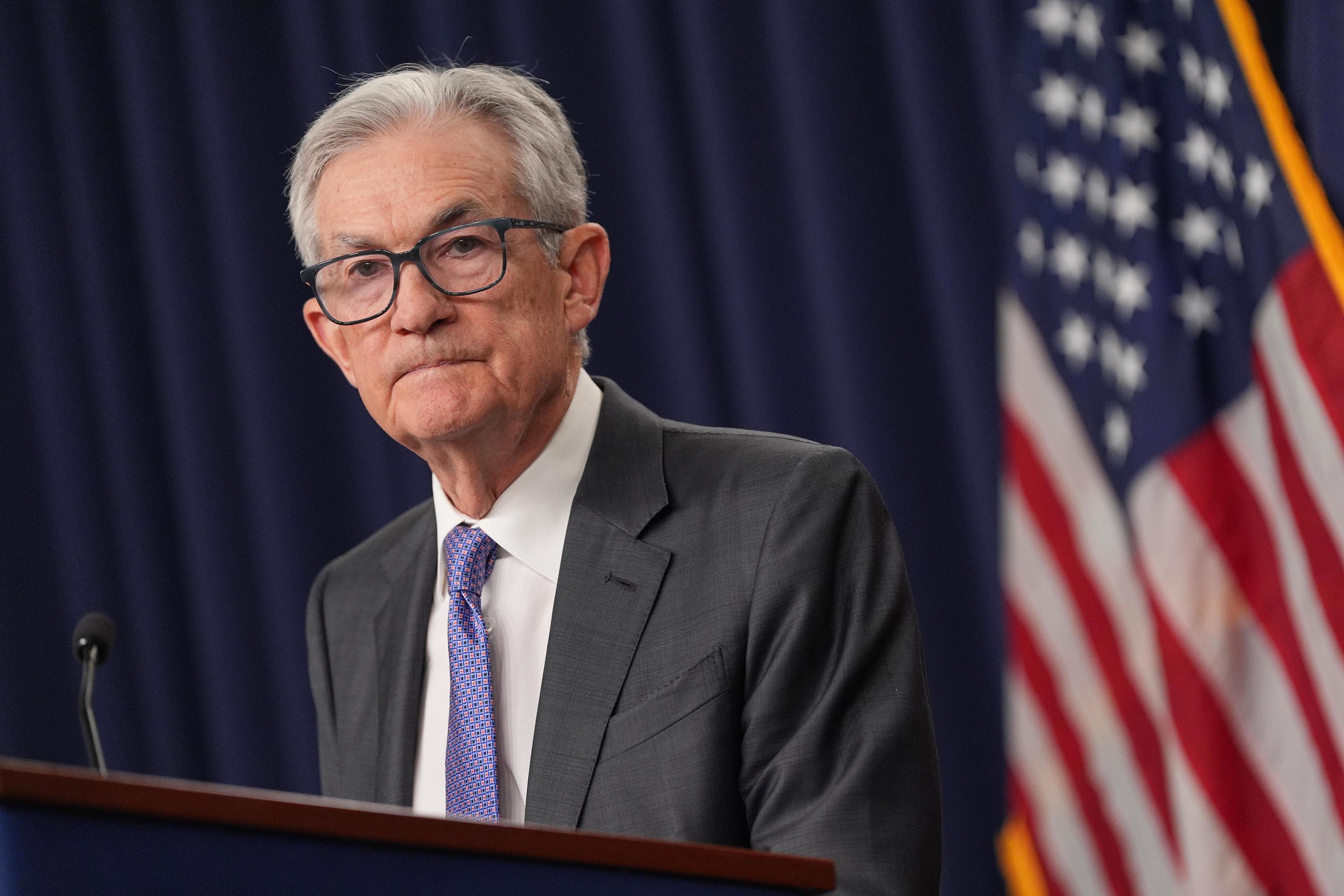
The U.S. Federal Reserve has lowered interest rates on Wednesday by a quarter percentage point for the third consecutive time. The decision, controversial and with three dissenting votes (in addition to four others who have expressed serious doubts using a more subtle mechanism), sends a message to the market that there may be more cuts in the future, but the next decision, at any time in 2026, may require much more concerning data on the labor market or growth. "In the short term, risks to inflation are tilted to the upside, and risks to unemployment to the downside, a complex situation. There is no risk-free path for monetary policy as we navigate this tension between our employment and inflation objectives," summarized the central bank's president, Jerome Powell, emphasizing that "goods inflation has rebounded, reflecting the effects of tariffs".
Wednesday's decision leaves rates in the range of 3.5% - 3.75%. Stephen Miran, White House's chief economist temporarily appointed by Trump a few months ago, once again distanced himself, advocating (also for the third consecutive time) for a half-point reduction. On the other hand, Jeffrey Schmid, president of the Kansas City Federal Reserve, voted for the second consecutive meeting to keep rates unchanged. Meanwhile, Austan Goolsbee, president of the Chicago Federal Reserve, voted for the first time against the decision to continue easing monetary policy.
"Available indicators suggest that economic activity has expanded at a moderate pace. Employment growth has slowed this year, and the unemployment rate has slightly increased through September. The most recent indicators are consistent with this evolution. Inflation has increased since the beginning of the year and remains somewhat elevated," succinctly summarizes the institution in its statement, pointing to a very controversial fact: the lack of complete data due to the suspension of federal activity this fall for six weeks. "The Committee seeks to achieve maximum employment and inflation of 2% in the long run. Uncertainty about economic prospects remains high. The Committee is monitoring risks to both sides of its dual mandate and considers that risks to employment have increased in recent months," adds the Fed.
Most members estimate that the Fed will cut rates before the end of 2026, to 3.25% or 3.5%. Seven out of the 19 policymakers disagree, with eight advocating for at least two cuts. And one, undoubtedly Miran, predicts that rates will fall close to 2% over the year, once the new Fed president is in charge.
This meeting, the last of the year, had little resemblance to the previous ones. It may not be the last with Powell at the helm, but it is likely the last before Trump appoints his replacement. Although not directly addressed in his language, the sense of the end of a cycle is starting to prevail. The end of an era marked by consensus-seeking, discreet work, and as much independence from the Executive power as possible. An era that ends with the still-distant fear of possible stagflation. "Conditions in the labor market appear to be gradually cooling, and inflation remains somewhat elevated", Powell emphasized in his statement.
After two consecutive rate cuts, where the main doubts were whether it would be a quarter or half point, and with more focus on language and medium-term growth, employment, and price forecasts than on the monetary decision itself, Powell's team has arrived more divided than ever. He led the path in the second half of the year, following the same mechanism used in 2019 with three consecutive cuts before setting stricter criteria for the following ones. The market saw it similarly, with global bond yields at 15-year highs assuming that the monetary easing path would come to an end today, one way or another.
But the consensus that all central bankers aspire to is completely shattered, and analysts were eagerly awaiting the outcome of internal deliberations, whose spirit was revealed with the publication of the latest minutes a few weeks ago. With complete unanimity ruled out, the president's goal was to minimize frictions and show as little division as possible, both in the Open Market Committee (FOMC) voting itself and in what is known in-house jargon as "soft dissents," indicating in the forecasts for the coming years a higher rate level for 2025 than the actual rate after this Wednesday's decision, showing disagreement. In addition to the two mentioned members, four others have taken advantage of the mechanism to disagree with the course taken, without fully opposing it. Either because they couldn't, not having voting rights, or because they didn't want to openly dissent.
The current situation is far from simple. The White House, through its man in the institution, Stephen Miran, and Kevin Hassett, most likely the next president, is not letting up. President Donald Trump continues to exert constant pressure, reproaching, threatening, and almost savoring a victory with Powell's imminent departure from the institution. On Tuesday, in a speech in Pennsylvania, he briefly threatened council members, suggesting that some of them may have been irregularly appointed by Biden. The president, who continues to boast of having the best economy in the country's history thanks to his management and despite the "inherited legacy", wants much lower rates immediately. Surprisingly, investors, who rarely pass up a treat, are jumping on board, seemingly unconcerned about the possible end of the Fed's independence.
Five of the 12 voting members of the Monetary Policy Committee, and up to 10 of the 19 members according to The Wall Street Journal's calculations, had publicly stated in recent weeks through interventions, interviews, and speeches that they saw no reasons at all to continue lowering the interest rate. One of them even voted against the decision last time, and skeptical voices have multiplied, driven by inflation, which has stopped falling when it is still far from the 2% target. The doves, however, believe that global uncertainty and labor market weakness require more stimulus. Especially now, when the exact economic data is unclear due to the federal government shutdown for over a month between October and November, preventing its collection and processing.