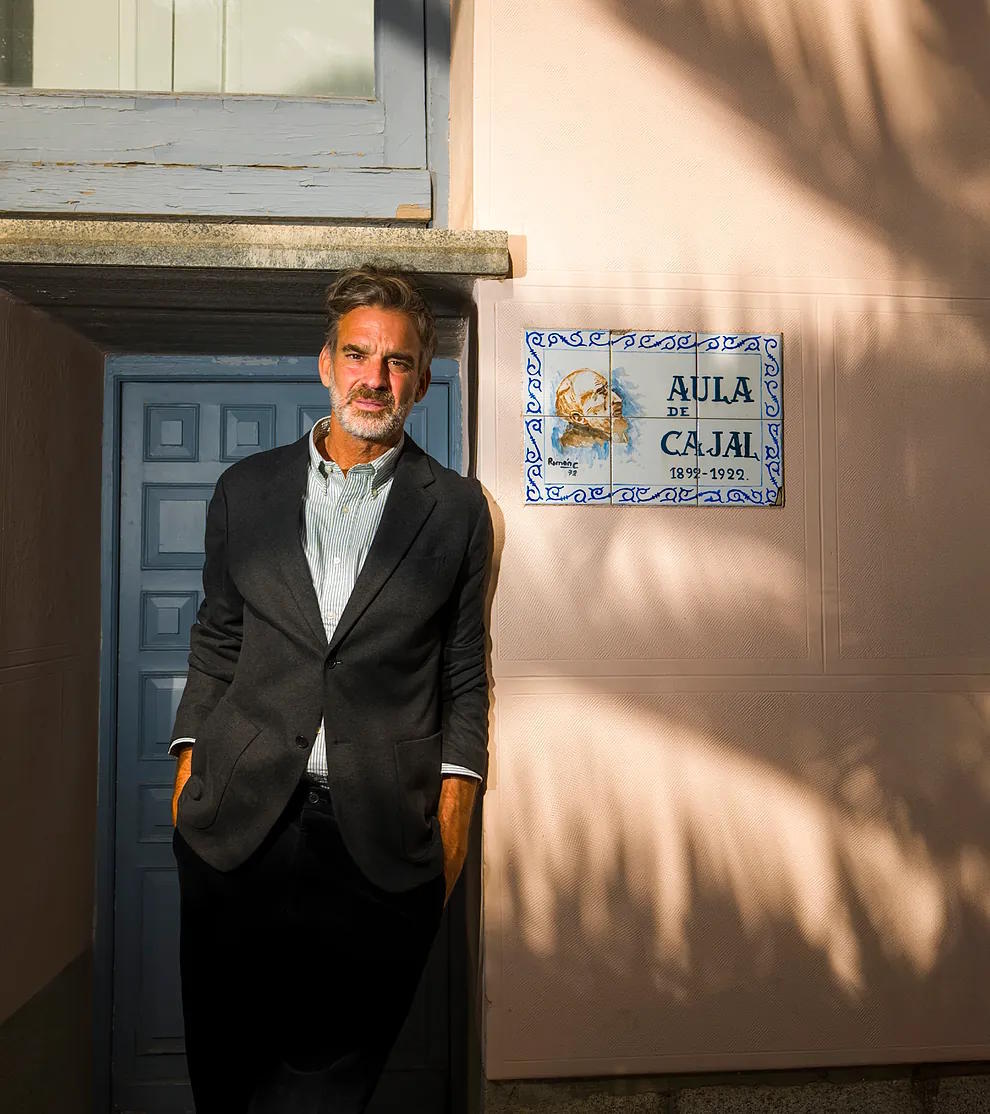
One sees David Erritzøe arrive and might think he is a painter, maybe a professor, or even a musician. But this Danish is one of the most reputable scientists in the world in the therapeutic study of psychedelics, drugs that in recent years are starting to be accepted as medicines in a few countries around the world.
They are allowed in some states in the USA, Canada, Germany, Czech Republic, Switzerland, Australia, New Zealand, Portugal, Jamaica, Brazil, Peru, and the Netherlands. Currently, there are seven phase 3 clinical trials, the step before commercialization, of medicines where the main compound is part of the psychedelic family. Among them, psilocybin - a natural substance found in some mushrooms and similar to ayahuasca in its effects - is one of the most used, but other substances with more stigma, such as LSD, ketamine, or MDMA, are also in play.
Erritzøe is a psychiatrist and neuroscientist researching this at the Psychedelic Research Center at Imperial College in London. He was recently invited by the Inawe Foundation to give a conference at the Official College of Physicians in Madrid, as part of their first congress on the therapeutic use of psychedelics.
In a courtyard near the Ramón y Cajal classroom, he answers this interview while dozens of Psychology students around him observe with great interest because they know that the next major revolution in psychotherapy depends on his findings. He states that "psychedelics have been tested and proven effective in treating deep depressions or disorders such as post-traumatic stress (PTSD)", but it turns out that they work best in helping addicts to stop being addicted.
Question. Could you explain simply how a drug allows an addict to other drugs to stop being one?
Answer. I know I belong to this field of work, but it never ceases to amaze me that everything surrounding this issue is always so controversial or difficult to interpret. That being said, what is a drug? Alcohol is a drug. Selective serotonin reuptake inhibitors (SSRIs) are drugs. And illicit drugs are drugs as well. What do they do to the body? And what concept of a drug has been placed on the side of illegality? This is a completely different construct, and it is also arbitrary regarding the risks and benefits they provide. Psychedelics should have been classified in a category of legal regulation given their risk-benefit profile. But that's not what happened. And then you have legal drugs that are less stigmatized precisely because they are legal or part of a culture. But it has been prescribed that the level of risk is higher with psychedelics.
Q. How do these drugs work?
A. Psychedelics are challenging and difficult drugs, and also interesting in terms of the psychological aspect, and safer than others in terms of risks because they are much more than almost any other drug we can think of. Heroin is ultimately an easy experience, although you could die from an overdose; just stop breathing. Heroin can destroy a person's life but, psychologically, it is a simple experience. The same goes for stimulants, drugs that boost and inflate the ego, chatty drugs that, however, lead to dependence and tons of problems, cardiovascular, etc. Psychedelics are a bit the opposite, or they work the other way around.
Q. Why are they illegal then?
A. It happened during a process of arbitrary political and legal decision-making that had nothing to do with health or the potential medical benefits of psychedelic science. It has been oversimplified. Just because someone put them all in the big pot of illegality does not mean they should be compared to each other because they are not the same. The benefits are proven in the case of compounds like psilocybin: there are potential health benefits, the development of treatments, self-development, intellectual exploration of individuals, their own minds and lives, and understanding themselves and the world.
Q. So, do they not cause addiction?
A. They are very useful and powerful tools. We should not fear them because they do not cause addiction. At least classic psychedelics. A bit different is ketamine, an atypical or non-classic psychedelic, as some would call it, or MDMA and derivatives, novel psychedelic compounds that are related to classics but have different characteristics. Some of them have higher risks than classics. So, it all depends on the exact molecule we are talking about.
Q. One of the most used substances now is psilocybin, can you tell us more about it, please?
A. Classic serotonergic psychedelics, such as psilocybin or LSD, are physiologically very safe. They have an extremely low risk of developing dependent behavior. But they are psychologically very challenging. That's why you need a safe therapeutic and psychological "cushion" around you when you take them. Whereas other drugs work the other way around: you can take a stimulant without needing any therapist to examine it. You are going to have a great time, but you could end up falling into dependent use and with a strong physiological impact on your brain. That's why it seems crazy to me that, without explaining the medication, it is declared illegal. I know the question many people will ask: 'Why give an addict to an illicit substance, another illicit substance?' But this is because at some point someone considered it illicit. There is no correlation between risks and benefits and the place this substance occupies in terms of illegality.
Q. History tells us that the great era of psychedelic research was the 60s, which President of the United States Richard Nixon destroyed in the 70s during his war on drugs. Has a lot of time been lost?
A. Too much. Too much time lost in the medicinal development of certain drugs. Some research continued a bit in animals and also some in Switzerland by American colleagues, and some also in the US, but very little. Until research slowly resumed and suddenly some people were authorized to conduct some studies, and that ended up slowly opening this new era or renaissance of psychedelic science of which we are all now a part. The inactivity was generated by Richard Nixon, as mentioned, brutally ending psychedelic research. A precious time has been lost. Although some will say, "Well, now we are much more prepared."
Q. Are we?
A. Yes, certainly. But people were not foolish back then. There were great professionals, scientists, and patients with the same stories as now. It's a shame so much time was lost, but we can't change the past. We must look for glimmers of hope, and we can find it, for example, in the evolution of talk therapy. 100 years ago it was very psychodynamic, psychoanalytic, Freud, etc. Then came a very cognitive approach, cognitive-behavioral therapy developed, and now we have this third wave where many things are mixed: mindfulness, somatic exercise... There are many conversational therapies maturing that fit quite well with psychedelic therapy. Perhaps psychotherapy has matured spontaneously, and this provides opportunities for psychedelics. A field to be explored where there are already very good schools, training, experienced clinical therapists, and new approaches. All of this can be combined significantly and safely with psychedelics.
Q. You also come from neuroscience and are a specialist in brain imaging. How has your research evolved?
A. We still don't have the perfect method, we don't fully understand the brain, we are just scratching its surface, but we scratch it better than in the 70s so I think we can better understand what is happening. In all we have published so far on brain imaging after the use of psychedelics, we have not found any signs of addiction. People with addictions come to our center for treatment, and we are setting up two new trials, one for gambling addiction and one for opioid addiction, where we will try to treat these people with psilocybin therapies. There is even a lot of published work on ketamine therapy for alcohol addiction. I know it's a paradox to treat alcohol addiction with ketamine, but it works very well.
Q. Explain how it achieves this, please
A. The main characteristic of psychedelics is the opportunity to generate changes, to break cycles and behavior patterns, and improve well-being, resilience, the creation of meaning... And all of that is very important for a person trapped in addiction and really suffering. Something transformative is needed, and psilocybin is a perfect tool to generate that transformative experience, people do not become addicted to it because it does not go through the brain systems that make people addicted.
Q. What should happen among mental health professionals to accept these treatments?
A. One of the psychiatrists working with me at Imperial College holds retreats in places where the use of psilocybin is legal and has a very specific and innovative profile: he is very therapeutically informed and is very open and reflective in terms of the relationship with patients. This should be happening, it happens, but we need it on a larger scale: professionals who are able to collaborate with others, such as psychologists and therapists.
Q. What role would each professional have?
A. The psychiatrist can work with ketamine or psilocybin, and the therapist can help experience and catalyze it. Together, they make the space where ingestion occurs safe for patients. But conventional psychiatry has not yet reached this level. It is not fully understood what an altered state of consciousness is, which is what psychedelics achieve. And there should be the humility to recognize that a psychiatrist alone cannot solve things. I wish there were more centers where therapists and psychiatrists worked together.
Q. What do you propose?
A. I dare only to suggest: we have the medications, we have the professionals, why not create safe spaces in which to work for the patients? There is evidence for the treatment of addictions with ketamine even for OCD and particularly for depression or PTSD.