The test circuit for the unmanned ground vehicles is designed with logs, truck tires, mud, and puddles. It aims to recreate the real conditions that future drivers of what is known in the local military jargon as UGV or NRC will have to face.
One of the instructors is explaining to a group of military personnel how to park one of the Tarhan vehicles (cockroaches), maneuvering the small vehicle between two wooden blocks. The next step is to drive through the marked routes with obstacles, avoiding getting stuck in the mud.
"The basic course lasts five days, and the advanced one, two weeks," explains Viktor Pavlo, founder of the UGV Operators College, established earlier this year by the Third Assault Brigade of the Ukrainian army, whose location cannot be disclosed.
A few meters away from the robot section students, other pilots are learning from an advanced FPV drone program, and further on, in a field dotted with trenches, an instructor is teaching a group of infantry soldiers.
For Roland, 21 years old and eight months in the army, this is the second day of his training. "I thought it would be harder to handle them," he comments.
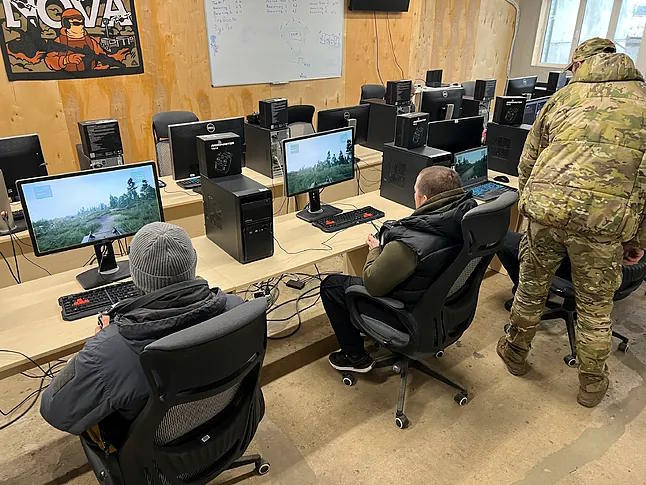
Pavlo shows another facility of the school: a position called the bunker, built in a basement, where the students' computers are placed on empty ammunition boxes, and the walls are covered with military camouflage nets. Another scenario simulating the positions these operators will take on the front line.
The Ukrainian military moves among the large number of locally produced vehicles used in the complex: here, one can learn with cockroaches, kamikaze tritons (which move on a triplet of anti-tank mines replacing the wheels), termites, snakes, and even a bulky Estonian Milren. "The big difference is that a Milren costs 300,000 euros and a cockroach is under 10,000. You have to consider that they don't survive long on the battlefield, so the price is also a key factor," asserts the expert.
Field practices are only carried out once newcomers have become familiar with driving. For this, they use a computer program very similar to video games.
Currently, on the third floor of the facility, half a dozen young people are about to start a fictional "mission" on the computers, following a digital map that replicates the real conditions of the Donetsk province terrain, where many of the main clashes of the conflict take place.
"You have to find the four flags. I warn you that between the third and fourth flags, there is a trap, a minefield," comments the instructor before giving the start order.
On the screen, you can see the devices advancing through anti-tank obstacles, burnt cars, and remnants of armored vehicles. The software allows students to switch between two positions: they can be UGV drivers or the hypothetical drone guiding it from the sky.
"With UGVs, speed is not important because they usually don't exceed seven kilometers per hour. The key is to know the different uses of each one and the tactics used in those actions," adds Pavlo.
Under the unique name of La Casa de Matar (The House of Killing), the educational center to which Pavlo belongs offers more than half a dozen different specialties, mostly focused on the handling of unmanned aerial vehicles and NRC.
"In the era of digital technologies, warfare has acquired new characteristics, where dominance is determined not only by strength. Mastery of modern tools becomes a key factor for victory," reads their advertisement.
When La Casa de Matar announced the first UGV course last March, they did not expect the demand for spots to exceed their capacity. Now, they say, there is a five-month waiting list. "We have already trained a thousand pilots. We provide classes to civilians, for a fee, and to military personnel. The latter are free. There is a 10% failure rate in the exams," remarks the uniformed officer.
The inclusion of ground robots in the curriculum of this unique academy is part of the accelerated program launched by Kiev to train thousands of ground and marine robot pilots, following the climax experienced by the country in 2023, witnessing the proliferation of military and civilian academies dedicated to training operators of aerial drones (UAS).
The local Ministry of Defense recently granted permission to the first of seven private schools -La Casa de Matar being a military institution- dedicated to training UGV drivers.
In August, President Volodymyr Zelensky's government also announced a plan to finance this type of education due to the increased use of UGVs on the battlefield, especially on the Ukrainian side, which seeks to compensate for its disadvantage in soldiers with drones and robots.
Amid the brutal revolution witnessed in wars - increasingly resembling the futuristic model of conflicts anticipated by James Cameron - the traditional delivery of supplies and ammunition by trucks is already part of history, at least in the so-called death zone subjected to UAS action. The same goes for evacuating the wounded with ambulances that used to approach the front line or manual landmine laying, tasks previously carried out by sappers.
UGVs have begun to take on these tasks and also support the military in their assaults, with new robots incorporating everything from fixed machine guns to rocket launchers or various types of grenades.
As reported by New Time (NV) in October, we are already witnessing the "massive use" of these robots, with over a hundred different models. Only one local company, Tencore, plans to supply over 2,000 to the army, which, according to the Ukrainian media, is "more than what the entire European NRC industry has produced in the last five years."
According to the founder of this company, Maksym Vasylchenko, 80% of the missions of these ground platforms focus on logistics and 15% on transporting wounded soldiers. The NRC units of the Third Assault Brigade, for example, transport over 100 tons per month and evacuate dozens of wounded every week, as reported by the media. Only a tiny fraction would involve direct combat operations.
The intensified construction of thousands of these devices takes place in small hidden factories in warehouses or premises that, from the outside, no one would imagine house the array of devices, weapons, and cutting-edge technology that accumulate within the walls of the facility located in the Zaporiyia province.
The company owner, 64-year-old Eduard Trosenko - a former military man in the Soviet era - alternates between producing electric vehicle charging stations for civilian use and manufacturing NRC.
Trosenko considers himself ahead of his time. He started creating NRCs at the beginning of the war in 2014. "Even back then, I realized that we had to adopt what I call the mosquito doctrine," he clarifies while showcasing the latest designs from his factory.
Here, there are robots carrying a heavy machine gun, an RPG, and a rocket launcher simultaneously, others serving as launchers for four drones (UAS), or the usual mine carriers. They come with tracks and wheels, analog and digital.
"We are trying to adapt them to artificial intelligence. That is our next challenge. In the future, the pilot could be anywhere in the world," he points out.
"This is a kamikaze robot. You attach an anti-tank mine to it, and the pilot launches it against armored vehicles. We use them in ambushes," he proclaims, pointing to one of the devices.