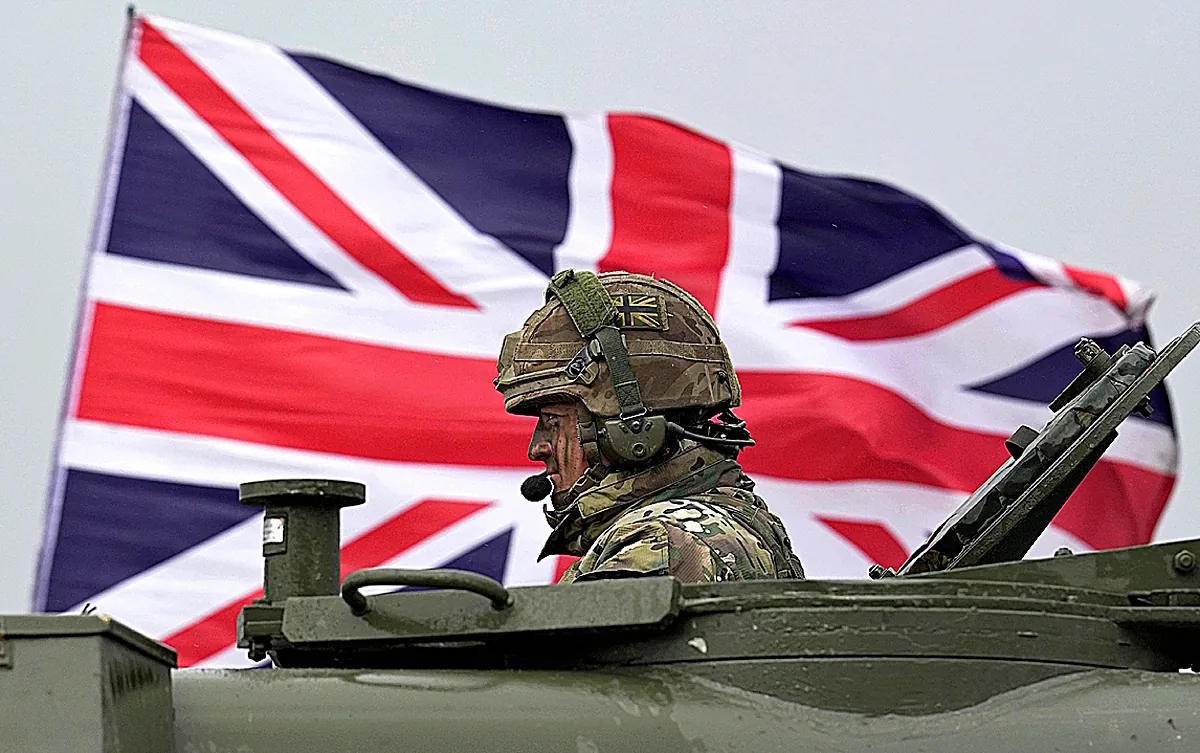
The chances of Russia launching a direct military attack against the United Kingdom are around 5%. It is therefore a remote but not non-existent option. And it may possibly increase in the coming years. Therefore, British citizens must be prepared to "build, serve [the country], and, if necessary, fight."
This was expressed on Monday night by the commander-in-chief of the British Armed Forces, Marshal Richard Knighton, who addressed this message to "sons and daughters. Colleagues. Veterans...", stating that "we all have a role to play." Knighton predicted that "more families will come to know what it means to sacrifice for our nation."
His message is particularly significant as it comes after similar warnings from the top British intelligence official, the head of the French Armed Forces, the NATO Secretary-General, and the top military official of the Alliance. The repetition of the message is not a coincidence.
Events seem to confirm these analyses. Nathan Gill, former leader in Wales of the ultranationalist party Reform UK, currently leading in the polls nationwide, was imprisoned yesterday for a 10-year sentence for receiving "tens of thousands" of pounds from Russia for making pro-Moscow statements in the media and in his speeches in the European Parliament, where he was a member. Thus, Europe seems to be facing what the new director of the British foreign intelligence service (known as MI6), Blaise Metreweli, also declared on Monday in her first public statements since taking office in September, that the "frontline [of combat] is everywhere."
Prime Minister Keir Starmer announced on Tuesday a review of electoral donation regulations in the United Kingdom to contain foreign interference. Among the proposed measures is the ban on contributions in cryptocurrencies, which are by definition almost impossible to trace and therefore are often used by criminal groups and governments. The founder and leader of Reform UK, Nigel Farage, has stated that cryptocurrencies are one of the main sources of funding for his party.
Knighton, who is from the Air Force, was extremely direct. "The situation is more dangerous than I have seen at any point in my career", he said. Considering he joined the Armed Forces 37 years ago, this means that the United Kingdom - and by extension, all of Europe - is in a more dangerous situation than during the 9/11 terrorist attacks or the late Cold War era. And certainly more dangerous than during the wars in former Yugoslavia, which led to two NATO bombing campaigns in the 1990s and the surge of ISIS attacks in the mid-2000s.
Additionally, the admiral delivered the message at an event of utmost importance: the traditional Annual Defense Conference held by the top British Armed Forces official every year at the RUSI think tank (the acronym in English for what could be translated as the Royal Institute of Military Forces, which despite its name, is a private organization).
Knighton was addressing the top Defense and security establishment of the United Kingdom. But he was also trying to send an extensive message to the entire British society: in this crisis, it is not possible to think that professional Armed Forces alone can take care of the country's defense. This is not the Iraq War. Some form of national mobilization is needed.
Even a stable peace in Ukraine would not dispel the fears. In Knighton's words, "we cannot delude ourselves. Russia has massive Armed Forces, with increasing technological sophistication and now combat experience." The marshal also mentioned the uncertainty factor of the US strategy, which is rapidly distancing itself from Europe. In this regard, NATO is delivering $5 billion worth of US-purchased military equipment to Ukraine since the summer when Donald Trump decided that the US would no longer provide weapons to the Kiev government.
Knighton's speech came just five hours after Metreweli's. The coincidence in the date and content of the messages from the head of the spies and the head of the soldiers does not seem accidental. Nor is the warning, made two months ago by the French Chief of Staff -"my good friend, General Fabien Mandon," as Knighton referred to him - who stated that Russia could launch a war against Europe "in three or four years." In November, the top military official of NATO, Italian Admiral Giuseppe Cavo Dragone, told EL MUNDO that the Alliance does not rule out direct actions against Russian bases - land or naval - from which Moscow launches drones over Europe. Like Mandon, Cavo Dragone's predecessor, retired Dutch Admiral Rob Bauer, does not rule out a NATO war with Russia in the coming years, but adds an extra factor of concern: Moscow could use nuclear weapons in the conflict.
For the United Kingdom and the rest of Europe, the prospects of conflict with Russia are harsher because the Donald Trump administration seems increasingly willing to disengage from Europe. According to The Washington Post, the US Department of Defense is considering eliminating the European, African, and Central commands (which cover the Middle East) and merging them into a single international command. The implication is clear: Europe would lose strategic importance for the US, not only in its own geographical area but also in Africa, where Russia is expanding its influence in countries like Mali, Burkina Faso, and Niger, the latter being a significant uranium producer.