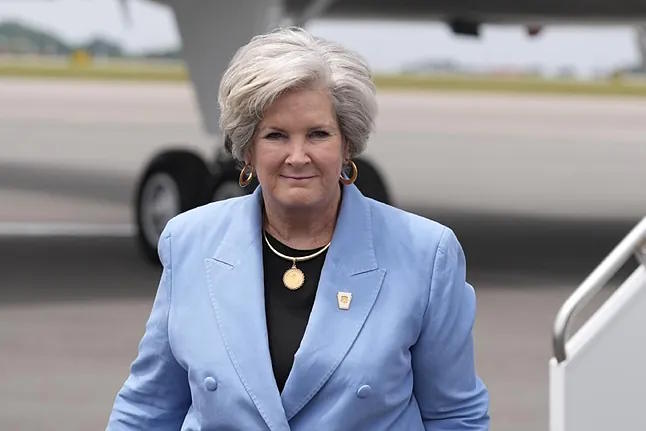
In the United States, there is a long tradition of politicians and high-ranking officials publishing memoirs about their White House or government experience, generally juicy books with gossip, settling scores, and bitter portraits of colleagues, bosses, or rivals. What is less common is for this exposure to come while they are still in office. This Tuesday, the magazine Vanity Fair has published a piece with the content of a dozen interviews by journalist Chris Whipple with Susie Wiles, Donald Trump's Chief of Staff. Unlike the more well-known members of the team, Wiles has always played a secondary role, away from the cameras, attention, and spotlight. But in this piece, the woman who led Trump's reelection campaign, and who tries to bring some order to the chaos of Washington, speaks candidly about the more ambitious figures.
The main focus is, obviously, Trump. His chief of staff never antagonizes or openly criticizes the president, but acknowledges some of the most concerning traits of the politician or his mistakes. For example, she says that Trump "has the personality of an alcoholic", even though he does not consume any alcoholic beverages. "Some clinical psychologist who knows a million times more than I probably will disagree with what I'm about to say. But functional alcoholics, or alcoholics in general, have personalities that are exacerbated when they drink. And in that sense, I am a bit of an expert on strong personalities (...) Trump has the personality of an alcoholic (...) and acts with the conviction that there is nothing he cannot do. Nothing, absolutely nothing."
She acknowledges that they have gone too far in deportations of immigrants without guarantees and states that she advocated for not pardoning the most violent Capitol rioters, but she was not listened to. But she describes her role not as a counterbalance to Trump, but as the facilitator for his will to be done.
One case: how she failed in trying to get the leader of the MAGA movement to stop using his position and power to "settle scores" with his enemies. Wiles says she reached an "informal agreement" with him to move on from his obsessions after three months in the White House, but it didn't work. She asserts that it's not that Trump is constantly thinking about revenge, but that "when the opportunity arises, he takes it".
The advisor, highly respected in the Republican world (especially in Florida), has no issue showing much less affinity with the country's vice president. J.D. Vance, whom she labels as a political opportunist, after going from a fierce Trump critic to a flatterer when he ran for the Senate. She also portrays him as "a conspiracy theorist for a decade", in a very negative context. She refers to him in those terms when addressing one of the administration's biggest problems, the Epstein case. For example, Wiles says that Trump was wrong or lied when he tried to involve Bill Clinton in visits to the private island of the pedophile financier Jeffrey Epstein.
The main culprit in the fiasco of the case is the Attorney General, Pam Bondi, a former personal lawyer of the president. "I don't think she appreciated at all that this was precisely the group that cared about this issue," Wiles says about the MAGA world. "First, she handed them folders full of irrelevant information. And then she said that the list of witnesses, or the list of clients, was on her desk. There is no such list of clients, and certainly it was not on her desk," she reproaches.
But the person she speaks worst of is probably Elon Musk. "He is a completely solitary actor," she explains about the world's richest man and the head of the DOGE, the Department of Governmental Efficiency that dismantled agencies and entire departments without any criteria or justification, laying off tens of thousands of people. Disregarding the White House's instructions and acting without control.
"Wiles describes Musk as a hyperactive Nosferatu," says the Vanity Fair article. "The challenge with Elon is keeping up with him. He is an avowed consumer of ketamine. And he sleeps in a sleeping bag in the Executive Office Building during the day. And he is a very, very peculiar guy, as I think geniuses are. It's not ideal, but he is a person with a very strong personality," she states. "I think at that time he was consuming microdoses of some substance," she adds when recalling some of his most controversial tweets.
Her assessment of the DOGE's work, especially in the closure of the development aid agency, is brutal. The chief of staff affirms that she spoke to Musk about it but it was futile. "Elon's attitude is that it needs to be done quickly. If you are one of those who take step by step, you simply won't take your rocket to the moon. With that attitude, you are going to break some things. But no rational person could think that the USAID process was good. No one," she concludes. She uses different but equally strong terms to describe Russell Vought, the architect of the famous Project 2025 and director of the Office of Management and Budget: "He is a right-wing fanatic".
Another of the most powerful revelations has to do with Russia and what the president really thinks. For years, Trump has sympathized with Vladimir Putin. He claims he would never have invaded Ukraine if he had been president in 2022 and after maintaining for years that he would end the war in 24 hours, he has repeatedly said that he truly believes Putin wants peace. However, in private, he did not think the same. Wiles acknowledges that Trump's team was completely divided on whether Putin's goal was the complete annexation of Ukraine or not. "Experts believe that if he could get the rest of Donetsk, Putin would be happy," Wiles told the journalist in August. But in private, the president actually didn't believe it. "Donald Trump believes he wants the whole country," the chief of staff admitted.