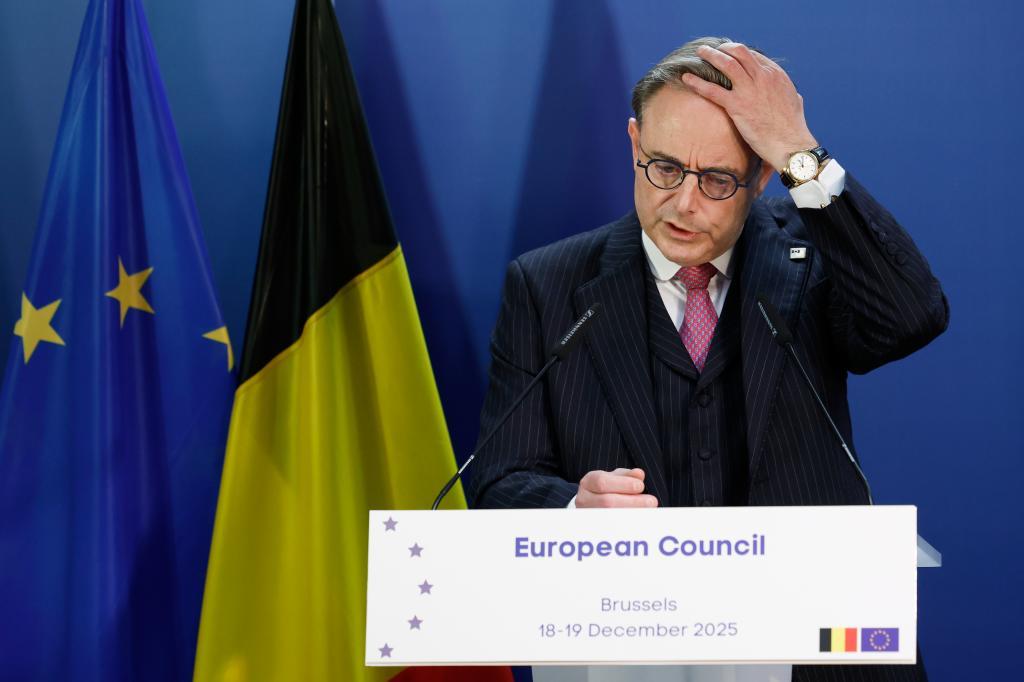
Total failure in Brussels. European leaders have been unable to reach an agreement on frozen Russian assets to provide a loan to Ukraine, and have finally agreed to issue joint debt worth up to 90,000 million euros. Months of negotiations, pressure on Belgian Prime Minister Bart de Wever, and firm statements from frugal countries, to finally accept a sort of eurobonds using the European Union budget as collateral.
In this decision, there are two clear losers and at least one big winner. European Commission President Ursula von der Leyen and Chancellor Friedrich Merz had pushed hard to access the up to 185,000 million frozen in Euroclear, and approve a 90,000 million reparations loan from this amount. Both have failed, especially the latter because many say this architecture came from Berlin.
They have been unable to overcome De Wever's resistance, who had always rejected this option since Euroclear is based in Brussels and fears Vladimir Putin's retaliation against the country. The ultranationalist leader of the EU's seventh economy has managed to stop the top leaders of the continent. The multiple demands he has made, which in recent days some in Brussels warned were "unlimited" and "excessive," have indeed raised many doubts in several countries. It is also true that France and Italy had shown support at some point to seek alternatives and that both countries are happy with the outcome. And of course, the pro-Russian governments of Hungary or Slovakia have not helped at all for the Russian assets option to prosper.
In fact, these two countries, along with the Czech Republic, have decided not to be part of the financing agreement for Ukraine. This is seen as a way to facilitate the least unfavorable pact for Russia, as by disengaging from the financing plan, they have given free rein to a certain form of unanimity in debt issuance at the expense of assets. Putin also emerges somewhat victorious from this meeting.
And even though, late in the afternoon, EU sources assured that they were working "exclusively" on the Russian assets option, that progress was being made, and that Belgium was "involved." But the final result could not have been further away. After several hours of negotiation, the agreement proved impossible, and leaders began to consider the option that was approved in the early hours. So many turns, so many negotiations, and so much technical work to end up not daring to use Russian assets and issuing debt.
In the press conference following the summit, both Von der Leyen and European Council President Alberto Costa tried to make impossible balances to defend what was agreed. They pointed out that the important thing was to ensure financing for Ukraine, and that the country will have its needs secured for the next two years. But it seems like a very poor outcome considering the expectations created.
And this failure also occurs on the same day when leaders were supposed to definitively approve the Mercosur-EU agreement, so that Von der Leyen could travel to Brazil this weekend to sign the pact. But this will also not be possible due to the reluctance of Emmanuel Macron and Giorgia Meloni, and once again the German official and the German chancellor see their plans frustrated as they were very interested in the agreement going through.
"This afternoon we have made a decisive breakthrough that paves the way for the successful conclusion of the agreement with Mercosur in January. We need a few more weeks to resolve some issues with the Member States, so we have contacted our Mercosur partners and agreed to slightly postpone the signing," explained the German official. But the day has been unfortunate for her and for Merz.