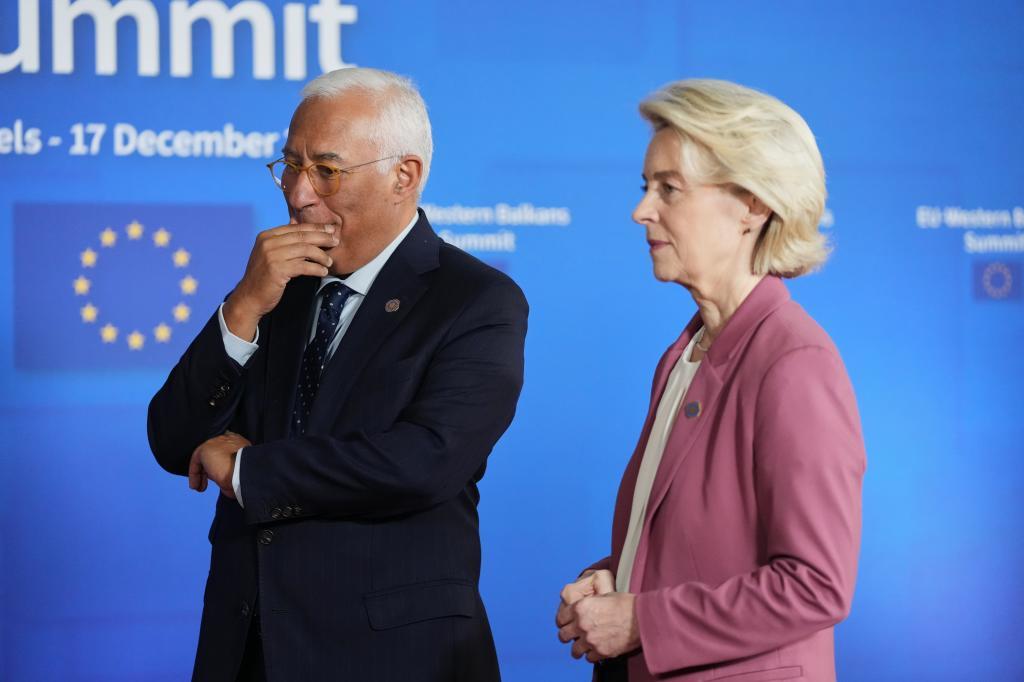
Belgium continues to strongly oppose and demand even more requirements for the use of Russian assets frozen in Euroclear, a financial securities clearing and settlement company based in Brussels, to financially support Ukraine. "Their demands are unlimited," denounce community sources, adding that the Commission considers that so many safeguards are not necessary just before the summit of presidents taking place in Brussels today and tomorrow.
And what are the Belgian requests? To begin with, a mutualization of risk. "They want everything that can be applied to them to be applied to the rest," explain diplomatic sources, recalling the demand that the Central Bank of Russia has already filed against Euroclear.
The government of the ultranationalist Bart de Wever also demands a joint system of collective guarantees, in which all EU countries participate. It would serve to strengthen defense against Russian threats and also ensure the liquidity that exists in Euroclear. And this should be maintained indefinitely, something that many countries consider excessive.
There are also other concerns such as defending European companies that Russia, or an allied country, may attack, as well as taking into account all Russian assets immobilized in the EU. These are minor issues, and in fact, the Commission already considers another 25,000 million euros held in other countries and entities. But all this mixed together, and above all, the absolute reluctance of the Belgian government to touch the accumulated liquidity in Euroclear, is causing some countries to turn back to the option of common debt. And especially the Belgians themselves.
However, the issuance of joint debt requires unanimity, something that is very unlikely to happen not only because of Hungary, which rejects anything that supports Ukraine, but also because of the northern countries. At this point, diplomatic sources from several countries agree that Belgium has mentioned that one option is to use emergency article 122. This is the route that was sought last week to indefinitely retain these same Russian assets, which until now had to be renewed every six months, and in this case would allow the issuance of public debt using the EU budget as collateral.
"Christine Lagarde is being quoted [President of the European Central Bank], when she said that if 122 can be used in a decision to extend the immobilization, then surely it can be used to issue debt backed by the EU budget margin," explain diplomatic sources. "It's not going to happen," openly reply from the north. And neither the European Commission itself sees this measure favorably. They point out, in both cases, that the legal services of the Commission and also of the Council have indicated that this option is not viable.
The situation, therefore, is that there is a significant group of countries that continue to push to use the frozen Russian assets and thus provide Ukraine with a reparations loan. They want, however, to have Belgium on board with the plan, hence all these weeks of negotiation. The loan would be worth 90,000 million; it would have to be ready by April 1; it would be released in installments during 2026 and 2027; and the country would have to repay it once Russia agrees to cover the war reparation expenses.
When Ukraine repays it, Russia could recover the frozen assets that would have been used to structure the credit. This repayment, as pointed out in the Commission, demonstrates that it is not any kind of "confiscation." Belgium, on the other hand, claims that it is, and that is why it demands all the guarantees and safeguards mentioned. And in their rejection of the plan, and this is also important, de Wever has found some allies: Bulgaria, Malta, and especially Italy.
The Italian Prime Minister, Giorgia Meloni, has called for exploring alternatives to Russian assets and has become the key player in the summit of these two days because she has also shown many doubts about the Mercosur agreement that was initially expected to be closed in the coming hours. The European Union faces hours in which it will have to make very relevant decisions for its future, and which will also convey an important message to the world about whether it is capable of moving forward or, as before, will continue to take half measures and postpone decisions.