Like all trips made to the front line now, the meeting is set in the early morning. The vehicle driven by the military moves without lights. The driver knows the route by heart and doesn't even use a night vision device.
The all-terrain vehicle crosses territories where anti-tank ditches, dragon's teeth, and barbed wire abound.
Fox (his military nickname) waits next to one of the few clusters of trees that have not been completely destroyed by artillery. "Of the ones we used to hide behind two years ago, only the roots remain," jokes the Ukrainian soldier as he hurries along. His location is in the middle of the death zone, where killer drones reign. The darkness of the night is occasionally illuminated by flashes of light followed by the echo of explosions.
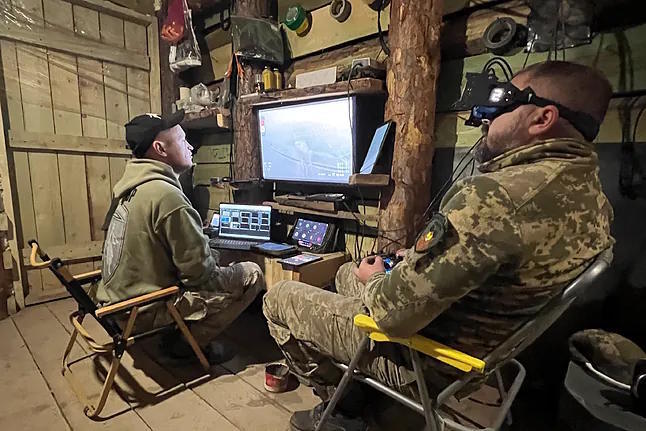
The walk is brief. Fox leads the visitors to a maze of trenches that leads to the bunker occupied by his unit for the past month and a half.
The 33-year-old Ukrainian is the commander of a trio of soldiers specialized in intercepting Russian unmanned aerial vehicles (UAVs) from the 65th Mechanized Brigade. Drones against drones. A scenario reminiscent of science fiction scripts that is now a reality on the Ukrainian battlefield.
"Our unit started operating at the end of last year. We learned on the go. It took us two months to shoot down the first drone," explains Fox.
The shelter for the soldiers is an underground wooden compartment with several bunk beds. Coffee Man (The coffee man), a curious military nickname for the 39-year-old Ukrainian, hides the group's UAVs under the beds. With explosives attached. Ready to be launched in a matter of seconds.
Fox's team has four iPads and a computer. One of them marks Russian aircraft with white triangles as they enter the circle that constitutes their area of responsibility. Another is connected to a reconnaissance unit that confirms the type of approaching aircraft.
"Sometimes the program mistakes birds for drones. We have to validate the identification by observing the flight altitude and speed of the target," explains Fox.
Previously, the Ukrainian group was dedicated to shooting down enemy fighter-bombers with Stingers. But combat aircraft have ceased to be a visible element in this war, being replaced by the omnipresent presence of UAVs.
Fox and his men's top priority are the infamous Molniya, an unmanned low-cost device invented by the Russians that is used massively on the Zaporiyia front, where the Ukrainian unit is fighting. They claim to have shot down 15 enemy aircraft in the last two weeks.
The screen currently shows images of another drone swooping down on areas defended by the Russians. The camera focuses on a soldier trying to escape on foot before the signal is lost. In today's war, death can be seen from a distance and in real time.
Fox and his team's activity begins at dawn. They sleep during the night. "We don't have drones with night cameras," indicates the group leader.
But as daylight breaks, the alerts begin. "Attention, a Molniya is heading in your direction! Be careful!" Surveillance drones start to warn as the white triangles multiply on the screen.
"It's going to the right. Where the blue house is, next to the factory." Fox directs the operation. Tourist, 41, is the pilot commanding the Ukrainian UAV, and Coffee Man is in charge of launching the devices and controlling the antenna for flight.
The FPV camera (the acronym for the drone used) provides a desolate view of the area southeast of the city of Zaporiyia. The fields are pockmarked as if they were a lunar landscape. Tourist has not been able to detect the aircraft. It's a day dominated by fog.
In any case, it is the beginning of a cascade of similar warnings. They occur at an average rate of one every 30 minutes. The trio doesn't even have time for breakfast. They launch one drone after another. Coffee Man retrieves them from under the bunk beds.
Sometimes, Tourist becomes desperate.
-"Damn, where is it? You can't see anything!"
Other times, they manage to spot the Russian UAV, only to lose sight of it later.
At 3:31 PM, the Ukrainian pilot locates yet another Russian adversary. This time it's a Privit, another Moscow invention made mainly of plastic and foam rubber but with deadly effects. The images of the pursuit are reminiscent of those aerial duels of World War I, where pilots showcased their skills.
Whoever is guiding the Russian UAV must be an expert. First, it avoids the impact of another Ukrainian aircraft and then narrowly evades Tourist's, although the latter makes it explode in the vicinity hoping that the shrapnel will take effect.
"The Russians have brought the Rubicon pilots to Zaporiyia. They are very good," says Fox.
The proliferation of drone interception units like Fox's is a response to the ubiquitous use of UAVs in the Ukrainian conflict, which is completely changing military theory just as airplanes or tanks did when introduced on the battlefield.
20 million of these devices
The Ukrainian Ministry of Defense recently announced its intention to produce 20 million of these devices next year, giving an idea of the massive use granted in the conflict.
However, Russia's production capacity - a country that far surpasses Ukraine in population and economy size - has led to a rapid increase in the number of UAVs used by Moscow's forces to attack Ukrainian territory. If three years ago the Russians used dozens of drones in their air assaults, now they exceed 5,000 each month, according to the estimate by the Institute for Science and International Security (ISIS).
Vladimir Putin's army has also begun to balance the creativity disadvantage it had compared to Ukrainian designers, and now experts discover new innovations in their UAVs every month.
Recently, some photos circulated in Ukraine showed how the Geraniums - the heirs of the Iranian Shahids - are now equipped with cameras, aided by repeaters installed in Ukraine by Russian agents - allowing them to expand their range of action - and are also used to carpet the local territory with mines, thus multiplying their initial function: being a kamikaze drone.
Earlier this month, Ukrainian authorities also warned that these Russian drones had started to be equipped with anti-aircraft missiles, making them a threat to the local air force.
Attached to the 53rd Brigade, the team of soldiers led by Dex, 33, is another group dedicated to drone destruction, although they are deployed in the Donetsk province and specialize in large UAVs like the Iranian ones.
"This year we have shot down more than 70 Shahids," he specifies.
Like Fox's group in Zaporiyia, Dex's forces also have to face waves of Molniya. "We shoot down 10 to 15 per day," he adds.
The unit is housed in a residence covered with camouflage nets. The interior is pure chaos. Chinese food and sauce jars mix with explosives prepared by the soldiers in the kitchen. One of them takes the yellow paste from a simple plastic bag and molds it into a Sting, the Ukrainian UAV designed to attack Shahids. Most of its components are made with 3D printers.
"I put about 500 grams," says the young man, picking up the devices resembling mini-rockets from a cardboard box placed in the hallway.
With a speed of 315 kilometers per hour, the Sting has become Ukraine's most recent response to the Shahid. Last November, the company that produces them, Wild Hornet, stated that their interceptors have already shot down over a thousand of these Russian drones, including at least one using reactors that allow them to increase their speed. The main advantage of all these interceptor models is their low price compared to traditional anti-aircraft missiles.
The Prytula Foundation of Ukraine estimated in June that these devices can cost just over $2,000 compared to the tens of thousands that ground-to-air rockets cost and the over $10,000 that each Shahid represents. The issue is that according to the Ukrainian Air Force's own calculations, for every Russian drone of that type, their troops have to deploy three interceptors, which implies that they would need about 2,500 per day, a figure currently impossible to achieve. President Volodymyr Zelensky urged Ukrainian manufacturers last July to increase production and ensure that the country can launch at least 1,000 interceptor drones each day.
Last November, Kiev announced the start of large-scale production of another new device against the Shahid, the Octopus. Former Lieutenant General Ihor Romanenko stated in November to a local publication that his country now produces about 150 per day. "It is insufficient to address current challenges," he opined. The Russians, as Dex points out, use their drones as they do with soldiers, seemingly unconcerned about the number they lose. "We have to ration them because we also have a shortage of drones," he concludes.