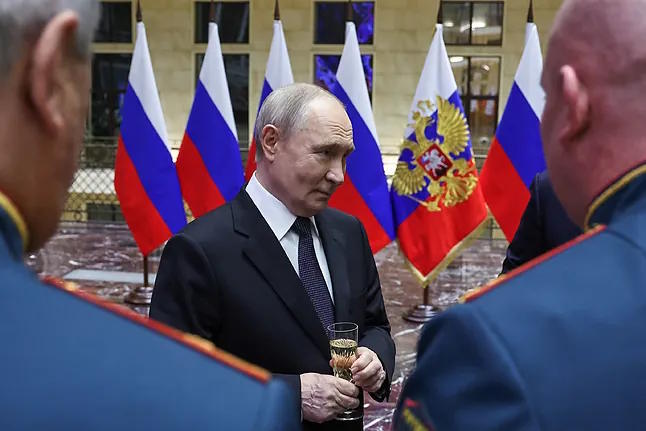
Two parallel worlds separated by about 8,000 kilometers, which is the distance between the White House and the Kremlin, are beginning to converge into one. In the first, condensed in an Oval Office filled with stuccos and golden appliques, Vladimir Putin is a man seeking peace and willing to negotiate in good faith to achieve it.
In the second, entrenched in the largest European conflict since World War II, Vladimir Putin himself, personally directing operations, receives news from his generals about grand military victories in cities that have not yet been taken, about redesigned maps and wooden figures he moves with a maneuver rake just like others did with the cannon fodder of Verdun, Gallipoli, or Stalingrad, comforts alleged widows of fallen heroes who thank him for sending them to die in the black earth of Ukraine, decorates the maimed, approves military budgets to manufacture wonderful weapons like his brand-new Oreshnik missile, and rejoices in imperial theories served by three or four pseudo-historians (among the few people he listens to since the pandemic) about the "historical lands," meaning those that Putin considers and that Russia will liberate in its existential confrontation with the West.
Both worlds, one encapsulated in supposed military victories and the other in the personal businesses of its real estate elite, come together in the negotiation for peace in Ukraine. In the midst of these two circles of power, an impotent Europe remains. The more urgency Trump shows, the more patient Putin seems, the more conciliatory Washington appears, the more aggressive Moscow is. In recent weeks, Vladimir Putin has increased threats against Europe while calling its politicians "pigs": "The defeat of European powers will be so absolute in case of confrontation that there will be no one left to even negotiate a peace agreement," to culminate the speech: "Russia has no intention of going to war with Europe, but if the EU desires it, Russia is ready from this moment on," he said on December 3. It is worth remembering that Putin and his followers repeated ad nauseam that they would never invade Ukraine in the weeks leading up to their massive attack.
Unfortunately, Putin is not lying this time: Russia is much more prepared for war than all of Europe combined. There are several aspects in which Moscow far surpasses the slow and uncertain European advances in defense, innovation, and strategic autonomy, but also in the cognitive field, where the Kremlin has years of advantage over any opponent beyond Ukraine.
WAR MACHINERY AT 100%
Weapons factories operate in three shifts of eight hours, seven days a week, to produce not only classic armaments of 20th-century wars, such as armored vehicles and cannons, but also weapons tested in the new type of warfare fought in Ukraine, namely, drones of all kinds. Although militarily the invasion of Ukraine has been disastrous for its army, Moscow has developed capabilities that allow it to produce close to 1,000 Shahed drones per day of long range, as well as thousands of fiber optic units capable of reaching the logistics of an army about 40 kilometers deep. Groups like Rubicón, seasoned in the Ukrainian scenario, train hundreds of drone pilots every day in the latest models, technologically superior to Western ones and cheaper thanks to Chinese technology.
Europe not only lacks these capabilities, but it also does not possess those that would allow it to counter these same systems in time. It was evident when Russia deployed about 20 Grebera drones in Poland. The only way to shoot them down was to launch several fighter jets from three NATO countries, which only managed to shoot down three unmanned aircraft.
Russia can recruit, outfit, and train tens of thousands of soldiers in weeks because the war in Ukraine has sharpened its fangs, no matter how poorly it trains its own infantry. The Russian army can send its soldiers to die without anyone having to be held accountable, and that, although atrocious, is a great advantage compared to the armies of democratic countries, where one must answer to parliament.
Their aviation has salvaged thousands of Cold War bombs and fitted them with modern guidance kits, allowing them to be launched about 50 kilometers away without risking being shot down. Europe can access this technology, but not in the current quantities of Russia. To do so, it would have to mobilize its entire industry and vast amounts of money to sustain it, something that carries an evident political cost for a British, German, or French leader, but minimal for Putin.
AN ECONOMY THAT CANNOT STOP
It is not that Russia is prepared for war, its economy is now entirely focused on it. The conflict in Ukraine has created internal winners, such as certain oligarchs and governors loyal to Putinism, as well as a growth model supported by excessive military spending: turning it off quickly implies bankruptcies, unemployment, and social tensions in places that now depend on the military-industrial complex. Volunteer money has reached the poorest corners of Russia, causing little discontent. Furthermore, returning to a peacetime economy involves managing the significant political-criminal problem of demobilization: hundreds of thousands of traumatized veterans armed with weapons.
Jeffrey Mankoff, a member of the Center for Strategic and International Studies, stated in the specialized outlet War on the rocks that "the development of railways, road transport, and oil and gas pipelines has allowed Russia to diversify its import and export routes. Moscow can also bypass Western sanctions and export controls to access weapons (including drones, artillery shells, and rockets) from Iran and North Korea. While China has refrained from providing lethal weapons, it has become Russia's most important source of dual-use goods subject to Western export controls.
Interior of a Shahed drone factory in Russia.Sveda TV
The Russian war economy has woven a complex architecture that is difficult to dismantle: directed and subsidized credit to the military-industrial complex currently sustains employment, wages, and consumption, so a sudden transition to peace could reveal defaults and banking tensions even stronger than those already experienced by Russian entities. At the same time, demobilization would require relocating hundreds of thousands of workers and veterans in an already tense market, with the risk of social clashes if incomes decline. There is also a demand trap: shifting resources from defense to civilian uses is not automatic and requires investment, technology, and imports that sanctions complicate. And politically, the state of war has consolidated power coalitions and expectations: ending it could open internal fractures among veterans, regional-industrial elites, and a society accustomed to the war effort.
BUILDING WAR CONSENSUS
It is a field focused on political communication: the process by which a government articulates a narrative that legitimizes war and generates sustained public support. For the Moscow regime, the conflict in Ukraine is just a Western proxy war against Russia, therefore, the narrative has been working for years to convey that, in reality, the Z troops have not yet been able to conquer their objectives against Kiev because, in reality, they are fighting against more powerful enemies. This is an easier path for an autocracy than for a democracy.
Mark Galeotti, one of the leading experts in hybrid warfare, states that "the Kremlin acts as if Russia were already in permanent war with the West, only that most of that war is fought outside the battlefield," and speaks of the labyrinth that Putin faces in reversing course: "The more Russia gets used to living in war, the more dangerous it becomes when soldiers need to be demobilized and return to normalcy." The Kremlin has been working for years on preparing the home front, a progressive militarization of Russian society to normalize the idea of sacrifice and mass casualties.
In Europe, society is at the opposite end. French General Thierry Burkhard, Chief of Staff of the French Armed Forces, sparked controversy with these statements: "War has returned to Europe. French society must embrace the idea of sacrifices, not just the Army, we must be willing to accept losing our children and to suffer economically because priorities will be directed towards defense production."