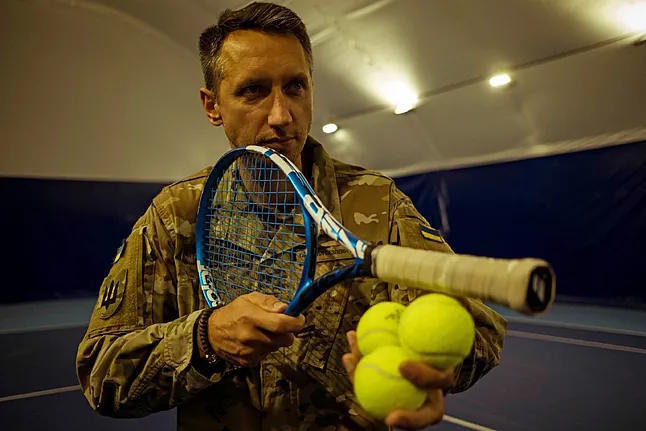
If his appearance was somber when he showed up on a court in the Ukrainian capital, with his uniform on a hanger that he will later put on for the photo, the feel of the grip has reminded him of a past that now seems very distant. "What good sensations," says the former world number 31. In another life, he was able to defeat the reigning champion Roger Federer in the second round of Wimbledon in 2013 and reach the final of the US Open junior in 2004, which he lost to Andy Murray. When the Russian invasion of Ukraine began, he left his life linked to tennis and joined his country's army. At that moment, his story was published worldwide. Today, almost four years after that and after having been through several military units, he is part of the Security Service of Ukraine or SBU, responsible for the most audacious attacks inside Russia. Today he stays in touch with Federer.
Question. How does an elite athlete like you feel, at this point in the war, physically and mentally?
Answer. Physically, more or less fine. Mentally, it's a different story. We are all very tired of this war, but it's not a fatigue that allows you to give up. It's a kind of adaptation. You get used to living like this, to this being the routine. I changed professions, but it's still a job, just in extreme conditions.
Q. Has the way you face the war changed over time?
A. Yes. At first, we were emotionally stronger because we needed to react quickly, with intensity. Now we understand that this won't end soon and that we have to manage our energy better. It's not a short race, it's a marathon.
Q. You were a professional tennis player for years. How has tennis helped you to face the war?
A. In many ways. Physical preparation, of course, but above all, mentally. Tennis teaches you to adapt to everything: from sleeping in a humble hotel in Uzbekistan to a luxury one, to winning and losing. In tennis, you analyze your mistakes, draw conclusions, and play another match the next day. In war, it's not like that: here a mistake can cost you or a comrade your life. The responsibility is much greater.
Federer congratulates Stakhovsky at Wimbledon in 2013.A. GRANT / AP
Q. Do you still have a relationship with the tennis world?
A. During the first year and a half, I couldn't even watch it on TV. It was too painful. Then I started dreaming again of playing tennis. In the midst of this chaos, you need something to remind you of who you were. Even today, when a friend like Elina Svitolina comes to Ukraine, sometimes we play a bit. Tennis is still there for me.
Q. What was the most important match of your career?
A. From a sports perspective, the 2008 Davis Cup final in Croatia. That match marked the real beginning of my professional career. I still remember it point by point today.
Q. Has the professional tennis circuit disappointed you?
A. Many Russian tennis players acted as if the war didn't exist. That deeply disappointed me. There were exceptions, very few. I don't maintain relationships with Russian tennis players.
Q. What was your first experience under enemy fire like?
A. On the first day of the large-scale invasion, I was in Dubai and returned to Ukraine. At first, I observed the situation. Everyone said Ukraine would fall in three days. When we saw that we were holding on, I took my family to Hungary, and on February 27, I crossed the border back. I was practically the only one entering Ukraine; thousands were leaving. They asked me if I was sure. I was. The fear was immense. I had no experience. At first, I did more logistical or surveillance tasks. The first direct confrontation was in 2022, during the counteroffensive in Izium, and then in Bakhmut in 2023. When you are less than 50 meters from the enemy, you don't think: you act. If you hesitate, you die.
Q. Do you think Ukraine can win this conflict?
A. This war is like a long tennis match. Sometimes you are losing, but you keep playing to keep the pressure on your opponent. Ukraine cannot freeze this war. If we stop, Russia will rearm and attack again, as it did after 2014. The only real way out would be to destroy Russian imperialism, but the world doesn't want Russia's disintegration due to its nuclear arsenal. That's why this war will last for many years.
Q. Has the war changed with the massive arrival of drones?
A. Completely. Now you hardly see the enemy. The war has become more technological. I work with long-range attack drones. It's our way of giving back to Russia what it has done here and taking the war to its territory.
Q. Do you regret returning?
A. No. I was abroad, I could have stayed in the United States or Europe. But this is my country. And if someone comes to destroy your home, you have no choice but to defend it.
Q. Does Ukraine feel sufficiently supported by the West?
A. The support exists, but it almost always comes late and with fear. The West is terrified of provoking Russia, as if Russia needed provocations to attack. We have seen it many times. We are not talking about geopolitical theory, we are talking about real people dying because someone in Europe or the United States needs months to make a decision.