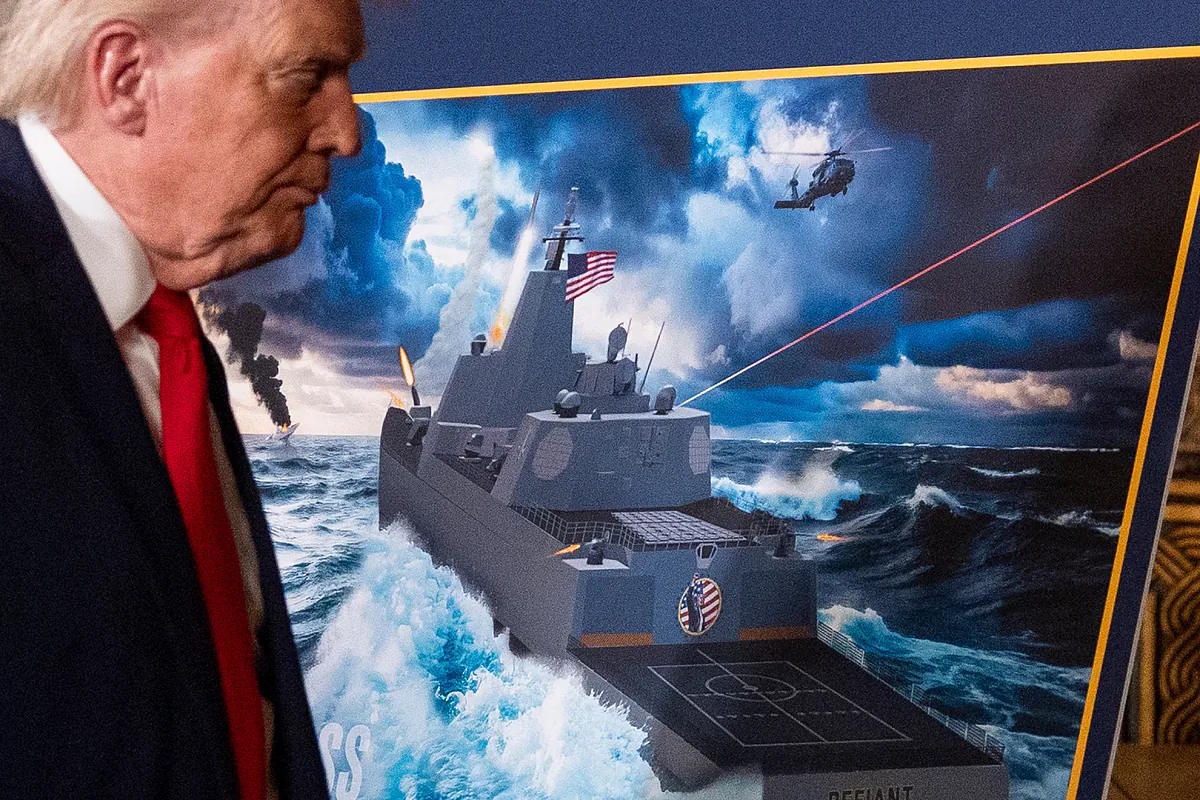
Donald Trump continues to try to project power by land, sea, and air, although for now, what he achieves is to send messages about the vast size of his ego. This Monday, he presented a plan to renew the US Navy based on the construction of 25 large ships, whose model he named, of course, "Trump Class." He called it "the golden fleet."
This event, where blueprints were shown with a quality not suitable for an institution like the White House, left more doubts than certainties, as Trump spoke not of corvettes, frigates, or cruisers, but of "battleship" type vessels, commonly translated as "battleship," that is, the large armed and armored ship that dominated the seas until World War II. "These ships will be 100 times more powerful than those of the Iowa class," Donald Trump stated with his usual confidence.
The Iowa class ships that Trump refers to today are floating museums that were built in the 1940s, at a time when strategists believed they were the ultimate fist in the oceans, the true "king of the sea" that would dominate the world conflict. But reality prevailed: all the great battleships were sunk, most by aviation or submarine torpedoes. The largest of them, the Japanese Yamato, sank in April 1945 attacked by US planes, but previously the submarine U47 had sunk the British Royal Oak in Scapa Flow (October 1936), the Bismarck, the pride of the German navy, in May 1941, the USS Arizona during the Pearl Harbor bombing in December 1941, or the Bretagne, the flagship of the French navy, which ended up at the bottom of the port of Mers El Kébir (Algeria) in June 1940. And these are just a few examples. During the Cold War, the battleship transitioned to secondary roles, such as long-range coastal bombardment in the Korean and Vietnam wars, but no longer exposed to combat.
The battleship became obsolete in the 1940s because it was designed under the doctrine of striking first and from a distance. In practice, naval aviation (embarked on aircraft carriers) and later guided missiles came to decide the battle at much greater distances than the cannons of a battleship. An aircraft carrier could concentrate firepower hundreds of kilometers away, while the battleship depended on getting closer to use its heavy artillery. Additionally, battleships were very expensive (with huge crews), required many years to build, were very slow, and increasingly vulnerable to torpedoes, bombs, and coordinated air attacks. They lived up to their name on the sides, where the armor was powerful, but dive bombers could destroy them with a single barrage on their deck.
If the battleship died when the cannon no longer decided naval warfare and the missile took over, why does Trump now insist on it as a bet? Admiral Michael Franken, now a senator from Iowa, states that "the likelihood of a US Navy Trump-class warship existing is zero." In fact, the Chinese navy has always ruled out the return of large battleships and opts for redundancy and mobility, not putting all their eggs in one basket.
Each battleship would cost $10 billion, but several experts have already confirmed that this type of ship can be destroyed by a $10,000 drone torpedo like the ones Ukraine uses to corner the Russian fleet in the Black Sea, operated by a teenager with a laptop and a decent wifi connection.
Furthermore, Trump mentioned capabilities that do not even exist yet, but wants the first ones to be built in two and a half years, even though currently neither the railgun seen in the designs nor the 600-kilowatt anti-aircraft laser system exist. And that's not to mention that there are currently no shipyards in the US that can accommodate a ship of such dimensions.
"The Japanese attack on Pearl Harbor abruptly removed battleships from their place in naval hierarchy. The era of the aircraft carrier had arrived," says James Holmes, professor of Strategy at the Naval War College. In today's battlefield, which tends towards total robotization and mosaic warfare, these large platforms are even more vulnerable than before.
Retired Admiral Juan Rodríguez Garat assures that "Trump mentioned ships of around 30,000 tons, which is a lot, but only twice the size of the failed Zumwalt-class destroyers and just over half the size of the last true battleships. To survive in the battlefield of the future, surface combat - the role currently assigned to cruisers and destroyers - needs weapons with greater range than the enemy and better defenses. For now, the first of these conditions is possible because current ballistic missiles are not very effective against mobile targets. The second, not yet. A truly effective laser will take a long time to be available."
The Spanish admiral jokes: "Trump says they will be more beautiful than the previous ones, but he will be long gone before the project can bear fruit. In reality, to do what Trump wants, the US Navy already has ballistic submarines."