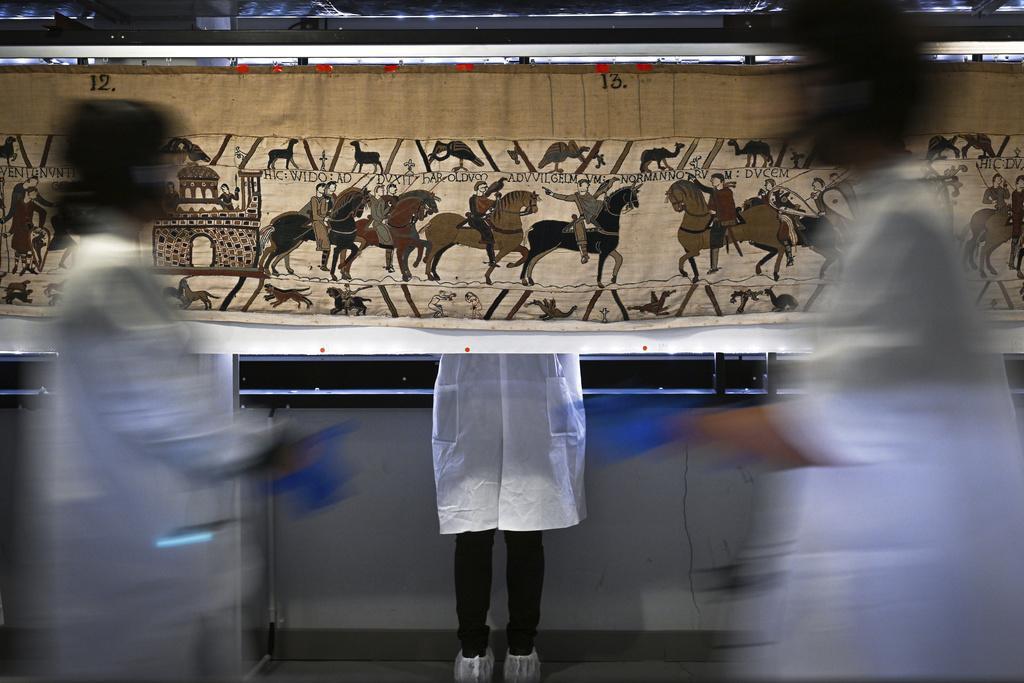
It will be a journey of just over 250 kilometers and almost a thousand years of history. The Bayeux Tapestry, created in the 11th century to commemorate the victory of William the Conqueror in the Battle of Hastings, the beginning of the Norman invasion of England, will embark on the journey to London in 2026 to be exhibited for the first time at the British Museum.
The Latin inscription Angli et Franci symbolizes the unique alliance in the impressive 70-meter-long tapestry (which is technically an embroidery) and is considered as "the most devastating document of the wars" of the medieval era in Europe.
The loan has been made possible thanks to the new entente cordiale sealed by the French President, Emmanuel Macron, and the British Prime Minister, Keir Starmer, and has generated a lot of controversy in France, with dozens of experts warning that the artwork may suffer irreparable damage during transportation.
But the die is cast, and the British Museum has decided to take the definitive step forward by insuring the historical piece for 800 million pounds (915 million euros) through the Government Indemnity Scheme, which allows museums to have extra guarantees and substantial savings compared to private insurance.
The spectacular tapestry contains 58 graphic scenes of war and everyday life, with 626 characters, 202 horses and mules, 55 dogs, 41 ships, and 37 fortresses and buildings. There is no record of the author or master who conceived the work, nor the exact date of its creation. It is believed to have been mainly embroidered by women in Canterbury, Winchester, or Kent, in southern England.
The widely accepted theory is that it was commissioned by Archbishop Odo of Bayeux to serve as an ornament in the cathedral of the Norman city for the "consecration" of his brother, William the Conqueror, and his victory over Harold II, the last king of Anglo-Saxon England. "Harold Rex Interfectus Est", "King Harold has been killed," can be read in another of the Latin inscriptions accompanying the sequence of embroideries.
The return of the tapestry after almost ten centuries has aroused great anticipation in the United Kingdom, where it will be exhibited from September 2026, taking advantage of the renovation works at the Bayeux Museum, which attracts 400,000 visitors every year (a third of them British).
The first time President Macron hinted at lending the tapestry to the United Kingdom, in 2018, it caused a stir in France. A preliminary study by conservators in 2020 confirmed the poor condition of the artwork, with a total of 24,200 stains and 10,000 holes, among other damages.
"It is a worn and fragile piece and cannot be transported," was the initial diagnosis by Antoine Verney, chief curator of the Bayeux Museum. Several tests conducted in recent years and an additional budget for restoration upon its return convinced the museum's management to change their minds, as they are undergoing a 38 million euro facelift to exhibit the historical piece in 2027.
Verney himself now praises "the close relationship" of their experts with the British Museum, which has allowed them to "share resources to better understand the context in which the tapestry was created, as well as to give it greater visibility and maximum historical relevance due to our relationship with the United Kingdom."
"Such a loan could not happen with any other country or institution," highlights Verney, recalling how the tapestry has left Bayeux only three times: in 1803, when Napoleon feared an English invasion and ordered its transfer to Paris; during World War II, in 1939, when it was moved to a basement of the Hôtel du Doyen and then to the storage of the national museums of Sourches; and finally, when the German authorities requisitioned it during the occupation and sent it to the Louvre.
Didier Rykner, director of La Tribune de l'Art and a fierce critic of the Louvre Museum after the theft of Napoleon's and Empress Eugenia's jewels, has also stood out as one of the most vehement opponents of the loan of the Bayeux Tapestry.
"President Macron has once again made a catastrophic decision regarding our historical heritage, against the majority opinion of the conservators and restorers of the artwork," wrote Rykner, who has reactivated his particular campaign as the date of the historic journey of the jewel of Bayeux across the English Channel approaches.