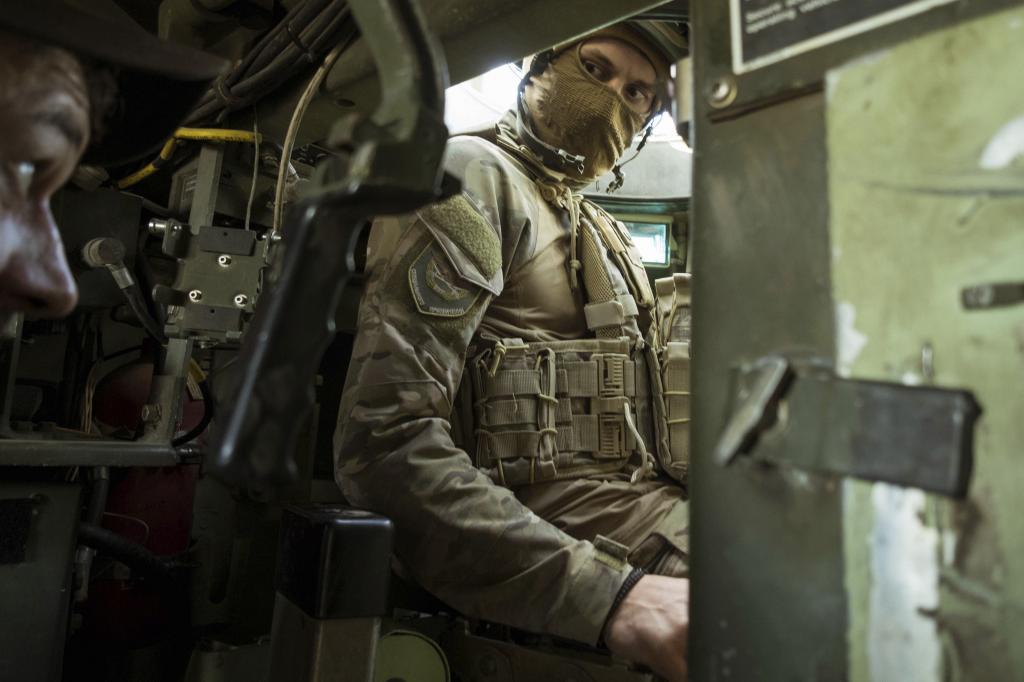
Sergeant Major Vasil from Brigade 153 sums up a typical day in his current life: "We have to learn to read our surroundings. If you don't know what mines look like, you'll step on one. If night falls and you haven't found a hole to hide in, drones will detect your body heat and you'll die. If you don't hear infiltrating enemies approaching, they'll attack your position and you'll die. If you don't wear a gas mask, the Russians will launch their poisonous gases into the shelter and you'll die. If you have nothing to eat and drink and they can't supply you by air, you'll also die."
I ask him to give us an example: Vasil shows what appears to be a stone with a somewhat spherical shape and natural texture, almost imperceptible on any path. A second later, he splits it in two and discovers a detonator and space for explosives inside. "We hadn't seen these types of mines before. They leave them on the ground with drones and add to the huge catalog of things that can kill you," he says. This device doesn't take your life instantly, but it blows up your foot, just like the so-called butterfly mines. If you don't stop the bleeding with a tourniquet, you'll bleed out. If they can't get you to a hospital within a couple of hours (almost impossible), you'll lose your leg. If they can't do it for several days, consider yourself screwed. These are the rules.
A soldier from Battalion 107 was evacuated with a severe leg wound many days after shrapnel tore through him. When the doctors cut his pants, they had to remove with tweezers, one by one, the worms that had colonized his flesh.
Soldiers call this territory the "kill zone" or "annihilation zone." It's not a classic battlefield, with a front where two armies clash, but an undefined landscape stretching for many kilometers on both sides: craters, devastated forests, swarms of drones hunting for prey, unrecovered corpses, and some wounded screaming for help. It's that space between the contact lines where life and death are decided in seconds. It's a liminal territory: a physical threshold between the occupied and the free, the visible and the invisible, where the state and the law are suspended in the mud, among shattered armored vehicles and the dead lying face up.
In this battlefield, the most decorated soldiers from the wars in Iraq or Afghanistan, experts in urban combat, would die within minutes, eliminated by a 23-year-old overweight gamer or a university student who has never fired a weapon in their life.
In this new territory, spanning about 20 kilometers wide, considering the 10-kilometer range of FPV drones, one moves the old-fashioned way, with a map and compass. GPS devices have stopped working due to electronic warfare, which is increasingly intense, and can mislead you or lead you down a road that ends at enemy positions. If you're on foot, there are drones that can locate your mobile signal, so you have to switch to airplane mode and only connect to the WiFi provided by the Starlink antenna once you reach shelter. If you have a smartwatch with internet access, leave it at the base because they can track you with it too. That's why almost everyone here wears a Casio watch.
We have Maxim, Valery, and Bogdan in front of us, a night drone pilot, military gunsmith, and Mavic drone pilot, the observer. The three of them form a team in the annihilation zone with one of the most feared (and still unmatched) war instruments by the Russians. Although its name is Vampire, here they call it "Baba Yaga," meaning "witch." They have it in the back of a pickup truck and must lower it with two people. It's a design of an agricultural drone transformed into a night bomber capable of carrying four projectiles loaded by Valery in the belly of the large black spider. "I can see the Russians fleeing in panic when someone discovers our presence. It's a drone of terrible precision, flying at night, and we can even use it to deliver food and water to our comrades because it can carry 40 kilos," Maxim explains.
All of them must enter the kill zone to launch their drone, so they are subjected to the same fear and dangers as the rest. "This is like a job now. We're used to it, but we can't wait for this to end. We can't afford to fall into depression. That's why our best weapon is humor. Jokes are constant throughout the day and allow us to keep going without breaking," says Bogdan, who has been fighting for a year. "There are also ground drones for these logistical deliveries, and they will be used more and more," Maxim tells us. As we leave their position, we come across one loaded with bags, moving along a muddy path. Its camera sees us because it turns towards us but continues forward.
The case that best exemplifies life and death in that annihilation zone is that of two men. Taking advantage of dense fog, Sergeant Olexander Tishaiev and Soldier Olexander Aliksyenko from Ukraine's Battalion 138 left their combat positions after 165 days of fighting (five and a half months in a hole). They walked 12 kilometers to Orijiv on October 28, to the surprise of their own comrades. They were received as heroes: they had beards like castaways, disheveled hair, red eyes, black nails, stiff uniforms, and poorly healed wounds all over their bodies. They still had the strength to smile. Days later, Zelenski decorated them with the Cross of Military Merit. Their comrades had already bid them farewell over the radio because they thought they would never see them again.
The case of Aliksyenko and Tishaiev exemplifies the new war that humans face, not in inferiority against a superior enemy, but against increasingly powerful and autonomous machines.
The closest reference to this type of war, with positions sometimes surrounded by enemies, who are in turn also encircled, may need to be found in the "zanry nipponhei," that is, the Japanese soldiers who continued fighting on Pacific islands even after World War II had ended.
We are possibly in the deadliest phase of the war since 2022. Daily casualties sometimes exceed 1,000 dead, wounded, and missing. Armored vehicles are no longer used, not only because most have been destroyed but because they are vulnerable and, in most cases, useless. All tanks are in the rear, waiting for a miracle to return them to the time when they were decisive. "We now use our tank crews as infantry," admits Sergeant Vasil, longing for the times when they were the fist that drove armies towards victory.
"Have you seen those robotic dogs?" asks Maxim. "We'll see them here soon. Some will shoot bullets, others will carry flamethrowers, and some will even enter enemy trenches and blow themselves up," he says when we ask him what kind of war he expects next year. Some sources confirm that they are training drones with artificial intelligence to operate autonomously, without humans, to patrol a specific area of the battlefield and respond on their own to the presence of humans. AI has to help them distinguish a Russian soldier from a dog or a cow. It will be more difficult for them to distinguish a Russian soldier from a Ukrainian one, especially considering that both armies now wear the same type of uniform, and that from above it is impossible to tell whether a soldier belongs to one side or the other.
With current advances, and with drones controlled by fiber optic cables with a range of up to 60 kilometers, almost the entire Donetsk region will soon become a zone of annihilation. These devices, manufactured in bulk, sometimes printed near the front line with 3D printers, are becoming cheaper and at the same time more lethal.
In recent months, the emergence of the Russian group Rubicon, which is now fighting near Pokrovsk, has turned the tables. While Ukraine had the upper hand in this type of warfare, Moscow has now evened the score. "They are skilled pilots, many of them civilians, who attack not only our positions but also our logistics. That's what we used to do, and now they're doing it to us," says Max, a very young drone pilot who faces Rubicon operators head-on.
Max shows us his great trophy: an AK-12, the most modern version of the old Kalashnikov, taken from a Russian soldier he killed. "We are now in a decisive phase. We have to hold out until next year. Russia will collapse."