The coordinates 35°50'01'' north 13°14'00'' west correspond to the exact location in the Atlantic Ocean (680 kilometers west of Gibraltar, 470 kilometers northeast of Madeira) where the Spanish Armada found, on August 9, 1780, its needle in a haystack and scored its greatest loot in history. It was the worst debacle ever experienced by the Royal Navy and the worst day on record for the London insurance companies. That day, after several confusing sightings, the fleet led by Luis de Córdova (33 Spanish warships and 10 French ones) pocketed, in the middle of the sea, the double convoy that had departed from Portsmouth on August 29 with 53 transports and three warships to support the English troops in North America, at war against the 13 Colonies, and to supply Asia in preparation for a British invasion of the Philippines. 52 English ships were confiscated along with 80,000 rifles in that action. Also seized were 294 cannons and clothing for 12 regiments, and 2,700 British soldiers were captured. The captors did not have to fight nor did they lose a single man. They appeared before their prey out of nowhere, in the middle of a hazy summer day, as such an overwhelming presence that it did not even allow for a suicidal escape attempt. When news of the disaster reached London, members of George III's Government said they had lost the war in America.
The action on August 9, 1780, is the core of "Hunting the Convoy. The triumph of the Spanish Armada, by Rafael Torres (Desperta Ferro), although the interesting part lies in the journey, in everything that led up to that action which, in part, was a miracle and, in part, the result of 80 years of work and planning. During the 18th century, the Spanish Navy improved from promotion to promotion, admiral to admiral, until by 1780 it had become an elite force, comparable in technology, knowledge, and information networks to the hegemonic Royal Navy. The loot of the 52 ships was the culmination.
"I wrote in 2018 History of a Triumph. The Spanish Armada in the 18th century, which was the account of that construction from a structural perspective," explains Rafael Torres, historian and professor at the University of Navarra. "The success of the Armada was not a bet by a minister or a king, it was the work of several generations of Spaniards throughout the monarchy, in the Philippines, in Peru, in Spain, who pushed and maintained that State project. And in this book appears their great triumph, the 1780s, the moment when several generations of sailors already highly trained, well-educated, and integrated into a structure that was very well developed in its functioning. These sailors were not only military, they were also highly qualified officials and acted as high-level administrators. They were politicians, strategists with a more comprehensive education than what is expected of a military officer. Their great test was the war at sea against Great Britain. And they won."
"Success was not the result of a minister's or king's bet, it was the State project of several generations"
A bit of context. In 1780, the Bourbon monarchy was allied with France and persistently opposed to Great Britain. When the War of Independence broke out in North America, the French and Spanish set out and did everything possible to defeat their enemies. They blockaded maritime trade in Great Britain, threatened with an invasion, and succeeded in having Spanish troops open a second front in Florida and Texas led by Bernardo de Gálvez. As part of that effort, the English and Spanish engaged in a game of prey and predators in the Atlantic. The Armada aimed to intercept the supply lines that kept the English troops in America, while the Royal Navy tried to isolate Gálvez from Spain. The Spaniards succeeded, the English did not. Why?
Because of espionage. "The role of Spanish espionage is very interesting. The Spanish spy network worked perfectly throughout the war and even before it broke out," says Torres. "In Spain, they knew perfectly well what was happening in North America because there were infiltrators within the British Government, just as in the major cities of America. Information flowed from the north to Havana, or from London to Paris and Lisbon, and from there to Spain. The English also had their spy network, mind you. There were two parallel structures in a silent struggle to know the routes of their respective convoys."
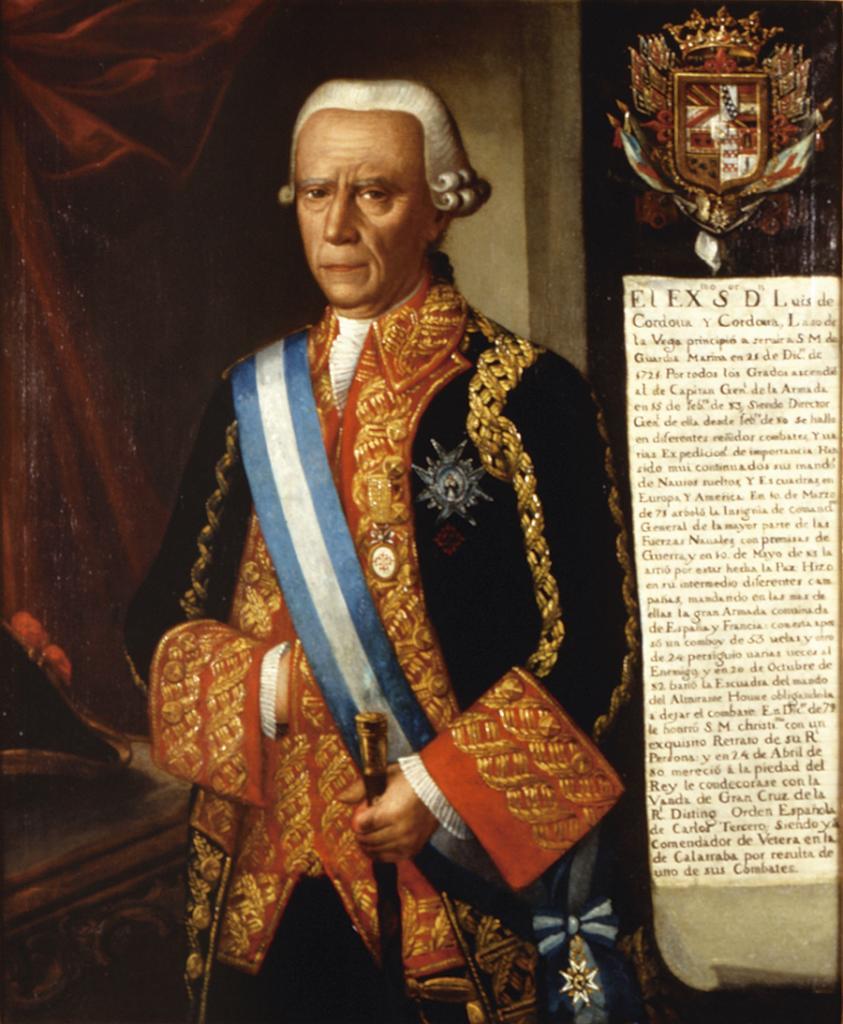
Captain Luis de Córdova.EL MUNDO
Who were these spies? "There were Spaniards and many Irish," the author replies. "For the Spaniards, the key was always the Irish, because they were Catholics and lived in conflict with the English, so they were willing to side with them. Some Irish had made a career in the British Administration and Navy. There was also a significant presence in the United States. O'Reilly, Pollock, there are many Irish names in the War of Independence."
Torres continues with the explanation: "Until now, the American War of Independence has been interpreted as a land war, of infantry and artillery. But for that to happen, things had to be taken there. And that was only possible through convoys. There was no other way. The convoy became the most precious object of the war, the one that determined success or failure if the enemy captured it. Spain made its great convoy to open the second front in North America from the south, thus unbalancing the battles. Great Britain tried to intercept it unsuccessfully, while Spain knew the route of the English convoy. Their spy networks worked, they had information about the exact point, the exact night, at the exact moment, and there was a squadron waiting for the double British convoy. It was not easy at all, the operation had to be perfect."
Were the English negligent? "There was a mistaken logic. Combining two convoys indicated a fear of enemy attack. The English believed that this way it would be better protected, that no matter how bad things were, the losses would not be complete. In reality, they raised the stakes even higher. It was the greatest loss of ships that Britain has ever had in its history," explains the historian.
"There was an advantage for Spain: they were already at war. The Armada had been mobilized and sailing for six years. That helped a lot"
Was Spanish technology, both in navigation and combat capability, comparable to that of the English? "Yes, exactly the same," he clarifies. "The two navies were constantly watching each other and constantly copying each other. A significant part of espionage involved copying technological innovations. But there was an advantage for Spain: they were already at war. The Armada had been mobilized and sailing for six years. That helped a lot."
That highly qualified, professional, and intellectual navy, however, did not have continuity during the 19th century. "In 1793, the State went bankrupt", Torres recalls. Great Britain had learned from its defeat and blocked trade with America. Since 1793, the system entered paralysis and the Armada stopped building ships. They even stopped repairing them."