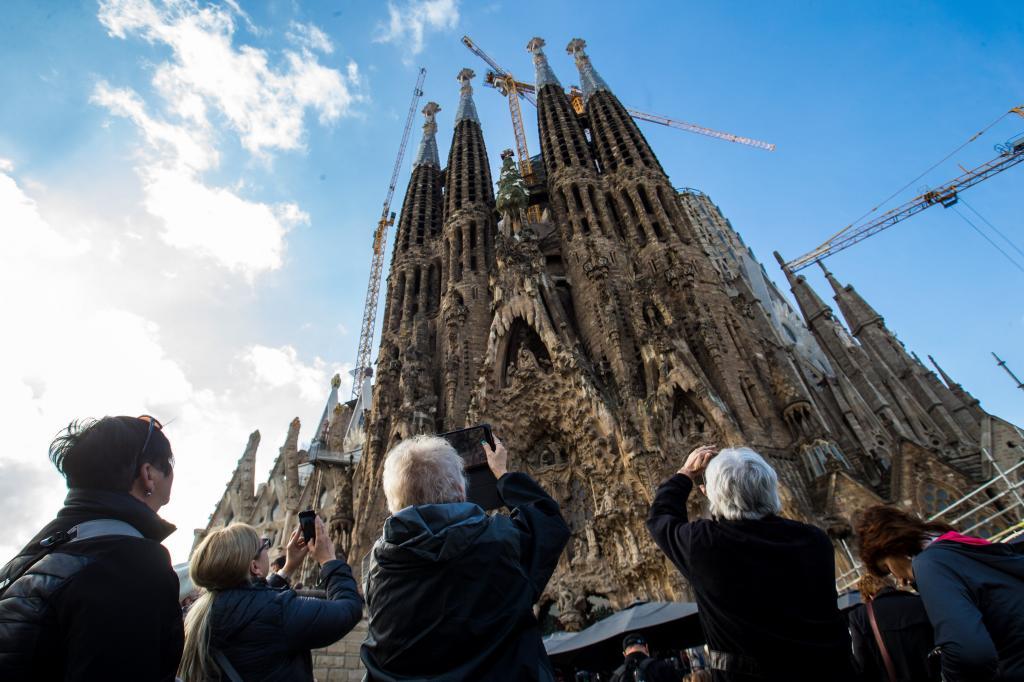
When, in 2013, the Foundation Junta Constructora del Templo Expiatorio de la Sagrada Familia contacted the British consulting and engineering company Arup to finish the eternally unfinished work of Salvador Gaudí, the company's executives could not believe it.
"It was one of those moments when you have to pinch yourself to convince yourself that you are not dreaming," explained Arup's lead structural designer, Tristam Carfrae, to The Times in an interview published yesterday, Monday. "They didn't tell us that we were competing with anyone else [for the project]. They just knocked on the door and asked, 'Can you help us?'. It was incredible," declared Carfrae, who holds a master's degree in Mechanical Engineering from the University of Cambridge and, according to his LinkedIn page, has spent his entire professional life at Arup.
Oscar Tusquets: "Believing that Greek art is worse than Picasso is tacky. I curse the progress of art"
The Plaza de España in Seville is a paid attraction: the logic of the lesser evil
It is planned that in June the Sagrada Familia will be crowned with its tallest tower, that of Jesus Christ, with a height of 172.5 meters. It is the tallest temple in the Christian world. But this vertical architecture rests on the problem that Carfrae and his Arup team have had to deal with for 13 years: ridiculously small foundations. The problem stems from the very conception of the temple. The Sagrada Familia was first designed by the Murcian architect Francisco de Paula Villar, who had planned a neo-Gothic church, in line with the fashion of the time. But after four years of work, and with the crypt already built, disagreements between De Paula and the Board that was his client derailed the project.
Then, Gaudí, who was 31 years old, took on the project. He kept the crypt and designed a monumental network of towers around it. Since he rejected the use of flying buttresses, the basilica was impossible to build with the technology of the time and with the foundations left by Villar. Carfrae assesses it with a very British skepticism: "There were no foundations to support that monstrous tower," although the chief architect of the Sagrada Familia, Jordi Fauli, is more benevolent towards his predecessor and believes that the designer of the Sagrada Familia simply bet on the future. "He knew that there would be possibilities for better construction," he says, referring to Gaudí. Be that as it may, Spanish history conspired to make things worse. In their anti-religious delirium, the anarchists set fire to the crypt and destroyed the plans and models that Gaudí had left when he died, run over by a tram, in 1926.
These "new technologies that would appear," in Fauli's words, have been what allowed the Sagrada Familia to move forward. An example is the walls of the towers. In the original design, they should have had a width of one meter and 20 centimeters. But Carfrae and Fauli managed to reduce that thickness by 75%, to 30 centimeters. To do this, they inserted steel tendons inside the stone that connect the rock blocks. This technique has only existed for three decades. It was first used in bridge construction and then in other projects.
This is how the Sagrada Familia has been rising, although it still has, at best, a decade of construction and administrative procedures ahead. On the horizon is the politically explosive expropriation of a series of houses next to the basilica and necessary to build the staircases designed by Gaudí. But that is no longer within the competencies of Arup, a company specialized in taking on projects that no one else wants, such as the Sydney Opera House in Australia, the Pompidou Center in Paris, or the National Stadium in Beijing. In their list of projects, someone always ends up mentioning the famous Millennium Bridge in London over the River Thames, which had to be closed two days after its inauguration due to its instability.