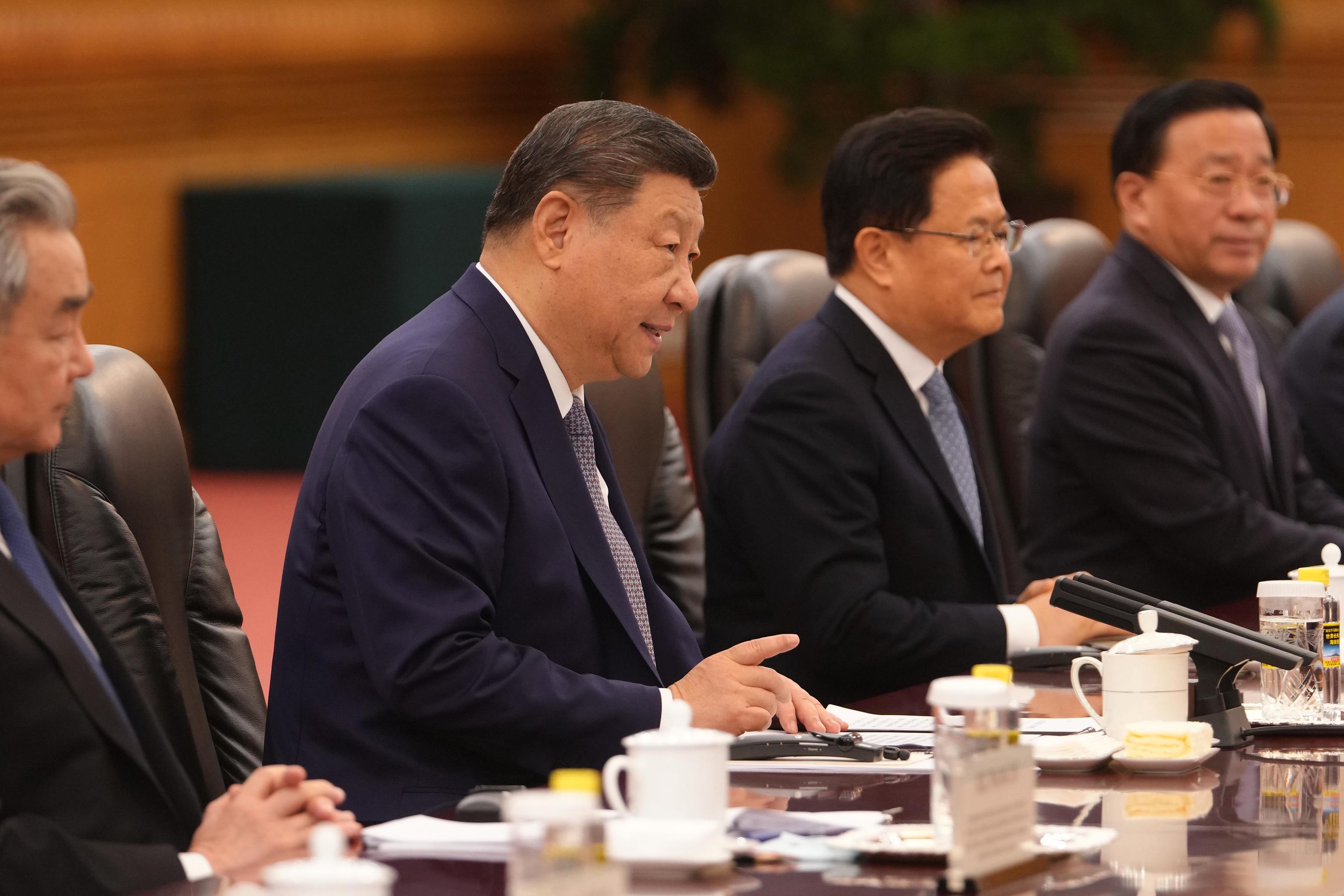
Xi Jinping's first public reaction to the U.S. offensive in Venezuela did not include explicit mentions or specific names, but rather a carefully calibrated message aimed at both Washington and the rest of the international system. In a time of growing geopolitical friction, the Chinese president resorted on Monday to his usual rhetoric on multilateralism to criticize the U.S. military operation that led to the detention of Venezuelan President Nicolás Maduro, who will appear before a New York court on Monday.
"Great powers should take the lead in respecting the development path chosen by other countries," stated the Chinese president, adding that the world is going through "unprecedented changes and turbulence." Xi has denounced the "hegemonic unilateralism that severely undermines the international order," a common formulation in Beijing's diplomatic lexicon when seeking to point fingers at the United States without naming it.
Xi made these statements in Beijing during his meeting with Irish Prime Minister Michael Martin. Chinese state media have highlighted that Ireland, like Beijing, is "a defender of multilateralism and the United Nations system."
During the meeting, Xi emphasized that China and Ireland should "strengthen coordination and cooperation on global issues," as well as "jointly uphold the authority of the UN and promote a more just and reasonable global governance."
Words commonly spoken by the Chinese leader, who presents his country as a guarantor of an international order alternative to U.S. leadership, especially in the developing countries of the Global South.
Xi's initial remarks on the U.S. military operation in Venezuela add to the stronger criticisms issued by Chinese spokespersons over the weekend. Hours after Maduro's capture, the Chinese Ministry of Foreign Affairs expressed being "deeply shocked" and denounced "the blatant use of force by the U.S. against a sovereign state." In another statement, Beijing called for Maduro's immediate release and accused Washington of endangering the peace and security of Latin America and the Caribbean.
Chinese Foreign Minister Wang Yi has also spoken out, stating that Beijing cannot accept any country acting as the "world's judge" following Maduro's capture. "The sovereignty and security of all countries must be fully protected by international law," he added during a meeting in the Chinese capital with his Pakistani counterpart, Ishaq Dar.
China is Venezuela's main oil buyer and one of its strongest political allies. According to the latest available annual data, the Asian giant bought goods from Caracas worth approximately $1.6 billion in 2024 - nearly half of the purchases were crude oil - providing an economic lifeline amid U.S. sanctions.
Last November, in a message sent on Maduro's birthday, President Xi described both countries as "intimate friends, dear brothers, and good partners," pledging to continue supporting Venezuela in defending its "sovereignty, national security, dignity, and social stability."
Some international analysts have pointed out that Washington's offensive, the most direct in Latin America in decades, threatens the advancement of Chinese influence in the region, which has been consolidating through investments, trade, and infrastructure. The U.S. has long considered China's presence a threat to its interests and security.