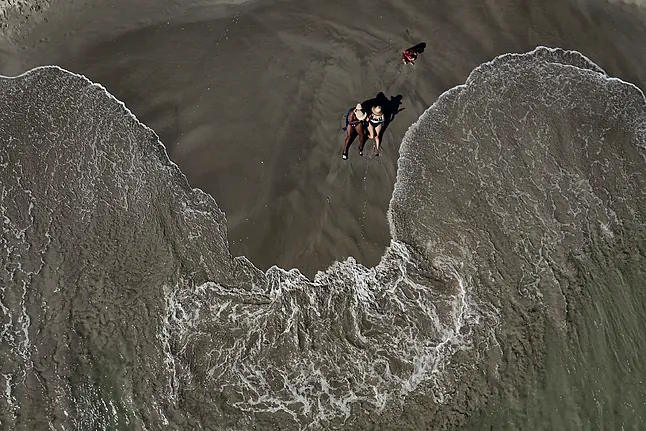
Venezuela holds the world's largest oil reserves, but that is not its only wealth. The country also boasts some of the most spectacular landscapes in Latin America - from Angel Falls, the highest waterfall in the world, to the archipelagos of Los Roques, Isla Margarita, or the tepuis of Canaima - yet tourism remains a marginal sector within its economy.
Far from appearing as a solid alternative to oil or at least an economic pillar to consider, the tourism activity contributes only 0.5% of Venezuela's Gross Domestic Product, as certified by the World Travel and Tourism Council. In its latest report Economic Impact of Travel and Tourism, the country now intervened by the United States not only does not stand out, but is positioned in last place among the 184 economies evaluated.
The paradox is evident: a territory with 43 national parks, 21 natural monuments, and a recognized international coastline, has a limited, underdeveloped tourist offer concentrated in specific enclaves. Beyond Caracas, the only area with a relevant hotel infrastructure is Isla Margarita, where some international chains operate, including Spanish ones. In the rest of the country, the lack of services, investments, and connectivity significantly reduces the ability to attract visitors.
But why? "The aspects with the greatest negative impact on Venezuela's low score continue to be insecurity, precarious internal road and transportation infrastructures, low investment rates, and deficient services provided to visitors," points out ICEX, the leading Spanish organization in internationalization and foreign investment attraction, under the Ministry of Economy, in its Country Report on Venezuela for 2025. Added to this, it mentions the difficulties in finding air connections after years of accumulated debts with airlines and potentially tourist-emitting countries.
The case of Isla Margarita is telling. For years, it was one of the favorite Caribbean destinations, especially among other South American countries like Colombia or Argentina, as it offered practically the same but at more competitive prices than other destinations like Cancun or Punta Cana. However, the rupture of relations with Colombia in 2015 cut off the flow of tourists arriving through two weekly flights from Cali and Bogota. Gradually, the local hotel industry began to suffer the consequences and reflect the deterioration, leading to a loss of quality followed by a lack of supplies. The pandemic ultimately confirmed the decline of Isla Margarita and its crystal-clear waters.
Structural barriers to tourism weigh more than the natural appeal of the destination. Insecurity, the deterioration of railway and transportation infrastructures, and insufficient services shape an uncompetitive environment in Venezuela, according to experts.
The Venezuelan economy remains highly dependent on oil, and potential sectors like tourism remain underexploited today. The Venezuelan economy's dependence on oil is enormous. According to ICEX, in 2024, it accounted for approximately 27% of the GDP (far from that 0.5% from tourism). It holds the world's largest oil reserves and is also the eighth country with the largest natural gas reserves. However, "mismanagement, corruption, lack of investment and maintenance of facilities, as well as US sanctions on the country's public sector in an attempt to democratize it, have caused Venezuela to lose more than half of its oil production in recent years," notes ICEX.
And what else sustains its economy? The agricultural sector contributes about 6%, after experiencing a 5.9% growth in 2024, largely due to favorable weather conditions. It mainly produces corn, rice, sugarcane, and coffee.
Mining is its second failed economic promise. Today, it barely contributes 1% to the GDP, despite being a country with great potential as it concentrates around 3% of the world's mineral supply, mainly in the so-called Orinoco Mining Arc. The most important minerals are iron and bauxite, but Venezuela also extracts phosphates, limestone, nickel, manganese, gypsum, gold, diamonds, and coal. "As in most sectors of this country, in this sector too, poor management, corruption, lack of maintenance and new investments have led to a significant setback over the last decade," warn ICEX.
Telecommunications contribute approximately 8% to the Venezuelan economy, more than the 7% of its manufacturing industry, or the 4% of commerce.
US President, Donald Trump, mentioned his plans for the Venezuelan oil industry up to 26 times during his press conference on Saturday. As for the rest, including tourism, he has not said anything yet.