Just seven hours before U.S. planes broke into the Caracas sky and a lightning operation ended Nicolás Maduro's long political cycle, the Miraflores Palace hosted a scene that now takes on an almost twilight value. In one of the halls of Bolivarian power, Maduro received a Chinese delegation led by Qiu Xiaoqi, Beijing's special envoy for Latin America, accompanied by senior officials from the Asian superpower's Ministry of Foreign Affairs. On the Venezuelan side, in addition to Maduro, Vice President Delcy Rodríguez was present. The official statement spoke of "unbreakable brotherhood," resistance to "unilateral coercive measures," and a Global South determined to defend its sovereignty.
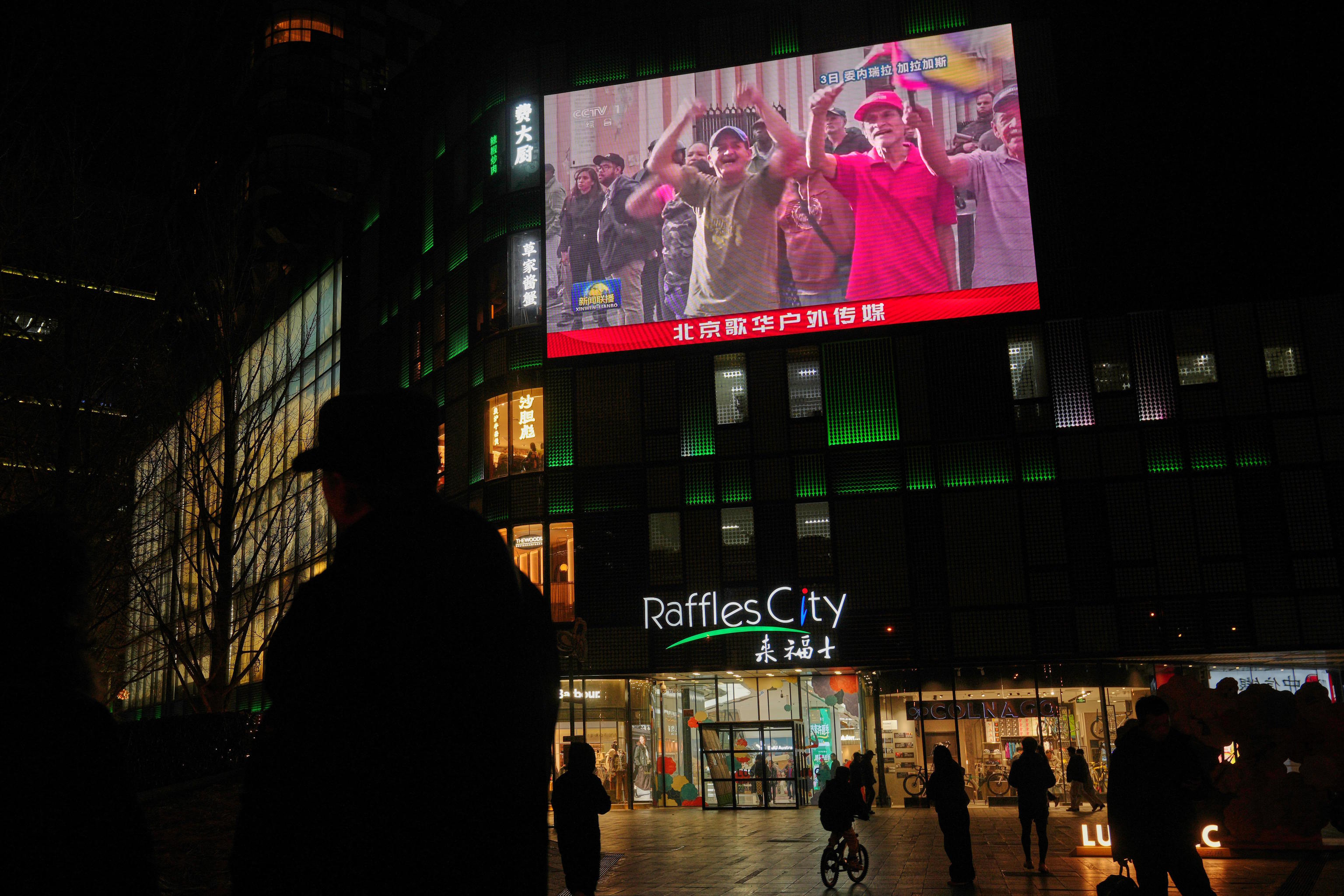
Beijing's reaction to Maduro's capture was slow to come. It wasn't until Saturday night (local time) when the Chinese Ministry of Foreign Affairs declared itself "deeply shocked" and strongly condemned the "flagrant use of force" by the United States against a sovereign state.
The statement followed the basic diplomatic condemnation manual of the Xi Jinping government: accusing Washington of violating international law and threatening regional peace, without any announcement of reprisals or a coordinated response with other allies (Russia and Iran) in support of the Chavista regime.
On Sunday, after Maduro spent his first night confined in the Metropolitan Detention Center in Brooklyn, Beijing issued another statement calling for the "immediate release" of the Venezuelan leader and his wife, Cilia Flores. "The actions of the U.S. clearly violate the basic norms governing international relations and contravene the purposes and principles of the United Nations Charter," they reiterated.
In the last few hours, there has been much speculation about the coincidence - or not - of the U.S. military operation coinciding with an important visit by Chinese envoys in Caracas. Responding to this newspaper's inquiry, a Foreign Ministry official from Beijing indicated that the trip was scheduled as a regional tour to several Latin American capitals to present the political roadmap on Latin America and the Caribbean that China recently published to the countries. In recent years, the Asian giant has expanded its influence in the region, overtaking the U.S. as the main trading partner for many Latin American countries.
The relationship between China and Venezuela has remained a solid alliance mainly on the political front. In the commercial field, Caracas continues to be a significant supplier of oil to the world's second-largest economy. In the last months of 2025, the Chinese would have absorbed nearly 80% of Venezuelan oil exports. Although China is by far Venezuela's largest oil buyer, this nation represents only 4% of its total imports. Like with other sanctioned partners such as Russia and Iran, the Asian country buys oil at significant discounts when convenient and uses intermediaries designed to bypass international sanctions.
However, Beijing has long since cut off the tap to the Maduro regime in terms of multibillion-dollar loans, financial rescues, or ambitious energy projects that flowed during the past decade when China became Venezuela's main creditor.
Now, the economic priority for Xi's government in the region is to maintain deep and profitable commercial ties with other countries like Brazil, Mexico, Chile, or Peru, where business can be conducted without the burden of sanctions. Days before the U.S. military operation, the Donald Trump Administration sanctioned companies from Hong Kong and mainland China for evading restrictions on the purchase of Venezuelan oil.
Although Chinese state media were heavily criticizing the U.S. military action in Venezuela in their editorials and columns on Sunday, there are also voices within the Asian country that believe Beijing will rely on its usual pragmatism and quickly adapt to the new scenario unfolding in Caracas, seeking to protect its energy interests and negotiating with whoever controls Venezuela.
"When the law of the jungle replaces international norms, no sovereign nation is safe," stated the latest editorial from the state-run Xinhua agency. "The actions of the U.S. completely tore off the hypocritical mask of Washington's fight against drug trafficking, exposing the true face of imperialism. First, it invents accusations to forcibly destroy a sovereign government, overthrow its regime, and then allows its own capital to enter and plunder its natural resources."