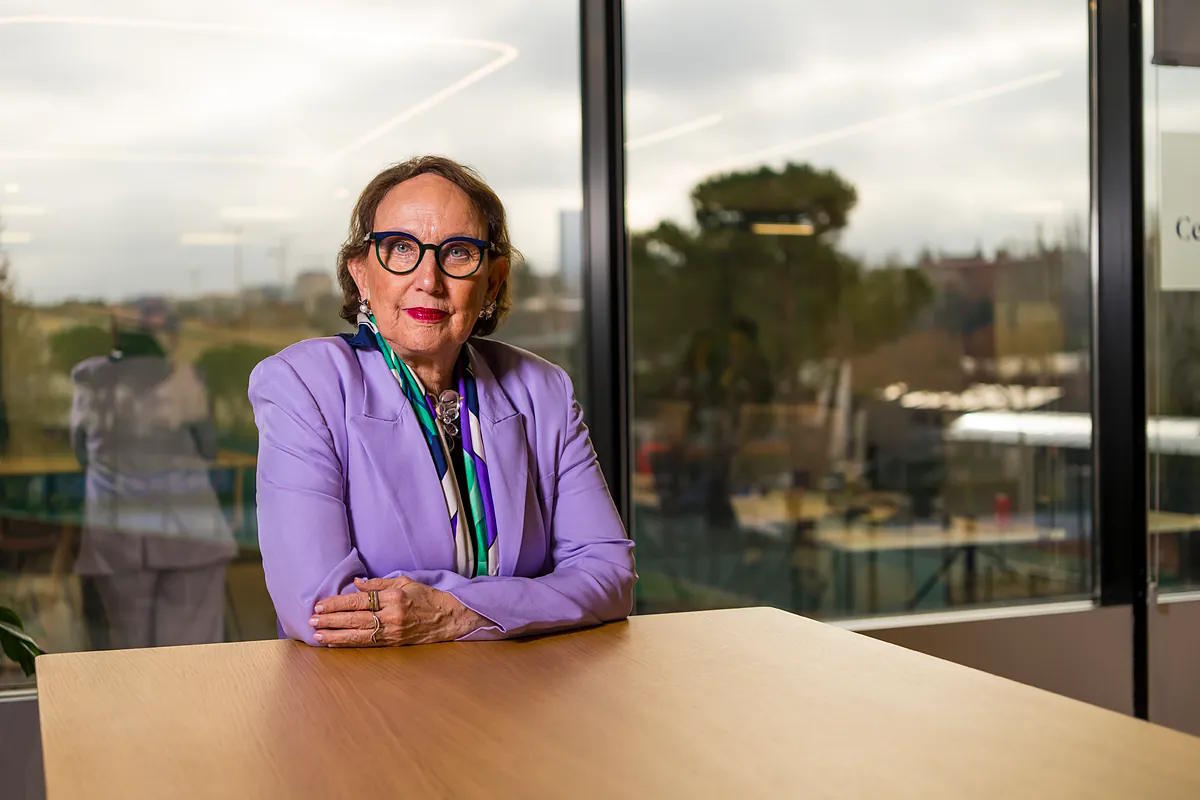
The Secretary-General of the United Nations on Trade and Development and candidate for Secretary-General of the UN visited Madrid to give a talk at the 15th Anniversary of EsadeGeo. "It is very important to understand that the world today is very different from that of 1945," she explains in a conversation with EL MUNDO. "And the ability of the United Nations to engage with an ecosystem with more capabilities than in the past would be very important so that it can focus on what is irreplaceable: I still believe that in a world of so many contradictions, having strong institutions is essential," she details.
What can we expect in international trade in 2026?
I believe we will see a weakening of international trade in 2026. However, we witnessed great resilience in trade in 2025. Part of it was due to anticipation of tariffs: at the beginning of the year, there was an exaggerated trade due to that anticipation. We also see structural trends that we believe will continue in 2026 and will remain part of the foundation of trade resilience.
What are they?
There are three. The first is the increase in services, which is the fastest-growing sector in international trade: they represent 15% of trade but 40% of growth. This dynamic will continue in 2026. It is important to note that services are not subject to the new wave of tariffs and fees imposed in 2025. The second is the dynamic South-South trade. This is a structural trend. Currently, South-South trade represents 30% of total trade, equal to North-North trade, which used to be dominant. It has shown great dynamism, growing around 9% annually, and we expect this dynamism to continue in 2026. The last point is the exuberance, let's say, of artificial intelligence. Artificial intelligence projects require many trade elements and have also been a driving factor in global trade.
These have been years of many tensions. Have we become more resilient or have we not yet recovered from the blow?
Unfortunately, the answer is not the same for everyone because some countries recovered quite well after COVID, but many developing countries faced very high interest rates, which greatly affected their debt. Therefore, we have a problem of high indebtedness in developing countries, especially the most vulnerable ones. These countries, in order to keep up with debt payments, stop investing in development because they cannot do both. There is a development crisis in many of the precisely most vulnerable countries in the world. These countries have been doubly affected by tariff issues.
In what sense?
According to our data, the Least Developed Countries, 45 countries in the world, have an average tariff rate of 27%. That is higher than Europe and higher than developed countries. Therefore, they are doubly affected: not only have their tariffs increased, but they have increased more than others, which is nonsensical. We have called for a review of the impact of tariffs on Least Developed Countries by the United States. We have also advocated for extending the preferential unilateral access that especially benefited the sub-Saharan African region, known as AGOA. It provided tariff-free preferential access to the U.S. market.
Perhaps the most paradigmatic crisis was the Ever Given blockage. It highlighted the fragility of supply chains and how any event can greatly affect us.
You are right. UNCTAD, the United Nations Conference on Trade and Development, released a document discussing bottlenecks in international trade. These are geographical bottlenecks. What happened with the ship in the Suez Canal is very clear; what is happening in the Red Sea is also evident: there is now a diversion of routes due to attacks in the Red Sea. We are more optimistic with the temporary ceasefire that occurred and believe that some maritime routes are returning to the Red Sea. However, if the situation in Yemen deteriorates, we will continue with that diversion through the Cape of Good Hope, making routes much more expensive, longer, and with higher greenhouse gas emissions. Then we have the Strait of Malacca, through which most of the trade from Asia passes. These are critical points that cannot be diversified as they are essential in logistical connections for international trade.
There was also an impact due to the war in Ukraine. You were involved in the negotiations.
Yes, we also experienced it with the war in Ukraine involving the Black Sea. There was a significant increase in prices in international grain markets, which greatly raised the FAO's food price index. This had a tremendous effect on populations because rising food prices significantly affect the world's poorest populations. We were on the brink of a food crisis, leading to the United Nations initiative where I led negotiations in one team with Russia, while Martin Griffiths led negotiations with Ukraine. We managed to open the grain corridor and reduce international prices by 23%. This is another example of the significant impact when a logistical point collapses. The repercussions are not limited to that point but affect the entire world because trade is like water: it spreads everywhere, and the well-being of many countries depends on trade.
Is inequality increasing?
Yes, inequality is increasing. Consider that the four most important technology companies in the world have market capitalizations greater than the entire GDP of Africa. This should raise concerns. Social mobility has stalled in many countries, contributing to disillusionment with globalization among sectors that have not seen their lives improve to the same extent as those more closely linked to international trade.
Less developed countries are making progress in development, but according to your data, their trade tends to be with neighboring countries (nearshoring) or political allies (friendshoring). Could this hinder the positive trend?
Yes. Geopolitics and geoeconomics are more intertwined today than ever before. Geoeconomics has lost degrees of freedom concerning geopolitics. This is evident in the increase in friendshoring. We were the first institution to measure the rise in friendshoring, with nearshoring activities not showing the same dynamism. This reflects the interdependence of geopolitics and geoeconomics today. While I cannot say they are two sides of the same coin yet, there is indeed a significant influence of geopolitics on geoeconomics.
Can vicious circles occur? Without trade, there is no development, and without development, there is no trade.
Small and medium-sized countries are much more open and generally depend more on trade. Of course, countries need trade and investment to develop. One of the areas most affected today by high uncertainty and policy volatility is investment. We have seen two consecutive years of declining foreign direct investment and an average decline in the developing world. This is a problem. We have called for international financial institutions to fill this gap. If the perceived risk is very high, we need the public international financial sector to reduce the perceived risk for private actors and combine private investment with public projects. Without doing so, there will continue to be a capital shortage in developing countries, hindering the construction of infrastructure and conditions for dynamic future growth
.When you mention that the financial system must adapt to the needs of the economy, how do you convince the financial system of this?
The G20 had a significant initiative, requesting a document for the revitalization of multilateral development banks. From that exercise, a path emerged presented by the World Bank, leading to reforms in the World Bank and instruments of the International Monetary Fund. For example, the trust fund for resilience and sustainability. These are welcomed innovations. However, we still lack the scale to address the needs of the developing world. We have lost the capacity to tackle the magnitude of the problems. These are crucial instruments for developing countries. Another issue we have raised is debt, where much more work is needed. Countries have not defaulted, but 3.4 billion people live in countries spending more on debt servicing than on education or health. Ultimately, postponing investment in health and education, in building population capabilities to face the future, will lead to serious problems and instability in many countries.
You mentioned AI. How does it affect trade? It can improve processes, but can it compensate for job losses?
Just as I believe in the importance of trade for many countries as a development element, a development strategy is much more than a trade strategy. Therefore, it is crucial to have an active policy in the strategy to support sectors that need to restructure within a trade strategy. This does not happen automatically, and indeed, there can be winners and losers in a trade strategy. If the state does not have a strategy for the losers, it can lead to frustration and dissatisfaction with trade policies. A development policy must go beyond this and include a productive diversification policy. Most developing countries still heavily rely on commodity production and are subject to greater international price volatility, failing to create jobs for the educated youth in our countries. An active productive diversification policy is essential to generate the quality jobs demanded by populations today. I believe that digitalization policies can enable countries to achieve greater productive diversification and skip a stage of development. Well-utilized broad-spectrum technologies can accelerate development in many countries. However, investments in infrastructure, population capabilities, and good governance of the digital world are necessary.
What would be the key points of your mandate if you were elected Secretary-General of the United Nations?
I find it crucial to understand that the world today is very different from that of 1945. Today's world has more capabilities, a more educated population, more regional organizations, and civil society involvement. Therefore, the United Nations must leverage these capacities and diversity. The United Nations is unique but not alone. The ability of the United Nations to garner support from an ecosystem with more capabilities today than in the past would be crucial to focus on what is irreplaceable: in a world of many contradictions, having strong institutions is essential. Fragile institutions will result in a more fragile and conflict-prone world. Hence, we must strengthen the United Nations, but being multilateral today means being reformist.