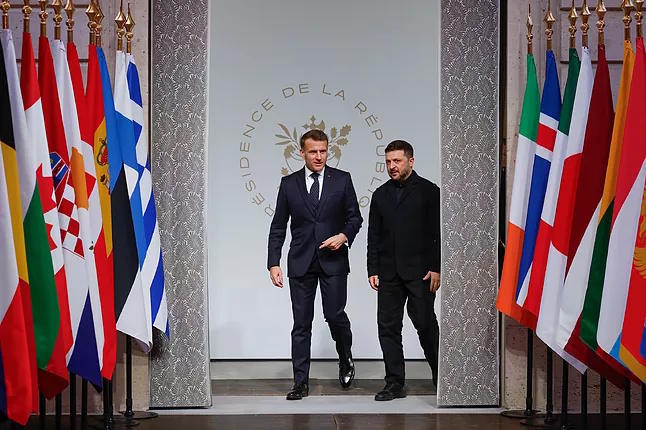
The meeting of the Volunteer Coalition in Paris this Tuesday concluded with significant steps by European countries and the United States, who attended as guests. The former committed to the deployment of a multinational force in Ukraine in case of a ceasefire. The document was signed by the promoters of the Coalition, French President Emmanuel Macron, UK Prime Minister Keir Starmer, and Ukrainian President Volodymyr Zelenski.
Meanwhile, the United States would leadthe monitoring of a ceasefire in Ukraine with European participation, as agreed at the meeting, attended by U.S. Special Envoy Steve Witkoff and Donald Trump's son-in-law, Jared Kushner, along with 27 heads of state and government and Ukrainian President Volodymyr Zelenski.
The U.S. also committed to logistical support and reconnaissance for a hypothetical European multinational force in the event of a peace agreement with Moscow. The draft text approved by the Volunteer Coalition, composed of 35 countries, acknowledges existing military plans to prepare "security measures in the air, sea, and land."
The agreement also includes joint support for "the regeneration of the Ukrainian armed forces" and the creation of a system to monitor compliance with the ceasefire, in which the United States would also participate.
President Zelenski stated that signing the security guarantees protocol in Paris represents a significant advancement for his country: "Now we have substantial documents, not just good words," he said.
Prime Minister Keir Starmer highlighted that the security guarantees include a "binding mechanism" in the case of future Russian attacks after a hypothetical ceasefire. Starmer questioned Vladimir Putin's willingness to seal a peace agreement and criticized the recent wave of attacks on civilians, hospitals, and infrastructure. "Pressure on Russia must be increased so that they finally sit at the table," he added.
German Chancellor Friedrich Merz appeared alongside Zelenski, Macron, and Starmer, expressing support for the future multinational force. Macron indicated that "several thousand" French soldiers could be deployed in Ukraine to maintain peace. The dissenting voice in Paris was Italian Prime Minister Giorgia Meloni, who immediately warned that they would not send soldiers to Ukraine in the event of a ceasefire.
Spanish Prime Minister Pedro Sánchez has opened the door to the participation of Spanish military personnel, as has Norwegian Prime Minister Jonas Gahr Støre, who has confirmed the possibility of his country contributing alongside the Baltic countries.
EU Council President António Costa confirmed that the EU is willing to support a peace agreement in Ukraine with civil and military missions on the ground. "We will assist with our EU civil and military missions on the ground. Ukraine must be in the strongest position possible before, during, and after any ceasefire," Costa stated.
Despite tensions between Washington and European allies over the military operation in Venezuela and threats from the Trump Administration regarding the annexation of Greenland, the Paris summit apparently met expectations of "convergence" in security guarantees in Ukraine after a hypothetical peace agreement.
U.S. Special Envoy Steve Witkoff stated that the protocol agreed upon in Paris "provides a guarantee for Ukrainians that the war will end once and for all." Witkoff reiterated that President Trump's determination did not waver during the peace agreement negotiations: "Trump wants to end this war and this carnage."
Security guarantees and the future of territories occupied by Russia in eastern Ukraine remain the main obstacles to a peace agreement. Moscow has repeatedly opposed the presence of NATO country troops on Ukrainian soil in the event of a peace agreement.