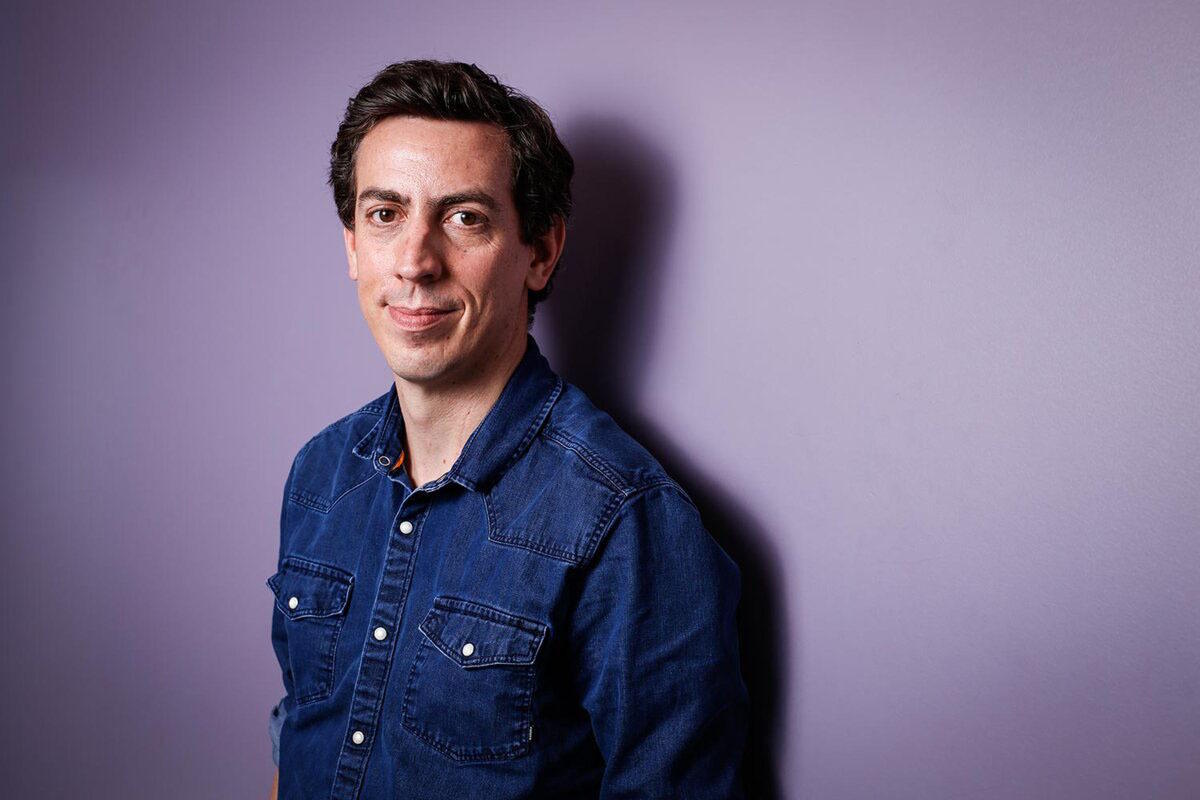
These are tough times for journalism. More journalists are dying in wars than ever before, autocratic leaders denigrate them as "enemies of the people," and the smokescreen of disinformation prevails on social media. In the midst of this bleak landscape for the profession, a powerful reference emerges: Forbidden Stories, the transnational investigative consortium founded eight years ago by Laurent Richard (Villefranche de Rouergue, 1976) to continue the investigations of murdered, threatened, or imprisoned journalists.
"Killing the messenger will not kill the message." This is the challenge thrown by this French investigative journalist, distinguished with the EL MUNDO International Journalism Award (in the Press Freedom category) for his work leading Forbidden Stories, based in Paris and with a global network of 300 journalists worldwide.
The impact of investigations like The Pegasus Project, The Daphne Project, or Story Killers, featured on the front pages of media outlets such as The New York Times, The Guardian, or Le Monde, speaks volumes about the work of this great rescuer of "forbidden stories" in the face of multiple threats.
Are we perhaps at the worst moment and, at the same time, the best moment for investigative journalism? I would say we are facing one of the worst moments for press freedom, one of the worst for journalists' safety, and also one of the worst for access to research. In Gaza, we have witnessed the normalization of the murder of journalists, with over 200 deaths. From East to West, from Trump to Putin, we are called "enemies of the people," and the White House website displays a list of media offenders. We all know what happens when journalists are made scapegoats and lists start circulating... And at the same time, we are facing a growing monster: the disinformation industry. It is a dangerous time for journalists, but indeed journalism is more necessary than ever. I would say journalism is essential for the survival of democracies.
Who is behind the disinformation industry that you denounce? The origin of our investigation into the disinformation industry was precisely the murder of an Indian journalist, Gauri Lankesh, who was about to publish an article titled "In the Era of Fake News." She investigated what she called "the factories of lies," directly accusing the Indian People's Party (BJP) of using fake news as a political weapon. Gauri was shot dead in 2017 at the doorstep of her home in Bangalore... A hundred journalists from 30 different media outlets took up the baton, resulting in the series "Story Killers," which has uncovered what we can now consider a global industry that uses disinformation to manipulate elections, destroy reputations, and destabilize democracies.Are we really in the midst of an information war? Indeed, and what we have seen in recent days with the denial of visas to four activists and a French politician (former European Commissioner Thierry Breton) is another example of the escalation between the United States and the European Union... Disinformation has always been a weapon of war, and we can refer to the work of Russian troll factories to interfere in European democracies on the eve of the Ukraine war. In the last five or six years, the situation has escalated further, with the merger of public relations companies and former military personnel providing these services. There are increasingly more private companies using these tools, with the help of artificial intelligence, to misinform the public.
What has been the biggest revelation of your investigations? In Israel, for example, we infiltrated an ultra-secret Israeli group called Team Jorge, which functions as a true disinformation unit on social media, controlling thousands of fake accounts and manipulating elections worldwide. In Spain, we had access to leaks from the company Eliminalia, specialized in "cleaning up reputations" and erasing the online footprint of hundreds of clients, many of them accused of corruption or money laundering, which is also a way to bury history and bury the truth.In other cases, the direct target is journalists themselves, as was evident with the 'Pegasus Project'... In 2021, we indeed received a leak of 50,000 potentially infected mobile phone numbers with the spyware Pegasus, marketed by the Israeli cyber intelligence company NSO Group to officially monitor "serious crimes and terrorism." Among the spied phones were indeed journalists, opposition politicians, dissidents, human rights activists, and lawyers. Dozens of journalists discovered they were being spied on, posing a threat to press freedom and risking their own lives.This risk exists not only in countries like Colombia or Mexico but is also around the corner in countries like Malta, where journalist Daphne Caruana Galizia died in a car bomb in 2017 for her revelations on corruption amid the Panama Papers scandal...The Daphne Project was precisely our emblem. We had just been born as Forbidden Stories, and it was a murder that impacted us all, both personally and professionally. After her death, 45 journalists from 18 countries took up the baton with the aim of continuing their investigations into corruption in Malta. "You can kill the messenger, but you will not kill the message," was the motto directed against her killers. The Panama Papers marked a milestone in the history of collaborative journalism, with dozens of media outlets worldwide joining forces in a globally impactful investigation. I believe it served to demonstrate that, by uniting forces, journalists are unstoppable.
It's hard to believe that collaboration will eventually replace the eternal competition among media... In journalism schools, we were taught to act as lone wolves, and there is still room for that type of journalist, but I believe we have reached a point where collaborative journalism is essential to defend the public interest. At the same time, we ensure protection, save resources, and have a greater impact. It is the only way to move forward in this crossroads, finding innovative ways to collaborate among various media outlets around the world.Do you receive threats frequently? Legal threats and also death threats on occasion. But these types of threats are common in almost all newsrooms. We have won all legal battles to date.You were practically a witness to the attack on the magazine 'Charlie Hebdo' in which 12 people died. How did it impact your life? I was working in January 2015 at the Première Lignes office, next to Charlie Hebdo. I arrived two minutes after the attack, when the two perpetrators had just fled. Entering the newsroom and seeing people dead and shot in your own office was a traumatic experience. My first instinct was to help the wounded. These were people I interacted with daily. I had been in the Iraq war and had experience as a war reporter, but when tragedy strikes in your city and in your own building, the impact is tremendous. I was stunned, wondering, "What can I do after this attack?" The answer came from a friend and journalist, Khadija Ismayilova, who had been imprisoned for her investigations into corruption among Azerbaijan's ruling class. From her cell, she sent me a letter reminding me of the importance of continuing her work. I ended up making a documentary about corruption and bribes to European politicians to whitewash Azerbaijan's image. I realized how important it was to continue the work of murdered, silenced, or imprisoned journalists and the need to amplify the message. That was the seed of Forbidden Stories, which we launched in 2017.
"Journalism is essential for the survival of democracies, more necessary than ever."
How has the way of working evolved since then?
We remain a non-profit organization, operating thanks to donations. We started with two investigations per year and now do between seven and eight. We have grown and have a central editorial office in Paris with 25 people and a global network of 300 journalists. Initially, it was challenging to convince major media outlets of the need to share information. The global impact of investigations like the Daphne Project or the Pegasus Project has served to demonstrate the power of collaborative journalism. I believe that recognition is behind the international journalism award granted to us by EL MUNDO. Our mission is to defend journalism using journalism.
One of the latest developments is the creation of the 'Safe Box,' something like a safe to secure ongoing investigations of threatened journalists...
Our work is not only to continue the investigations of murdered journalists but primarily to prevent a journalist from being killed. The Safe Box is indeed like a safety deposit box where journalists can deposit their investigations. Around 230 professionals use it daily. I think it is an innovative way to protect sensitive information and at the same time send a message to potential killers: killing an inconvenient journalist will not erase the story... If you kill an inconvenient journalist, 50 other journalists will continue their investigation, and the level of exposure and global impact will be much greater, so think twice.
With the 'Gaza Project,' Forbidden Stories' scope of action has expanded like never before...
Israel basically wanted a war without journalists, who are ultimately the witnesses of history. Not only were foreign journalists denied access to Gaza, but there is a suspicion that journalists were targeted. In the first part of the project, we investigated the deaths of 100 journalists. Some were shot despite wearing press vests, others were victims of drone attacks, which are highly precise weapons. Fifty journalists from 13 media outlets participated in the investigation. Israel has denied everything and imposed a total blackout. Unfortunately, the slaughter of journalists continued.
The death of Ukrainian journalist Viktoriia Roshchyna was also key in revealing the "ghost prisoners" during the Russian invasion...
Viktoriia was declared dead in captivity in 2024, after being secretly detained in Russian-occupied territories, where she was investigating cases of detained and tortured Ukrainian civilians. Her body was repatriated and showed signs of torture. Our investigation exposed the existence of dozens of informal detention centers where so-called Ukrainian "ghost prisoners" have been imprisoned and tortured, as well as the existence of the Taganrog prison, something like the Russian Guantanamo.
Lastly, let's talk about the 'cold war' of climate change and the journalists who have fallen trying to warn about environmental degradation...
In 2019, we coordinated the Green Blood Project, with investigations in countries like India, Guatemala, or Tanzania, where journalists risk their lives to report on the impact of mining and extractive activities, where many interests are at stake. In 2022, the murders of British journalist Dom Phillips and Brazilian activist Bruno Pereira made headlines. The event highlighted the risks faced by environmental defenders in the Amazon.
In 2019, we coordinated the Green Blood Project (Proyecto Sangre Verde), with investigations in countries like India, Guatemala, or Tanzania, where journalists risk their lives to report on the impact of mining and extractive activities, where there are many interests at stake. In 2022, the murders of British journalist Dom Phillips and Brazilian activist Bruno Pereira made headlines. The event highlighted the risks faced by environmental defenders in the Amazon. Shortly after their deaths, 50 journalists from 16 organizations coordinated by Forbidden Stories continued their investigations on the Javari Valley, an area turned into a hub for drug trafficking, illegal logging, and resource exploitation. That same year, in the province of Córdoba in Colombia, journalist Rafael Moreno was assassinated while investigating the illegal extraction of natural resources in the San José de Uré River. Moreno was known as "the voice of the people" and specialized in reporting on drug trafficking and corruption in one of the country's most violent areas. A few days before his death, he contacted us with the intention of depositing his research in the Safe Box. He didn't have time to do it, but we continued his work with The Rafael Project. His words in a video he recorded before being killed served as a stimulus: "You may kill me, but you will not silence me."