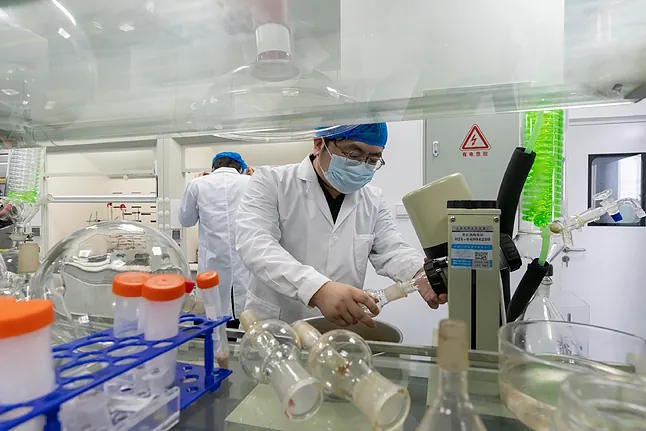
Among the ancient canals winding through Suzhou, where the water reflects glimmers reminiscent of an eastern Venice, lies the pulsating core of the Chinese pharmaceutical industry. In this watery labyrinth, which for centuries was a cultural symbol, active ingredients and generic drugs are now being developed to supply an increasing number of markets worldwide. This city in the east of the Asian giant, with eight million inhabitants and neighboring Shanghai, has managed to forge a unique alliance between tradition and biomedical forefront. A significant portion of the drugs consumed daily in Spain contains some component originating in Suzhou.
When, almost a decade ago, Spanish pharmaceutical companies like Grifols began announcing their first strategic collaborations with Chinese companies, few suspected that gesture was just the prelude to a deeper global transformation. Europe then dominated the sector's innovation, while China remained relegated to generic production. Today, the scenario has changed: the Asian superpower has become an essential hub of global biotechnology, and major Western pharmaceutical companies - from the United States to Spain - increasingly depend on its discoveries and new molecules.
Built on an extensive swamp on the shores of Lake Jinji, the Suzhou Industrial Park concentrates the backbone of the country's pharmaceutical industry: high-security laboratories, production plants, testing centers, and logistical complexes for national and international distribution. "As has been done in many other cities to boost strategic sectors, Suzhou decided to concentrate an entire ecosystem dedicated to medicine, articulated in various areas of specialization," explains Zhou Ming, an official appointed by the local government to address the media.
"There are mega centers with the capacity for massive clinical trials, chemical companies, industrial production facilities, pharmaceutical packaging manufacturers, logistics networks, universities that train highly qualified talent, and a regulatory environment that facilitates research," he details.
The authorities in Suzhou, like in other industrial hubs in China - such as those linked to electric cars - have showered the sector with generous subsidies and tax incentives to improve its global competitiveness. In the industrial park above the swamp, the most prominent biotechnology company is Innovent Biologics, which develops medicines and APIs (active pharmaceutical ingredients) for several European companies, especially from Germany and France.
In 2024, China surpassed Europe for the first time as a generator of new active ingredients. The Chinese pharmaceutical market, which has shifted from copying drugs to being the main global innovative engine of APIs, reached $252 billion. Official forecasts predict sustained annual growth exceeding 10%.
This boom is reshaping the global healthcare landscape and fueling a growing dependence of the West on Chinese biotechnology, a phenomenon that, for many experts, combines opportunities and risks. The European Union has begun to take notice: in March 2025, it introduced a Law on Essential Medicines to strengthen the production of over 200 critical drugs and in June, it banned Chinese companies from participating in public tenders for medical devices valued at over five million euros, a measure that strained commercial relations between Brussels and Beijing.
The reality facing the old continent is delicate. Key API suppliers have announced the closure of several plants unable to compete with Chinese prices. Xellia Pharmaceuticals, specialized in antibiotics and based in Denmark, announced a few months ago that it will relocate most of its operations to its plant in China. Its CEO, Michael Kocher, warned that around 80% of APIs used in the EU come from China and India, and that the figure could reach close to 100% if European governments do not adopt protectionist measures to curb dependence.
In Germany, three-quarters of the active ingredients used in imported antibiotics come from China. "Even when medicines are manufactured in India or the United States, the main players in the global pharmaceutical market often use Chinese ingredients," states a report from the Pro Generika association. In 2024, Germany exported over 15 million tons of pharmaceutical products to China, while China sent over 33 million tons to Germany. "Whether it's painkillers, antibiotics, or diabetes drugs, German pharmacies cannot do without medicines manufactured in China."
The scenario is similar in Spain, where three years ago a report from the Real Instituto Elcano warned that Spanish supply chains are increasingly dependent on China in strategic sectors such as pharmaceuticals. For years, several Chinese pharmaceutical companies have established a presence and operations in Spain, either through subsidiaries or by acquiring local companies. This is the case of Techdow Pharma, a subsidiary of Shenzhen Techdow Pharmaceutical, which was the first (in 2018) to sell its own drugs directly in the Spanish market. Or Qilu
Pharma Spain, focused on diabetes medications, which arrived in 2023 after acquiring the Spanish biotechnology company Diater.
In Beijing, state media have long been promoting the ambitious idea of a "medicines Silk Road," conceived to project Chinese pharmaceutical influence worldwide, especially in the Global South regions and in developing countries integrated into the vast infrastructure and trade program driven by President Xi Jinping.