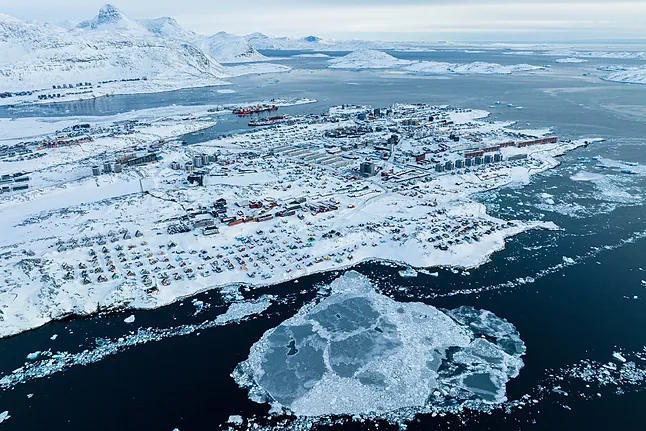
In Brussels, there is great concern and even fear about the expansionist ambitions of the President of the United States, Donald Trump. Due to the "warrior mode" that, according to diplomatic sources, the magnate has entered after the operation to capture Nicolás Maduro in Venezuela. "It has been a success for him, and he is completely obsessed with continuing his expansion," point out sources from a northern country. And if that means through Greenland, of course.
"The concern about what may happen in Greenland was shared by almost all countries," added from a second capital when asked about the Political and Security Committee meeting that took place in Brussels yesterday, where the solidarity shown towards Denmark was "total."
But this will not be enough to stop Trump. "He is obsessed with oil and expansion," emphasize sources from the north. Not only that, but also with the rare earth elements abundant on the island, essential for modern technology, and because Greenland is a surveillance and projection platform into the Arctic. "We need to be prepared for confrontation," these same sources add. Although such a confrontation seems very complicated.
Firstly, because it does not seem feasible for the EU to truly confront the United States. Added to this are the peculiarities of Greenland: it is not part of the European Union but belongs to the Kingdom of Denmark, a country integrated into the EU. Furthermore, the island is present in NATO, so an attack on this territory would allow invoking Article 5. But, against whom? Against the United States? That does not seem like a very realistic option, and if this were to happen, what could precipitate is the end of the North Atlantic Treaty Organization.
From the European Commission, there have not been any major statements so far. Probably the most assertive has been, once again, the President of the European Council, Antonio Costa, who on Wednesday stated that the EU cannot accept violations of international law in "Cyprus [a country that has assumed the rotating presidency of the EU], Latin America, Ukraine, or Greenland."
Yesterday, the High Representative of the Union for Foreign Affairs, Kaja Kallas, added that "the EU has always been a strong ally of the United States," but that the "statements and communications" from the US "do not help achieve stability." "International law is clear, and it is the only thing that protects small countries, so not respecting it will put us in danger. We have addressed that we adhere to international law at all levels," she added. Not much more.
While Brussels tries to make progress in this devilish context and the EU capital begins to wake up after the Christmas holidays, the Trump Administration continues to move at full speed. Secretary of State, Marco Rubio, confirmed on Wednesday that next week he will hold a meeting with Danish authorities to determine the future of Greenland. Some voices indicate that the US intention is to make an economic offer for the island. To buy it. Others suggest that what the Trump Administration plans is to offer something that the island cannot refuse.
For example, "a Compact of Free Association" (COFA), which is a type of agreement that the US has with small island states in the Pacific, and through which the Trump Administration would take over the defense and foreign policy of Greenland. In return, the country would receive commercial benefits in addition to protection, and the United States could, of course, establish all the bases it desires on the territory and have total control over it. Just what Trump wants. And another important thing: it would allow the nation to stop depending on Denmark, something that, as recalled from Brussels, is not liked by a large part of the 57,000 inhabitants that make up the island's population.