A report from the US bank Morgan Stanley sent to clients, and accessed by this newspaper, portrays in ten facts the true dimension of oil in Venezuela that explains the oil move by the US president (and businessman), Donald Trump.
The captured Nicolás Maduro was nourishing the regime with oil sales to China and granting the largest reserves for exploitation not controlled by the state oil company PDVSA. The rights granted to the Chinese Sinopec amount to 2.8 billion barrels, making it the most privileged after PDVSA. It is followed by the Russian state company known by its former name Rosneft, with 2.3 billion, and the third, also Chinese, CNPC with 1.6 billion.
In contrast, the top US company, Chevron, does not reach a billion, and the Spanish company Repsol appears on the list with just 200 million barrels. This means that the Chinese and Russians have managed to control six times more Venezuelan oil than Chevron and Repsol combined. And if we exclude the heavily sanctioned Russian oil company, the two Chinese companies accumulate four times more rights over Venezuelan oil than Chevron - which is poised to be the biggest beneficiary of Trump's maneuver - and the Spanish company.
Another significant data point provided by Morgan Stanley through the consulting firm Wood Mackenzie is that Venezuela holds the largest untapped oil reserves in the world. It is attributed with 241,000 million barrels yet to be produced. That is almost as much as Saudi Arabia (171,000) and the US (94,000) combined. However, Venezuela is the least efficient producer among the top reserve holders. "Among the top ten reserve holders, Venezuela is by far the smallest producer. Lack of investment and the impact of sanctions have severely affected it: from a peak of 3.5 million barrels per day in the late 1990s, crude production has dropped to just 900,000," the report states. And what little it exports mostly goes to China, according to Vortexa and Morgan Stanley.
Another data point highlights how Maduro was replacing dependence on the US with that of Russia in another critical element. "A critical factor that has often limited Venezuela's production is the import of naphtha. Much of Venezuelan oil is very heavy, making its processing and transportation difficult. The solution is to import very light oil (mainly naphtha) to mix with the heavy crude and allow it to flow," the document emphasizes. "Historically, these diluent imports have come from the US, but the long halt [sanctions] on these imports between 2019 and 2022 has been one of the factors that have conditioned production." And where does the naphtha come from now?
Both the Trump administration and the previous one of Joe Biden have justified for years granting exceptional permits for the import of Venezuelan oil to US oil companies and others like Repsol precisely to limit the drift towards Russian or Chinese monopoly. However, the current US president has decided to cut to the chase and try to take over, de facto, the oil fields.
This geopolitical move is coupled with Trump's attempt to fulfill one of his campaign promises to Americans, which is to lower gasoline prices to below two dollars per gallon at gas stations in his country. Both Morgan Stanley and Goldman Sachs foresee a cheaper global oil price in the short term after Maduro's capture, below $60. This, combined with US refineries being particularly well positioned to handle heavy Venezuelan crude, contributes to Trump being in a better position for the upcoming midterm elections. By appointing Delcy Rodríguez, he seems to be trying to avoid production declines as in two chaotic precedents of attempted oil control where transitions were abrupt: Iraq in 2003 and Libya in 2011.
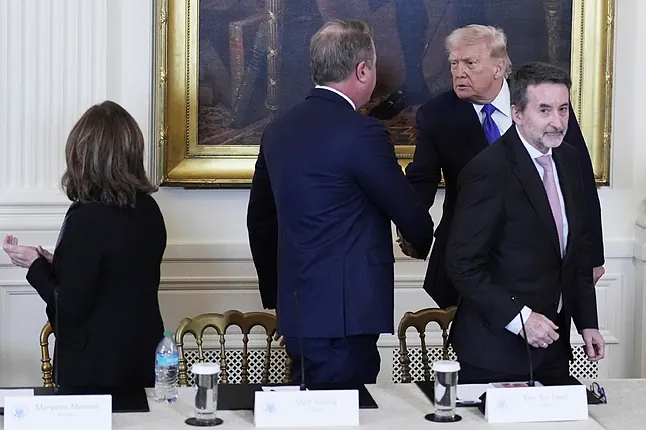
And Repsol? Its situation should only improve in terms of its chances of collecting billion-dollar debts and exploiting gas and oil in Venezuela. Its CEO, Josu Jon Imaz, participated in the White House oil summit with Trump last Friday and offers to triple its production if the regulatory and commercial framework changes radically in Venezuela, in line with the majority position of a sector that needs certainty for the costly relaunch of production in Venezuela. Being a partner there with ENI, the Italian group controlled by Giorgia Meloni who is much closer to Trump than Pedro Sánchez, favors Repsol. But "America First" is not just a slogan, it is the manual of the unpredictable and fierce Republican politician, so everything is uncertain for Europe and its companies.