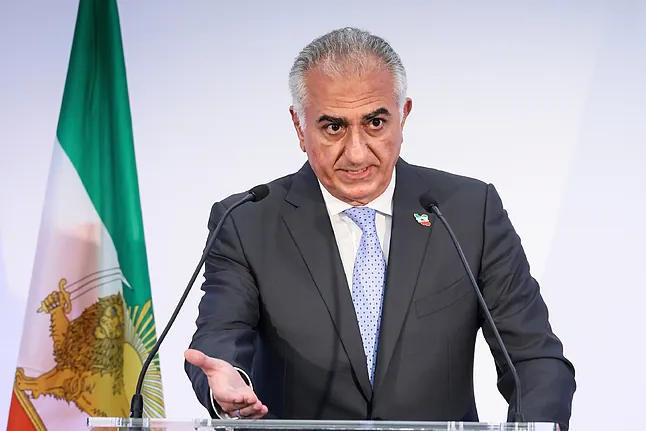
The widow of the last Shah of Persia, Farah Pahlavi, has never healed the wound caused to the then Iranian sovereigns by the betrayal of what they believed was an essential ally, the United States, and more specifically its president in 1979, Jimmy Carter. The Democrat not only abandoned the king of kings, the grandiose title of the one who holds the ancient Persian crown, when he deemed him an obstacle and facilitated the advance of the Islamic revolution of Khomeini. Carter also treated Mohammad Reza Pahlavi as an international pariah, subjecting him to a two-year exile ordeal despite his serious health condition, and even came close at one point to handing him over to the new ayatollah regime.
But, as the poem says, neither with you nor without you do my troubles have a remedy. And, almost half a century later, the United States, or its Administration, in this case that of Donald Trump, remains the major global player who moves pawns and kings. And the son of that Pahlavi, Crown Prince Reza Cyrus, cherishes the dream he has pursued all his life, that of seeing the fall of the Islamic Republic and perhaps with it the restoration of the Peacock Throne in Tehran, thanks in part to the underground support provided by the White House and the undisguised sponsorship of Israel, the other actor that is going all-in amid the massive protests that have been taking place since late December in the main Iranian cities and that, after the magnitude of the recent nights, seem to be seriously challenging Khamenei and his followers.
If there is something that Crown Prince Reza Pahlavi is achieving for now, it is capitalizing on all the attention as the most internationally recognized figure of the opposition to the ayatollah regime. Enlarged, moreover, by the fact that in the gatherings within Iran, defying the ayatollahs' prohibitions, monarchic symbols are more abundant than ever - especially the flag with the imperial lion - and chants are heard among the protesters, mostly young people, singing slogans like "long live the Shah!" or "Pahlavi will return!".
It is impossible in the current circumstances to establish the true extent of the support that the Monarchy, and specifically Crown Prince Reza, is gaining among the citizens protesting within Iran, of an extraordinary heterogeneity. It has even been proven that some videos and images circulating for days on social media calling for the fall of Khamenei and advocating for the Throne are manipulated. But many others are real. And they indicate that indeed, the monarchic slogans are serving as a glue to some sectors at the forefront of the protest as a banner of resistance and demand for change.
Call for a general strike
In this context, Reza Pahlavi multiplies messages to his compatriots. Just yesterday, he urged Iranian citizens to continue the protests throughout the weekend, following the massive gatherings on Thursday and Friday, while also calling on workers to join a general strike to increase pressure on the authorities he considers illegitimate. He also stated that he is already preparing for his return to the country when conditions allow.
American media, above all, are intensifying coverage of every step taken by the Persian Crown Prince. For example, The Wall Street Journal highlighted his leadership in the face of the evolving events. "From exile, the son of the Shah called on Iranians to demonstrate against the regime on Thursday and Friday. If few people had joined, Mr. Pahlavi would have been exposed as just another talker from a safe place abroad. But the Iranian people responded to his call," could be read in the influential media outlet, attributing to the prince a significant role that helps shape a narrative very much to the liking of at least several of Trump's closest collaborators.
Reza Pahlavi, 65, has been residing for decades in an affluent suburb of Washington. His royal blood has always granted him a certain media prominence, although he has never had sufficient support among the Iranian opposition in exile, plagued among other things by such deep divisions that until now it posed no challenge to the mullahs' government in Tehran. The prince continues to be perceived with great suspicion by broad sectors of the diaspora who associate him with the worst memories of the Shah's reign - the banning of political parties in 1975 and the harsh repression by the despised secret police of the Crown, the fearsome Savak.
But everything has changed in world geopolitics with the Trump tsunami, and specifically, the reconfiguration of the Middle East is a reality. Since the Shah's fall in 1979, the ayatollah regime has never been as weakened as it is now. The 12-day war with Israel last year, culminating in the US attacks on iconic Iranian nuclear plants, left the Islamic Republic severely shaken. And the population's discontent has exceeded all limits due to the exhaustion of a failed economic model and harsh international sanctions that have caused the national currency, the Iranian rial, to plummet like never before, while general hyperinflation reached up to 42.2% in December, plunging Iranians into utter despair.
Following the massive protests within Iran over the death in 2022 of young Mahsa Amini - the young woman detained and brutally tortured by the Islamic religious police for not wearing her hijab correctly - monarchists supporting Reza Pahlavi abroad approached center-left opposition groups with a strong presence in European countries like France to create the so-called Alliance for Democracy and Freedom in Iran (ADFI), a coalition that published the Mahsa Charter as a roadmap for a transition to a secular democracy in Iran. That failed project had the support of such renowned figures as Nobel Prize winner Shirin Ebadi, an Iranian lawyer who has dedicated her life to the fight for human rights and democracy in her homeland. Ebadi recently lamented that talk of a "coalition" came too soon, but insisted that "without unity in the ranks of the opposition, the Islamic Republic can never be overthrown."
And with Trump back in the White House, last February, during the Human Rights and Democracy Summit held in Geneva, Reza Pahlavi delivered a speech in which he proclaimed that he was taking "a step forward to lead the transition movement" towards democracy in his homeland, urging the international community, especially the G-20 members, to act and apply "maximum pressure" on Tehran.