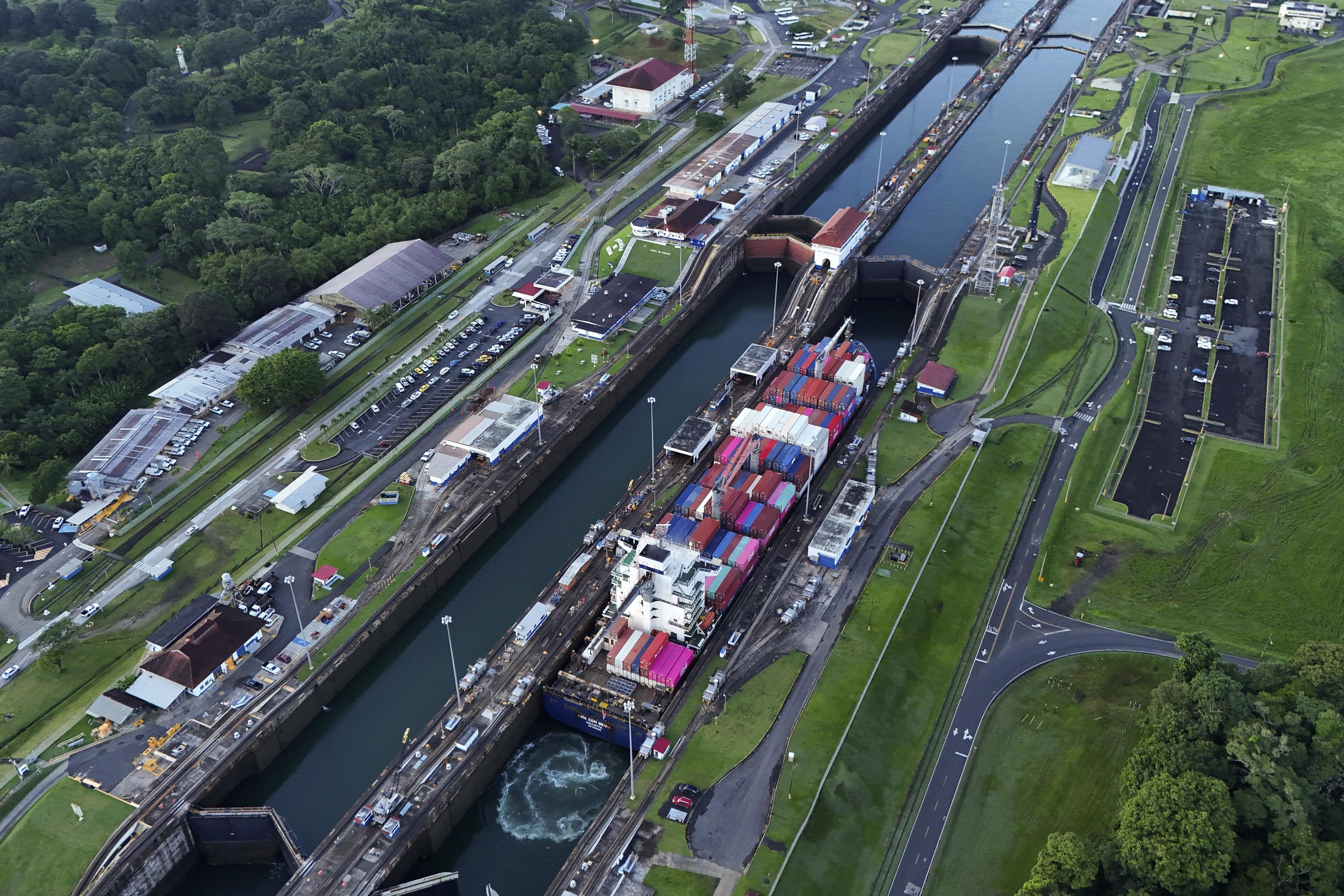
Seen from the skyscraper wall of the most thriving city in Central America, at dawn, over the silver-colored Pacific, a huge line of vessels of all kinds can be seen waiting for their turn to enter the bottleneck of the Panama Canal. Tankers, freighters, cruise ships, container ships, or military corvettes will soon relinquish control to a Panamanian captain, an expert in navigating within the locks, to become one of the 40 ships that cross daily from one ocean to the other.
Although the journey will take them 10 to 12 hours depending on size, thanks to this shortcut, these vessels will save weeks of navigation to the stormy marine roundabout of Cape Horn in southern Patagonia, as well as millions of dollars in logistical costs. This advantage makes this node, a crucial point between North and South America, irreplaceable.
5% of global trade passes through its 80 kilometers in both directions. Since winning the elections for the second time, Donald Trump has put it back on the map, marked with pushpins of key scenarios that interest him the most to develop his particular Monroe Doctrine for control of what he calls "our hemisphere".
Washington is once again looking at the Panama Canal as a vulnerable strategic infrastructure. Accusations of Chinese influence and potential espionage (without evidence) in its surroundings have reopened a debate that seemed closed since 1999: Can Panama maintain the neutrality of one of the greatest human-built infrastructures in all of history?
The canal has always been an infrastructure, but the United States desires it for its indirect military value. It is no longer about trade, but national security. Recent statements from Washington suggest that the canal should return to American hands as a symbol of a return to spheres of influence.
But who does the canal belong to? Since the conquest of America, Spanish explorers who landed on the continent searched in vain for a passage through the mountain range that separates the Atlantic from the Pacific to create a navigable waterway, something that was unfeasible with the technology of the time. The endeavor, although unsuccessful, offered a future idea to the French, who attempted the same, but again with a final failure and this time with a very high mortality rate due to one of the silent killers of the region: mosquitoes that spread malaria and yellow fever, leaving 20,000 dead.
It was US President Theodore Roosevelt who signed a treaty between 1903 and 1904 with the new nation of Panama, already independent from Colombia, granting the United States the right to build and fortify a canal connecting the Atlantic and Pacific oceans. With the help of John Frank Stevens, who built the Great Northern Railway in the US and later served as chief engineer of the Panama Canal between 1905 and 1907, thanks to his design of three sets of locks that fill with water from a lake called Gatun.
On the way to the canal, 15 minutes by car from downtown Panama City, we pass by the barracks of a base where the marines who captured General Noriega lived, the last moment with a strong US presence on the island. The canal passed into Panamanian hands thanks to the Carter-Torrijos agreement in 1977, and the last American soldiers left the island in 1999. Trump wants that to change and is pressuring by land, sea, and air.
His Administration demanded that Panama's ships cross the canal with economic advantages over their competitors, but publicly, President José Raúl Mulino Quintero has refused. The Panama Canal Authority has rejected the existence of an agreement granting preferential treatment or exemption to American ships, although other local sources claim that American vessels have been crossing with discounts for a few months.
Does the US have reasons to claim the canal as its own? It is evident that, thanks to its initiative, the first canal was built, a herculean challenge for the time surpassing any similar feat, like the Suez Canal. But Panama has gone much further. With the construction of increasingly larger cargo ships that could not fit through its old locks, the country embarked on creating a second canal slightly north of the first one, using less water but capable of accommodating those XXL container ships that surpass the size of the Empire State Building and could no longer pass through the old canal. After many years of work with companies from around the world, today the canal is a dual project and is adapted to 21st-century maritime traffic. How could Trump claim a structure in which the US, at least in its most recent part, no longer participated? "The Americans will end up taking it, even if it's with lies," says Diomedes, our taxi driver.
The key word is, once again, "drug trafficking". In the US, many voices link the infrastructure to the illegal drug transport, but the Panama Canal is not a direct route for drug trafficking, although it is indirectly connected to cartel activities as a key logistical infrastructure within global trade.
The relationship works as follows: cartels do not transport drugs through the canal itself, but rather contaminate containers in the ports surrounding it (Balboa or Colon), taking advantage of the huge volume of legal traffic. Cocaine enters from Colombia, mainly from its Pacific coast, is hidden in legitimate cargoes (bananas, coal, coffee, or industrial products), and heads to Europe or the US using maritime routes that connect to the canal system.
Joseph Díaz, prosecutor of the Specialized Drug Prosecution Office of Panama, has stated that "local criminal organizations work with international cartels such as Sinaloa and the Gulf Clan, which finance logistics and coordinate internal operations".
The value of the canal for drug traffickers is not the water, but statistical anonymity: millions of containers, constant rotation, and complex logistical chains that make total control difficult. It is impossible to inspect every container, and if it were done, global trade would come to a halt at unmanageable bottlenecks. That is why the challenge is not the transit itself, but port, customs, and financial security around the canal, where Panama cooperates with the US and Europe. But for Trump, that already serves as an excuse.