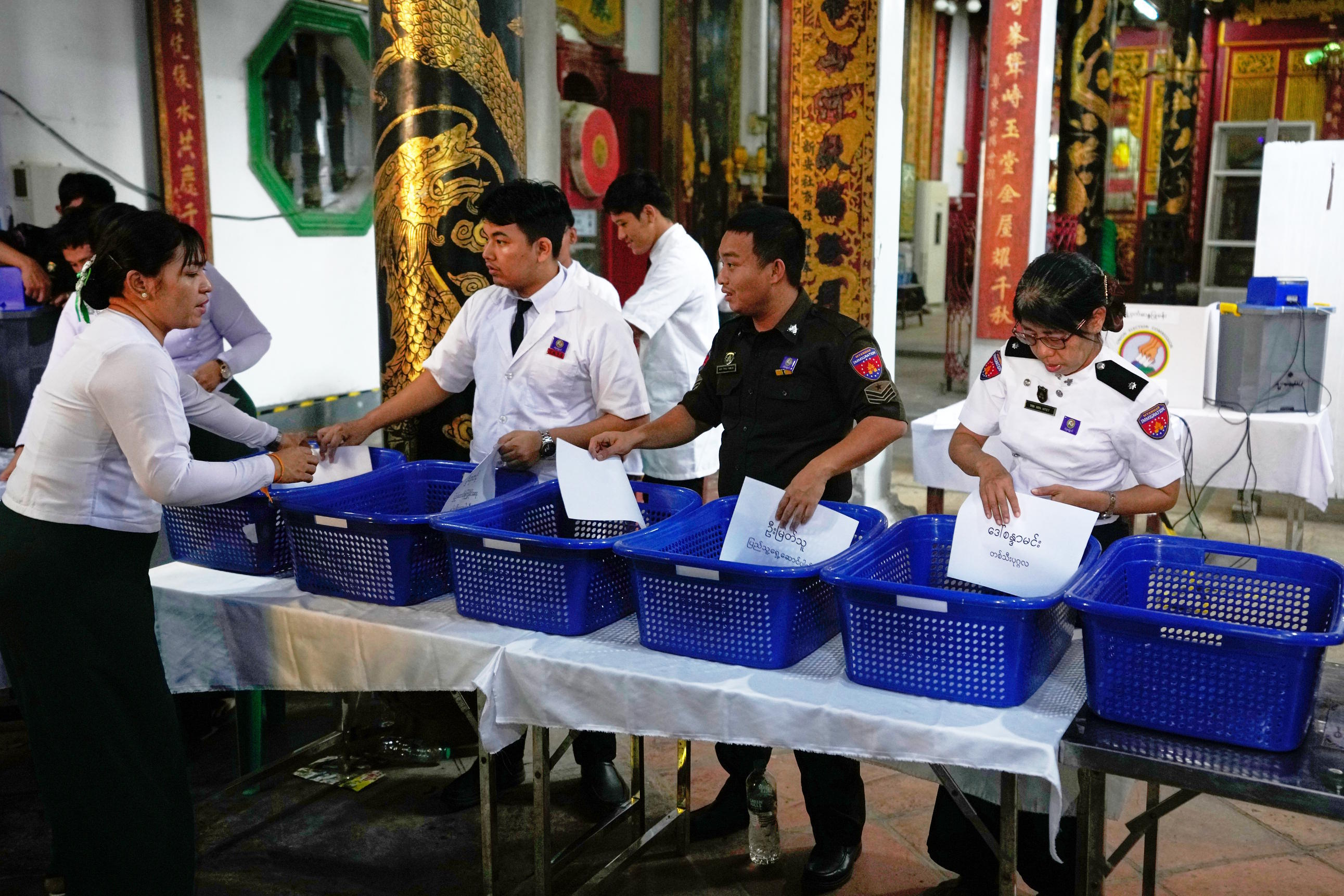
Myanmar, exhausted after almost five years of civil war, repression, and institutional collapse, went to the polls this Sunday in the second phase of an electoral process organized by the military Junta that has been ruling the country since the coup d'état in February 2021. The new vote has reinforced the complaints of the United Nations, Western governments, and human rights organizations, who consider these elections an operation designed to grant legitimacy to the regime.
After the military overthrew the democratically elected government and detained Aung San Suu Kyi, who was then the State Counselor and de facto leader of the country, a popular uprising ensued that led to an armed conflict between the Tatmadaw (the armed forces) and pro-democracy militias and ethnic armed groups. The result has been devastating for this country of 51 million inhabitants: more than 7,000 civilians have died, and the UN estimates that 3.6 million people have been displaced from their homes, in one of the worst humanitarian crises in South Asia.
In this war-torn context, the military Junta is leading a multi-phase electoral process that began on December 28 and will culminate on January 25. In the first round, marked by an official participation rate of 52.13% (an "inflated" percentage, according to human rights organizations, and still much lower than the turnout in the 2015 and 2020 elections), the Union Solidarity and Development Party (USDP), linked to the military establishment, won 90 out of the 102 contested seats in the Lower House.
According to preliminary results, the Junta's party is heading towards an overwhelming victory within an electoral structure designed to exclude any real opposition, especially led by the National League for Democracy (NLD), Suu Kyi's party, which swept the 2020 elections. This party, dissolved along with dozens of opposition groups for refusing to register under the military's rules, established an exiled government after the 2021 coup that has been denouncing the "electoral farce" in recent weeks.
The UN Special Rapporteur on the human rights situation in Myanmar, Tom Andrews, has also described the vote as a farce orchestrated by the Junta. "From any perspective, these are not free, fair, or legitimate elections", he stated. In his view, the process aims to deceive the international community while consolidating military dominance amid persistent violence.
Andrews denounced a pattern of systematic coercion: threats of forced recruitment to pressure young people to vote, intimidation of displaced persons, students, and public officials, and even the use of access to humanitarian aid as a tool of political blackmail. "This is not political participation; it is coercion", he emphasized.
"One cannot speak of credible elections when journalists are muzzled, fundamental freedoms crushed, and thousands of opponents behind bars," reiterated Rapporteur Andrews, who pointed out that the humanitarian situation in the country worsened due to the devastating earthquakes in March 2025, which hit areas already affected by the conflict.
"The USDP is heading for a landslide victory, which is not surprising given how much the playing field has been tilted in their favor," also noted Richard Horsey, Senior Advisor at the International Crisis Group for Myanmar. "This has included the elimination of any serious rival and a set of laws aimed at suppressing opposition to the electoral process".
The Junta argues that the elections will bring political stability and lay the foundations for a more prosperous future for the country. The regime's leader, General Min Aung Hlaing, recently praised the vote as a success and stated that it demonstrated the "strong desire of the people to participate in the democratic process."
However, these statements contrast with the reality on the ground. The military authorities acknowledged that they will not be able to hold elections in at least 65 municipalities and thousands of rural districts where fighting is ongoing, an implicit admission of their lack of control over vast areas of the country.
Beyond the monitored polls, Myanmar is bleeding in a war that is escalating away from the spotlight. While the Junta tries to showcase institutional normalcy, the country's map is fragmenting into a constellation of active fronts where the Tatmadaw no longer imposes its authority as before. Since late 2023, the armed forces have lost key positions to an increasingly coordinated alliance of ethnic armed groups and pro-democracy militias that emerged after the coup.
In the northern and northeastern parts of the country, especially in the states of Shan and Kachin, the offensive of the so-called Three Sisters Alliance - which brings together ethnic armies with decades of insurgent experience - has taken control of military bases, border posts, and vital commercial corridors for the national economy, especially along the border with China.
In the central regions of Sagaing and Magway, historically considered military strongholds, the People's Defense Forces (PDF), largely made up of young people who left their studies or jobs after the military coup, are attacking convoys, sabotaging infrastructure, and forcing the army to disperse resources in a war of attrition. The Tatmadaw's response has been brutal: indiscriminate bombings and village burnings that have emptied extensive rural areas.
The Junta still controls major cities and main airports, but its dominance is increasingly crumbling outside urban centers. The current elections, held only in areas controlled by the military, reflect the fragmented reality: a country where voting has become a manipulated administrative act disconnected from the actual course of the conflict. In this scenario, the electoral process, rather than an attempt at national reconciliation, appears as a defensive maneuver by a regime eager to consolidate its power.