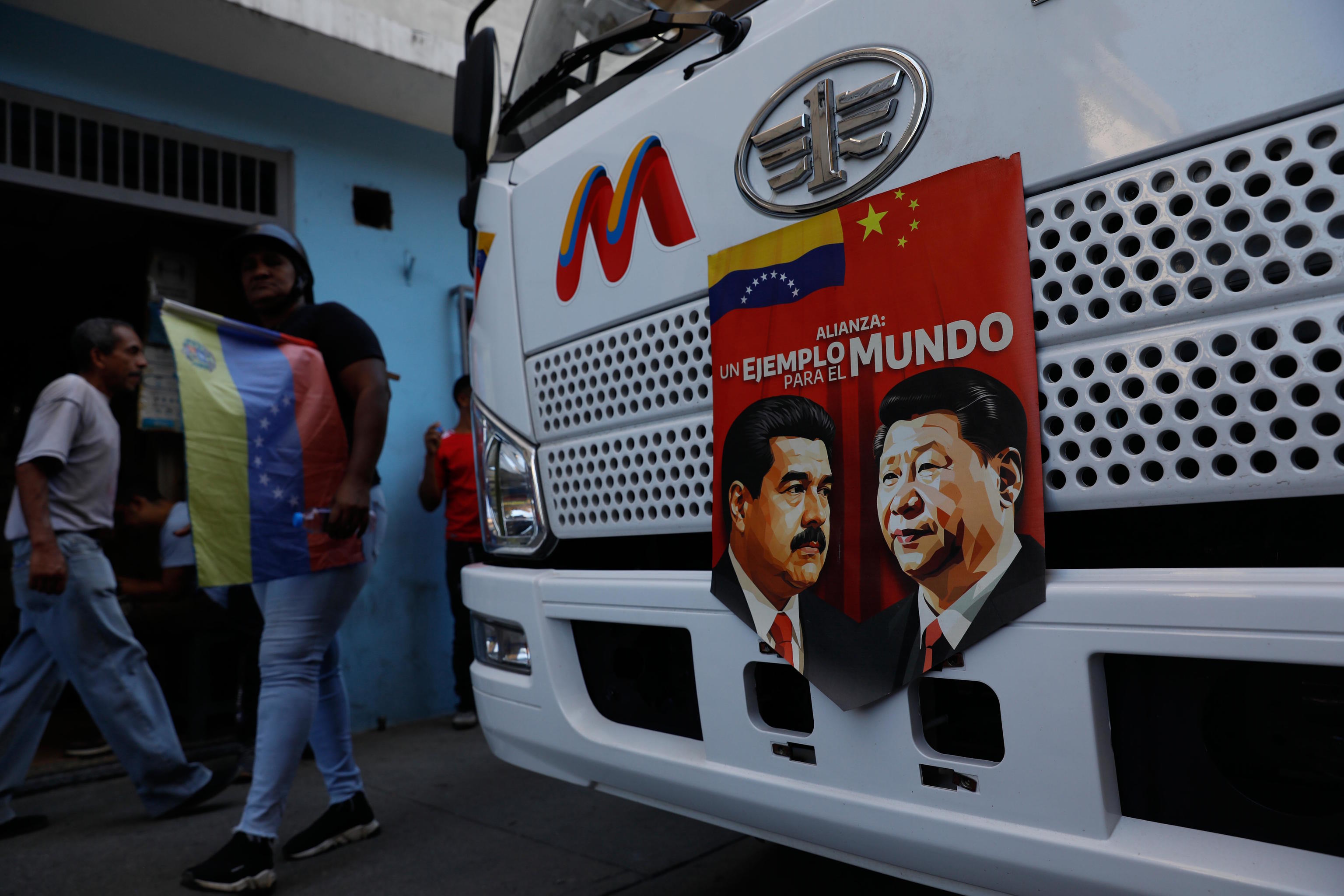
The nighttime attack ordered by Donald Trump to capture Nicolás Maduro has reopened an uncomfortable debate far from Caracas: if the world's leading power can forcibly decapitate a hostile regime in its immediate neighborhood, what prevents China from doing the same with Taiwan?
In Beijing, where every move by Washington is analyzed strategically, there has been a strong reaction against the U.S. attack on Venezuela. Outwardly, unlike the caution and division in Europe, Chinese officials demanded Maduro's release and supported the urgent convening of a UN Security Council meeting.
In China's domestic sphere, editorials in media controlled by the ruling Communist Party (CPC), as well as academics and nationalist commentators on social media, began to draw some parallels between Caracas and Taipei, fueling a desired path for many in the giant Asian nation: the use of force to achieve the "reunification" of Taiwan, the self-governing island of 23 million inhabitants that China has claimed since 1949 as an "inalienable" part of its territory.
The comparison between the Venezuelan and Taiwanese cases came shortly after one of the largest Taiwan invasion drills by the People's Liberation Army (PLA) of China. Since 2022, after the visit of Nancy Pelosi -then Speaker of the U.S. House of Representatives- to Taipei, Beijing has normalized in the strait that separates them military maneuvers simulating maritime blockades, precision attacks on critical infrastructure, and amphibious landing operations.
Some senior Taiwanese officials, consulted by phone by this newspaper, point out that, although the tempting comparison was expected (military superpowers against two much smaller actors, dependent on external support and with limited defensive capabilities), it is also very misleading.
While Venezuela is an internationally recognized state, governed by an isolated authoritarian regime, with a collapsed economy and no military alliances capable of deterring Washington, Taiwan functions as an independent democracy de facto, integrated into the most sensitive value chains on the planet and militarily supported by the U.S. and -probably- by other important regional actors, such as Japan.
While Venezuela is an exporter of raw materials whose main lever -oil- has been sanctioned for years, Taiwan is the epicenter of the global industry for the most advanced semiconductors, essential for the global tech industry. The island is a critical node for international supply chains. It produces over 90% of the most advanced chips. A blockade or invasion by the military would cause an immediate shock in the electronics sector worldwide.
While Trump has ordered the attack on Caracas and an effective surgical operation to capture Maduro without facing consequences so far, Chinese leader Xi Jinping would have to deal with broad international sanctions in the event of a military offensive against Taiwan, which would shake a weakened Chinese economy in recent years due to the real estate collapse and long closures during the pandemic.
Last Thursday, in an interview with The New York Times, Trump stated that the situation in Taiwan does not pose the same type of threat to China as Maduro's regime did to the United States. He also emphasized that he does not believe Xi will make "any moves against Taiwan" during his Presidency, which ends in 2029.
"He [Xi] considers it part of China, and it's up to him what he will do," the American replied regarding the lessons his Chinese counterpart could draw from Washington's military operation in Venezuela. Following Trump's comments, a spokesperson for the Chinese Foreign Ministry said on Friday that "the Taiwan issue is purely an internal matter of China" and that Beijing does not "admit any external interference."
Washington justified the violation of Venezuelan sovereignty and the operation against Maduro by combining accusations of drug trafficking, terrorism, and massive human rights violations, relying on extraterritorial jurisdictions of its judicial system. In the case of Taiwan, Chinese authorities argue that any military intervention would be an internal matter because the island is part of Chinese territory.
This position is reiterated these days by Shen Dingli, one of the most influential analysts in international relations in the Asian country: what happens between both sides of the strait is not an international issue, therefore, the U.S. action in Venezuela is irrelevant to the Taiwanese case. This was also well explained by Ryan Hass, a former U.S. diplomat and researcher at the Brookings Institution think tank: "China has not refrained from using force out of respect for international law but because it has considered a prolonged strategy of coercion without open war more effective."
Diplomats and officials from China and Taiwan consulted these days agree that the parallelism with Venezuela remains parked in the media and on social networks. In Beijing, they are now more focused on presenting President Xi Jinping as a champion of multilateralism and global stability in the face of the chaos left by Donald Trump.
"When Russia attacked Ukraine, Western media spent months publishing erroneous analyses that China would take note of the West's reaction and take advantage of the distraction of that war to attack Taiwan. But now, in the case of Venezuela, these are two completely different social, political, and historical contexts," said a Chinese Foreign Ministry official.
Xi's government has denounced that Maduro's capture has highlighted the accelerated erosion of the rules-based international order and criticizes the lukewarm response from many Western allies of the United States, concerned about not upsetting Washington during trade negotiations. In Europe, there have been some voices in recent days, such as Emily Thornberry, Chair of the Foreign Affairs Committee of the British Parliament, who warned that the lack of a clear condemnation of the U.S. operation in Venezuela could embolden powers like China and Russia. Tong Zhao, a researcher at the Carnegie Endowment, warned in Foreign Affairs that this leniency will further diminish the "moral authority of the West to criticize Chinese coercion."