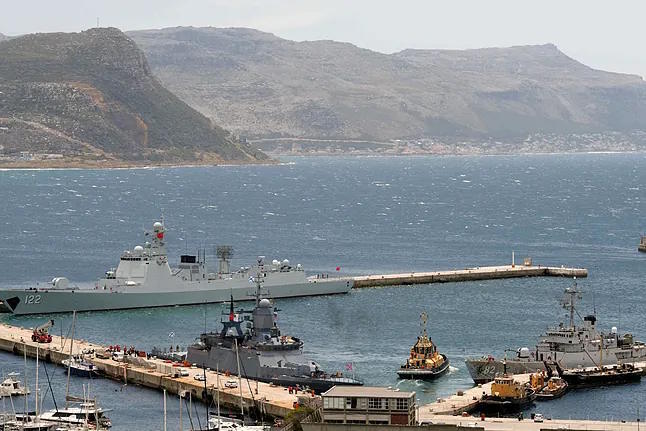
Off the South African coast, in one of the main arteries of maritime trade, at a strategic point where the Indian and Atlantic Oceans converge, the navies of China, Russia, and Iran are participating in joint naval maneuvers these days bearing the hallmark of the BRICS group of emerging economies. The exercises coincide with a moment of increasing fragmentation of the international order and concerning global geopolitical friction, while Tehran is experiencing a tumultuous social explosion, putting the government in the crosshairs of Donald Trump.
South Africa is the host of military exercises, named Will for Peace, which began on Friday and will last for seven days around the Simon's Town naval base near Cape Town. Around a dozen warships and support vessels docked in the port, demonstrating logistical capability and military coordination uncommon in this peaceful region.
China and Iran have deployed destroyers; Russia and the United Arab Emirates, corvettes; while South Africa has provided support with several frigates from its own fleet. Among the most notable military absences are India and Brazil, two founding members and heavyweights of the bloc. Brazil is only participating as an observer, while New Delhi has chosen to stay completely out.
From the Indian capital, several analysts interpret this decision as a calculated move by the Narendra Modi government to avoid further deterioration of its already tense relations with the United States, especially in a context marked by strategic rivalry with China in the Indo-Pacific. Washington closely monitors these military exercises due to the simultaneous presence of Chinese, Russian, and Iranian ships.
Iran officially joined the BRICS in 2024, in an expansion that also included Egypt, Ethiopia, Saudi Arabia, and the United Arab Emirates. This expansion has reinforced the demographic, energy, and economic weight of the group (its members represent over 40% of the world's population and around 26% of global GDP), but it has also increased its heterogeneity and internal tensions, especially with India, which is trying to balance its close diplomatic relations with Moscow and Washington.
Originally conceived as a forum for economic cooperation among major emerging economies, the BRICS are now going through a phase of strategic redefinition. Despite political and security divergences among some of its members, the group seems increasingly willing to coordinate positions and display military strength in response to an increasingly fractured international system.
Many international analysts agree that U.S. President Donald Trump has played a key role in this shift. By repeatedly treating the BRICS as a strategic adversary, Trump would have contributed to giving the bloc an external identity that, despite Beijing's push, it had not managed to consolidate on its own.
The "Anti-American" Bloc
Trump has repeatedly accused the BRICS of acting as an "anti-American" bloc and has imposed additional tariffs - from 10% to 30% - on several of its members. Last July, the U.S. president warned that if the group took on a "real and meaningful" form, Washington would dismantle it "very quickly."
In response, BRICS leaders, with China at the forefront, have adopted an increasingly defiant discourse, denouncing unilateralism, the use of economic sanctions as a political weapon, and military interventions against countries like Iran or Venezuela.
South African authorities explained that this week's maneuvers - including rescue operations, maritime attack simulations, technical exchange, and operational coordination among participating armies - are in response to the need to strengthen cooperation in an increasingly unstable maritime environment and to protect key commercial routes for the global economy. This is the third time since 2019 that South Africa has conducted these military exercises with Russia and China.
However, the South African opposition has strongly criticized the initiative, warning that the presence of ships from countries considered strategic rivals by the United States in national waters will be seen by the Trump Administration as a deliberate provocation, with possible economic and diplomatic consequences.
Bilateral relations between South Africa and the U.S. are at their lowest point since the end of apartheid. Last year, Trump suspended U.S. aid programs, boycotted the G-20 summit organized by this country, imposed 30% tariffs on South African products, and even offered expedited asylum to white Afrikaners. Additionally, without evidence, he accused President Cyril Ramaphosa's government of allowing a supposed genocide against white farmers, a claim widely rejected by the international community.
In this context, the naval maneuvers off the South African coast not only represent a military exercise but also a political signal of the new alignments on the geopolitical chessboard and the growing willingness of the BRICS to project influence beyond the economic sphere.