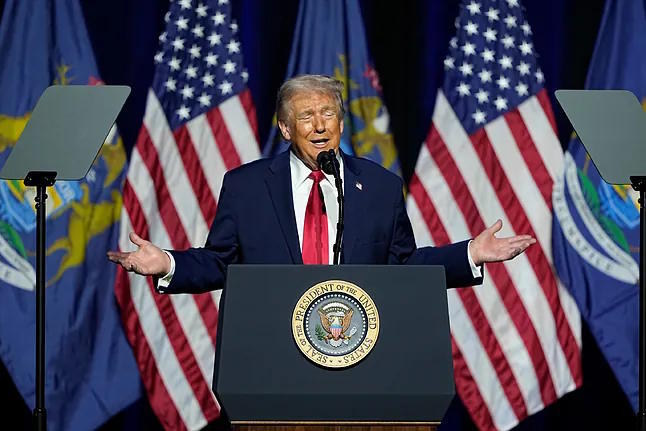
Donald Trump assumed the Presidency of the United States promising a historic shift: leaving behind decades of governments acting as the world's police, intervening militarily in Africa, Europe, or Asia. He insisted that Defense spending was excessive and should be directed towards citizens. However, in 12 months, he has bombed seven countries, captured the unelected president of Venezuela, deployed the largest naval contingent in his hemisphere since the 80s, while advocating for a 50% increase in military budget. Now, amid huge protests in Iran and brutal repression, he is considering using his power to try to force a regime change. "You know, it was a great country until these monsters arrived and took over", he lamented on Tuesday.
The Administration is currently weighing its options. New attacks on nuclear facilities, missile silos, or a massive cyberattack to punish the internet blackout and communication shutdown of the past week are being considered. The White House had generated much interest in the National Security experts' meeting with several ministers scheduled for this Tuesday, suggesting that the President would listen to different possibilities and could make a decision. Trump was not present at the initial meetings, according to his spokesperson, Karoline Leavitt, busy with his national political agenda, but the most important briefing, led by Vice President JD Vance, was scheduled for the afternoon, allowing time for the President to return to the capital in time.
The messages are confusing, but the sense in Washington, as with Venezuela, is that something is inevitable. A logistical problem, pointed out by those against a bombing, is that the United States currently does not have any aircraft carriers near Iran. The quickest option, according to military experts, would be to redirect the USS Abraham Lincoln from the South China Sea, something Joe Biden did in the past and that worries the Pentagon. Another option would be to repeat what was done a few months ago, but that would require a more complicated deployment from much farther bases and without coverage.
As a preliminary step, on Tuesday, the Republican leader suggested to his allies, especially Europeans, that they "should leave there, it's a good idea". And to do so as soon as possible, implying that an attack could be imminent. He did so in response to a direct question, almost improvising the answer while surrounded by workers. But the message was loud and clear in European capitals.
The United States believes this is the best opportunity to overthrow the Ayatollah regime since the 1979 Revolution and does not want to waste it. There is an evident risk that any intervention could strengthen the regime, which already claims that the protests are orchestrated maneuvers by Washington and Tel Aviv. However, the President seems increasingly inclined to take action and not wait. "Iranian patriots, keep protesting! Take control of your institutions! Keep the names of the killers and abusers, they will pay a high price. I have canceled all meetings with Iranian officials until the senseless killing of protesters stops. Help is on the way! MIGA!" he wrote on his social media on Tuesday, playing with the idea of "making Iran great again." Hours later, he repeated it word for word.
The President stated on Sunday that the military option is on the table. The United States will not send troops in any way; the memories of Iraq and Afghanistan are still fresh. But it believes it can destabilize the regime, now weaker than ever, from the air, through intimidation, and by supporting opposition factions abroad. The White House envoy, Steve Witkoff, secretly met over the weekend with the exiled heir, Reza Pahlavi, to discuss the protests, as revealed by Axios. And, just like 23 years ago, he believes that the population would welcome help to end an oppressive government and system.
Meanwhile, and avoiding giving direct clues - in the summer, before the nuclear program attack, he said he would take a few weeks to think about what to do, when the pilots had already received the order to take off - he announced indirect tariffs on all countries that trade with Tehran, with a focus on Russia, India, Turkey, and especially China, the largest importer of Iranian oil, as it was with Venezuelan crude.
"Effective immediately, any country doing business with the Islamic Republic of Iran will pay a 25% tariff on all business conducted with the United States of America. This Order [sic] is final. Thank you for your attention!" the President wrote on his social media on Monday, and reiterated the idea 24 hours later, without providing further details. Hours earlier, his spokesperson, Karoline Leavitt, had admitted that airstrikes were "one of the many options being considered," but that "diplomacy is always the President's first option". Something that, especially after the summer attacks in Iran or the operation in Venezuela, is much harder to believe. "What is publicly heard from the Iranian regime is very different from the messages the Administration receives in private, and I think the President is interested in exploring those messages," Leavitt added.