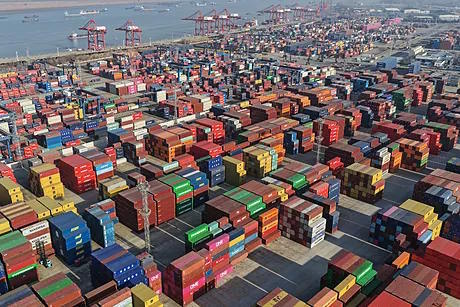
Beijing's annual trade surplus reached a record $1.19 trillion in 2025, confirming the extraordinary capacity of the industrial apparatus of the Asian giant to place its goods in international markets despite the trade war unleashed by Donald Trump.
Far from slowing down China's export drive, the high tariffs imposed by the United States seem to have accelerated a reconfiguration in Chinese factories, which now flood many more markets with their classic low-value-added goods, but also with many more automobiles, electronic products, and heavy machinery.
According to data released this Wednesday by Chinese authorities, exports grew by 5.5% year-on-year in 2025. In December alone, shipments increased by 6.6%, surpassing the 5.9% growth recorded in November, the first month that the cumulative surplus of the Asian giant exceeded one trillion dollars.
Analysts agree that Chinese exporters have successfully redirected supply chains and diversified shipments to more regions, especially to emerging markets, thus compensating for the deficit of orders destined for the US. Chinese exports to Washington fell by 20% throughout 2025, according to customs data. Meanwhile, shipments from China to the ASEAN region (Southeast Asian countries) increased by 13.4% in 2025, to Latin America by 7.4%, and to Africa by 25.8%. Finally, exports to the European Union expanded by 8.4% throughout the year.
Chinese trains advance with increasing momentum towards the heart of Europe. Containers filled with machinery, textiles, appliances, electric cars, solar panels, and industrial components cross Asia driven by Beijing's determination to continue stretching the dependence on the global factory. By sea, large cargo ships from the ports of Shanghai, Ningbo, or Shenzhen unload tirelessly, at an unprecedented pace, in Rotterdam, Hamburg, or Valencia.
China's export muscle not only returned to pre-pandemic levels long ago but has surpassed them by far, straining the response capacity of the European industry, with local manufacturers protesting against an almost insurmountable competition from a growing flow. While Beijing launches its exports to record numbers, Brussels watches with concern what it considers an aggressive expansion in strategic sectors.
"Some key players in the European Union, copying the failed strategy of the United States, are now threatening us with tariffs, believing that this will boost production in their nations. But these measures will not help because we are increasingly manufacturing in European soil," said an official from the Chinese Ministry of Commerce. "We are probably only seeing the tip of the iceberg when it comes to understanding dependencies. I'm not even sure if Europe could manufacture toothpaste without China," said Jens Eskelund, president of the EU Chamber of Commerce in the Asian country, a few days ago.
Throughout last year, China showed the world its two winning cards in the trade war unleashed by US President Donald Trump. On the one hand, control over virtually all global processing and supply of critical minerals and the much sought-after rare earths, essential for the technological industry. On the other hand, the manufacturing and export muscle, key to maintaining the growth of the world's second-largest economy.
According to official data released at the end of 2025, the trains of the China-Europe corridor (connecting 232 cities in 26 European countries) completed a record 120,000 trips, transporting goods valued at over 420 billion euros. China's export muscle also advanced by sea, and did so faster than ever. In October, a container ship opened a new chapter in world trade by inaugurating the route known as the Arctic Express, a journey that radically shortens distances by sailing through the far north. The Istanbul Bridge vessel completed its journey between Chinese ports and its final destination in Gdansk, Poland, in 26 days, halving the usual delivery time.
All this has pushed the new record of the trade surplus of the Asian superpower. "Our trading partners are increasingly diversified, and our risk resilience has significantly strengthened," boasted Wang Jun, Deputy Minister of the General Administration of Customs, at a press conference on Wednesday, attributing China's "solid export performance" to supportive policies and the country's "industrial depth."
Zichun Huang, an economist at Capital Economics, points out that this surplus will continue to increase because the Asian superpower has compensated for the drop in exports to the US with "greater dynamism" in shipments to other destinations, especially Africa, Latin America, and the Middle East.
"Chinese export resilience is explained by two key factors: the rapid geographical reorientation of trade and the growing price competitiveness of Chinese products, favored by an internal deflation environment and a lower real effective exchange rate," the expert notes.
Amid internal storms - the real estate market crisis and stagnant consumption - the persistent state push for exports has managed to make them grow at a faster rate than world trade. Several international consulting firms highlight that through the control of capital flows and direct and indirect interventions in currency markets, Chinese authorities have prevented the yuan - the local currency - from appreciating as classical economic logic would dictate with such a large surplus, thus preserving the external competitiveness of their exporters.
Frictions between Beijing and Washington have moderated in recent months, with Trump and Chinese leader Xi Jinping stretching a trade truce that has given a respite to the two geopolitical titans. But in other important arenas, such as Europe, there are increasingly more voices criticizing the avalanche of Chinese products.
President Emmanuel Macron, after his State visit to Beijing at the end of last year, declared that Europe cannot indefinitely accept "asymmetric" trade, a concern that gained strength in view of the increase in Chinese exports.
In Brussels, there is concern because Beijing is increasingly monopolizing strategic sectors with its electric vehicles, lithium batteries, telecommunications equipment, and advanced industrial machinery. Macron warned that the EU could follow the path of the US and impose tariffs on Beijing if the huge imbalance is not corrected.
"The eurozone is particularly exposed to the negative effects of the increase in Chinese goods supply, which threatens to widen the bilateral trade deficit," says an analysis by Giovanni Pierdomenico, an economist at Goldman Sachs. "We expect that increased Chinese export competition will reduce the real GDP of the eurozone by around 0.5% by the end of 2029," he adds.
According to the bank's estimates, Germany faces the greatest burden, with a forecast that real GDP will decrease by approximately 0.9% over the next four years due to this pressure. Italy is expected to suffer an annual impact of 0.6%, France and Spain around 0.4%.
IMF Managing Director Kristalina Georgieva urged China to correct its economic imbalances, stating that the country of 1.4 billion people is too large to depend on exports for its growth. "China's continued dependence on export-driven growth could exacerbate global trade tensions," she said. Financial firm Morgan Stanley predicts that by 2030, China's market share in global exports could reach 16.5%, up from the current 15%.