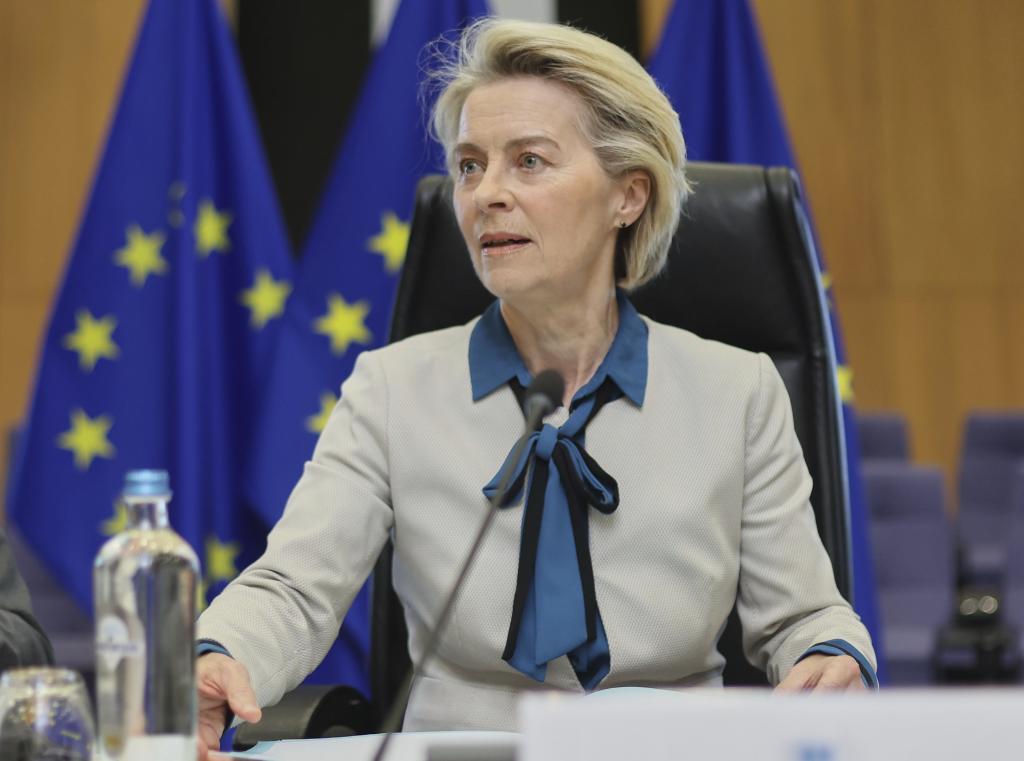
Ursula von der Leyen does not rule out applying Article 42.7 of collective defense of the Treaties of the European Union, which establishes that Member States have the obligation to assist each other and provide military support, in case Donald Trump forcibly takes Greenland. The President of the European Commission has been somewhat ambiguous when asked about this point. Too much for such an important issue that has even been hinted at avoiding at some point. But she has emphasized two points: "Greenland can count on us", and that it can do so "with actions, not just words".
The possibility of applying this article has not always been clear in Brussels as there are certain legal uncertainties given that Greenland is not part of the EU. Denmark is, of course, and the island belongs to the Danish Kingdom, but there are doubts as to whether this means that Article 42.7 can be directly applied.
This week, however, the Commissioner for Security and Space, Andrius Kubilius, referred to this same article when asked about Greenland. "It will largely depend on Denmark, on how they react and what their position is, but there is undoubtedly that obligation for Member States to provide mutual assistance," he stated from Sweden last Monday. And when combined with the words of Von der Leyen and those of the Commission's spokespersons, it is evident that the EU is very aware of this possibility to confront Trump.
Von der Leyen's response came during the press conference where she presented the €90 billion loan for Ukraine, just hours before Danish authorities meet with the Vice President of the US, JD Vance, and the Secretary of State, Marco Rubio, in Washington.
"The Arctic is also of interest to the EU, we have been investing in Greenland for years. We have opened an office in Nuuk, we have an investment program. There is a very good connection, a quality relationship between the EU and the Greenlanders," added Von der Leyen, who pointed out that the territory is part of NATO. This only complicates the situation further, as an invasion by the US would be an attack by one ally on another. So much so that according to the EU itself, "it would be the end" of the Alliance, as Kubilius also mentioned on Monday.
And in the presentation of the aforementioned aid credit to Ukraine, Von der Leyen specified that the €90 billion to be lent to Ukraine in 2026 and 2027 will be divided as follows: €30,000 for budget support and €60,000 for military aid.
"How will they be used? The funds will be used to acquire mainly European equipment and from the European Economic Area (EEA) partners. And if it is not possible to find the necessary equipment in this area, occasionally it may acquire equipment from outside," explained Von der Leyen. This means that Ukraine must first turn to Europe and its partners for the purchase of armaments, and if it does not find what it needs here or in the required volume, it can turn to the United States.
This, undoubtedly, will not please Trump, who always tries to ensure that procurement programs benefit the US industry. An example is the NATO PURL through which allies buy weapons from the US to deliver to Ukraine. However, the Commission's goal is for this loan not only to benefit EU security, as Ukraine is considered the first line of defense against Russia, but also to provide an economic boost and a source of employment and research for Europe.
The measure is the result of the decision that EU prime ministers and presidents made at the last Council meeting last year when Von der Leyen failed to advance her intention to structure a loan based on frozen Russian assets. Belgium's opposition led the leaders to ultimately opt for issuing eurobonds, although the decision was made by 24 countries: Hungary, Slovakia, and Czech Republic were excluded, and these nations will not bear the financial obligations of the loan.
The next step will be for the measure to go through the Council again for this body to approve the way the Commission has structured it and also through the European Parliament. Von der Leyen specified that Ukraine will not be required to repay the loan until Russia takes responsibility for the war reparations. And at the same time, the frozen Russian assets will remain frozen until Putin pays.