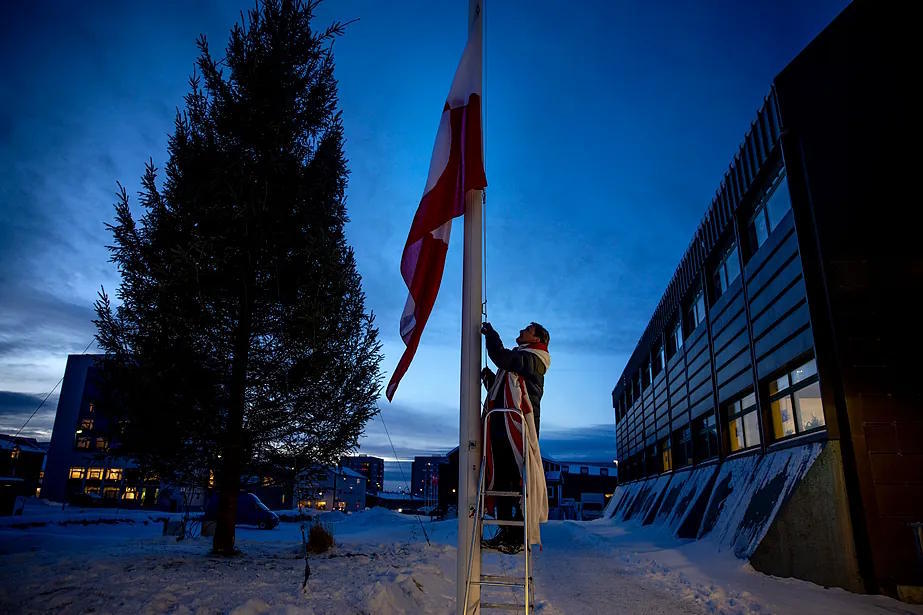
"I value my freedom too much to become an American." Inunnguaq Møller, 40 years old, Greenlandic by birth, reflected on this yesterday while sitting at Café Pascucci in downtown Nuuk with his wife and daughter, watching a debate on the local television about the threats of annexation of the United States to Greenland, a territory that is part of Denmark.
Inuk, as his friends call him, lived in the United States for a year, speaks good English - and acceptable Spanish, after a year of high school in Houston (Texas) - and, until Donald Trump returned to the White House and started talking repeatedly about annexing Greenland, he used to vacation there every summer. So, it can be said that he knows it well. "The freedom in the United States is not comparable to what we have here," he explained. And his verdict was clear: "If this land becomes part of the United States, my wife and I have already decided that our family will move to Denmark or Norway."
While speaking to EL MUNDO, Inuk kept an eye on a debate on the television at Pascucci about the meeting that had just started in Washington to decide the future of Greenland between the United States, Denmark, and the representatives of the island, which has competencies in almost everything except Defense, foreign affairs, and monetary policy. It was a somewhat surreal moment. The nationality of the approximately 15 people - including employees - in the café was being discussed in Washington, 3,200 kilometers away. It was as if the Africans whose future was decided at the Berlin Conference where European powers divided Africa in 1885 had the opportunity to see the prelude to the meeting.
And the Greenlanders knew that was their role. Normally, Pascucci is full by 2:00 p.m. Yesterday, more than half of the tables were empty. People were at home following the meeting on television. And they had good reasons to do so. The meeting that worried them so much ended in total disagreement, with the acknowledgment of "fundamental differences," in the words of one of the attendees, the Minister of Foreign Affairs - and former Prime Minister - of Denmark, Lars Løkke Rasmussen. "For us, ideas that do not respect the territorial integrity of the Kingdom of Denmark or the right to self-determination of the Greenlandic people are certainly totally unacceptable," he emphasized. The only agreement, for now, is "to continue negotiating."
Those words reached Nuuk around 5:00 p.m., local time, when it is already dark in the city, which in January has barely four hours of daylight. But before that, around 3:00 p.m., while Rasmussen was in the decisive meeting in Washington, the television interrupted its debate to switch to a press conference by the Danish Minister of Defense, Troels Lund Pulsen, accompanied, unusually, by the Chief of the General Staff of that country, General Michael Wiggers Hyldgaard.
Pulsen announced the deployment of soldiers to Greenland to protect critical facilities - especially submarine cables, mines, communication nodes, and energy infrastructure - and added that Sweden has already sent troops. Norway has sent two military personnel to coordinate the deployment. Germany will send a dozen. The Netherlands will also participate. The same goes for Canada, a country that has already been threatened with annexation by Donald Trump, and for which an American Greenland would be a major threat, as it would leave it sandwiched between that island and Alaska, with 90% of its population in a 75-kilometer strip of territory north of the border with the US.
Officially, these troop movements are part of the Arctic Endurance operation, to strengthen NATO's capabilities in the increasingly crucial theater of operations surrounding the Arctic Circle. In reality, they are a diplomatic signal to Washington that a unilateral annexation of Greenland would be a mortal blow to NATO because, in practice, and although no one wants to say it, it is equivalent to a declaration of war against an ally.
Although not participating in the exercises, France, as they are not sending - at least for now - ground forces, and the United Kingdom are also expressing their support for Copenhagen. Paris has sent at least one frigate to Greenland, and according to some reports, London has deployed ships to the waters of the western region of the island, where Nuuk is located. Yesterday morning, in front of the Qinngorput neighborhood, about three kilometers from the urban center of Nuuk, the Danish offshore patrol vessel Ejnar Mikkelsen was visible, specially designed to operate in the Arctic. And the day before yesterday, the Danish government declared that, in case of incidents, the soldiers of that country were ordered to shoot without authorization.
This deployment is symbolic. It is evident that, if the United States were to attack Greenland, all forces deployed by its NATO allies would not last even a quarter of an hour. But Denmark and Greenland's goal is to show that they are not alone. And that Donald Trump's expansionism threatens to end NATO.
Whether that matters to Washington is another story. In yesterday's meeting, the US was represented by Secretary of State, Marco Rubio, and Vice President, J. D. Vance. While the former is the most multilateral face of the Trump administration, Vance is almost an enemy of the idea of Europe, having expressed his displeasure at US Navy attacks on the Houthis in Yemen because it opened up the Red Sea to navigation, benefiting commercial traffic to and from Europe.
So the climate of concern and sadness in Nuuk was understandable. Although most of its inhabitants avoid the thousands of journalists from around the world who have appeared in this town of 40,000 inhabitants, which accounts for 70% of the population of an island four times the size of Spain, those who spoke yesterday did not hide their anguish. "In my family, we gathered and talked about this, and we don't know what to do," said a clothing store employee. Although there is always room for hope. Norah, 20 years old, who worked as a saleswoman in a store selling T-shirts with the slogan "Greenland is not for sale," was clear: "We are a small community, but very united. The United States will not annex us."