Jorge M. B. received a message via Whatsapp on December 17th. "Happy holidays," they wished him on a gray poster with three Spanish flags. But that wasn't all. The text appeared superimposed next to a photo of Isabel Díaz Ayuso naked. To be more precise, next to a nude of the Madrid president generated with artificial intelligence. The montage had replaced Ayuso's most intimate anatomy with that of another anonymous woman and, at the whim of its instigator, had added a half-open toasted-colored trench coat. As if it were a voluntary act of exhibitionism and with the intention of aggravating the mockery.
Those who have seen the composition claim that it resembles more those of the magazine Interviú than the typical Christmas ones, despite the excuse-felicitations. However, Ayuso's was not the only AI-manipulated image of a public figure that circulated on social media at the end of the year. Grok, the conversational robot from X (formerly Twitter), began around the same time to generate - or allow users to generate - a volume of sexualized images that did not go unnoticed, as in many cases they involved minors. So, Jorge's and thousands of other citizens' phones could have received a fake erotic pose of Yolanda Díaz, Sara Aagesen, or Irene Montero. Or, why not, a video equally produced with advanced technology (deepfake) of a pornographic nature incorporating the face of any political figure. Active or retired. Alive or dead. Spanish or foreign.
This is how indiscriminate nudification is, a term that refers to both the process of digital humiliation consisting of creating and sharing online portraits - mostly female - without the authorization of the people involved, as well as the industry shamelessly profiting from the dissemination of this hyper-realistic material.
The interest in artificially generated adult content is becoming an overwhelming phenomenon and a global pastime as obscene as it is criminal. In parallel, the sexual objectification of women and minors is reaching unimaginable levels. Indicator, a site specializing in online identity theft, identified up to 85 sites in the first six months of last year that allow anyone to undress effortlessly. These domains received almost 20 million visits and would have brought in over 30 million euros to their operators, according to Indicator's estimates. "It's not that the child seeks porn, it's that porn seeks the child," graphically denounces Miriam Al Adib, an Extremaduran gynecologist and social media educator on sexual education.
On the other hand, researchers from the universities of Oxford and Cambridge confirmed in a study that the 10 most popular websites for viewing sex performed by AI-generated avatars attracted over 78 million visits in just the first quarter of the past year, although independent metrics suggest that the actual traffic was three times higher.
The Home Security Heroes collective, which also works to minimize online vulnerability, has warned that it now takes less than 25 minutes to create a video from a single clear photo of your face or mine. The unstoppable development of general generative intelligence, the commercial orientation of these advances towards dubious forms of entertainment - summarized in the acronym NSFW (Not Suitable for Work) in the Anglo-Saxon world, the free and easy access to most wardrobe apps, and the lack of a regulatory framework to delimit and sanction the alteration of images by third parties would explain the current situation.
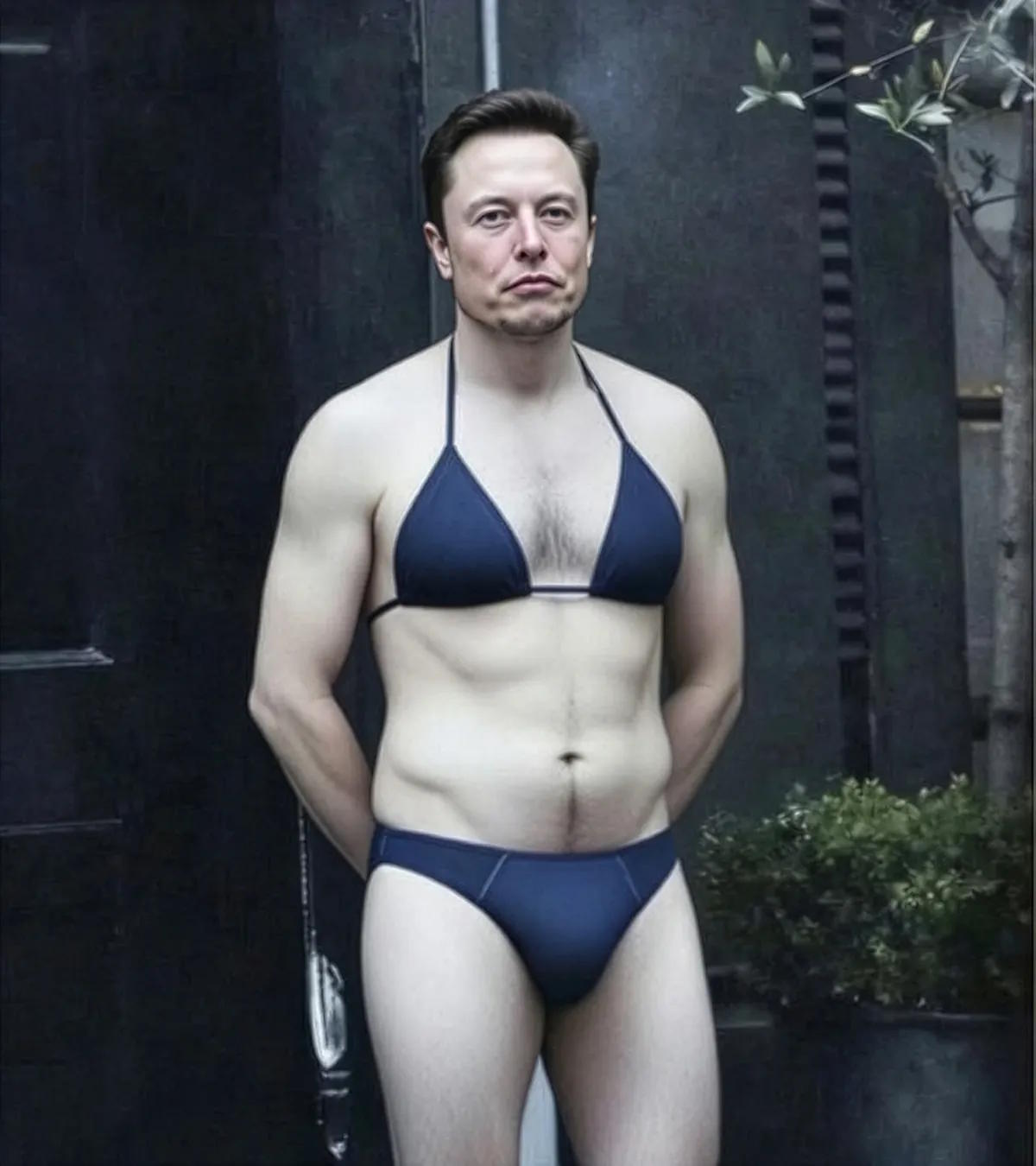
To this must be added the desire of Elon Musk, owner of X, to turn his platform into something completely opposite to its original condition as a virtual agora. The peak of nudification in the transition from 2025 to 2026 left an image for history: that of Musk himself in a bikini after asking his assistant Grok, who falls just short of total undress and sets the limit of image manipulation in the flesh that prevents seeing this swimsuit model. It was a form of social validation that overlooked the serious consequences of violating fundamental rights and with which the tech magnate unconsciously or not, encouraged imitation. Following the automeme, Grok began to churn out almost 7,000 semi-nudes per hour.
Six months earlier, xAI - the company behind Grok - had launched a female character with anime aesthetics created with AI (Ani) that can be asked to stay in underwear and describe sexual interactions. Grok Imagine, the company's AI video generator, has offered a spicy mode (Companion) since August capable of creating risqué clips from text. Some users wasted no time in creating videos of singer Taylor Swift topless.
Musk is not the only Silicon Valley guru who has envisioned the potential business of sexbots. Sam Altman, CEO of OpenAI, has also done so. The +18 mode of ChatGPT is expected to be operational in the first quarter of 2026. It is estimated that the AI-generated adult content industry will move over 2 billion euros this year. A report from the German consortium Global Commerce Media indicates that the business will grow steadily at an annual rate of 27% until 2028.
Tired of being a victim of nudification in Spain and aware that helplessness could escalate, actress Sara Sálamo decided to speak out a few days ago. "For years I have said that I have turned down roles because there are people who take sequences from my fiction films, take them out of context, and upload them to porn sites. That was already violence. I said it as an actress, but above all as a mother. Because it's not abstract: they are my children, their school, what they hear, what they will carry in a few years... Now it turns out that even stopping working is not enough. Because with AI and zero scruples, they can sexualize you again without your consent. Modify your image. Your body. Your gesture. Turn you into an object again...", wrote Sálamo on the same social network where Musk wore a bikini, just hours after he did.
With the intention of challenging the South African billionaire entrepreneur and, in passing, Spanish society, the actress concluded her tweet by specifying that "this is not about technology, but about power. About a culture that believes women's bodies are editable, available, and reusable. That confuses desire with right. And violence with a joke. The serious thing is not the fake image. It's how easy it is to do and certainly how little it scandalizes!!!!".
Elon Musk, owner of the X social network, in a bikini in a montage made with AI by the assistant Grok earlier this year and disseminated by the magnate.
Such a breeding ground prompted the Government on Tuesday afternoon to announce the approval of a draft law on civil protection of the right to honor, personal and family privacy, and one's own image precisely to try to curb it. The text with which the Executive aims to adapt Organic Law 1/1982 to the era of nudification defines deepfakes as "ultrasupplantations made with artificial intelligence" and considers illegitimate the use without express authorization of the image or voice of a person that has been created, simulated, or manipulated with AI or similar technologies.
The draft includes raising the age at which minors must give consent for the use of their image to 16 years, as stated in the law on the protection of minors in digital environments; it criminalizes -punishable with prison sentences of one to two years- the use of technology that simulates "sexually explicit or severely degrading situations" without the authorization of the affected person and with the intention to harm their moral integrity; it establishes criteria for calculating the compensation to which those whose rights have been violated are entitled, which in no case can be merely symbolic; it deems the unauthorized manipulation of image or voice as an illegitimate intrusion in the case of individuals over 16 years old when their dignity or reputation is compromised, even if the person has consented; and it includes the prohibition -through a will- of future use of the image or voice for commercial purposes.
"I value it positively: we need to equip ourselves with legal tools that improve the conditions to address this issue. It is important to consider that while data protection was more regulated, the images of minors and digital identity are also at stake," analyzes Ricard Martínez, Constitutional Law professor at the University of Valencia and director of the Microsoft Chair of Privacy and Digital Transformation. "What I cannot assess, because it requires waiting for the processing, is the quality and systematic nature of the legislative proposal. The problem is that this is a complex reality that affects society as a whole and, at the same time, has very specific implications for two specific profiles: minors and women. This leads me to wonder if we will be able to address those who may need a more focused regulation."
"These are announcements that are not going anywhere because they will not materialize," remarks Borja Adsuara, a digital law expert and professor at the University of Villanueva. "It will take months for it to become a bill, it is simply a government charade to make it seem like they are doing something. The Moncloa Communication Office has identified a debate that could occupy a lot of media space and prevent discussion of other topics. In other words, it is clearly a smokescreen."
Adsuara points out that Articles seven and eight of the 1/1982 law make specific references to social networks or AI unnecessary or redundant in this mess. Furthermore, the fact that the draft is part of the "famous" Action Plan for Democracy promoted by the Government in September against "fake news and the smear campaign of pseudo-media" makes him even more skeptical. "That is the real intention, because what Sánchez does not want is for any media to publish anything about his wife, and he has seen that he has not achieved anything with the right to rectification. The issue of deepfakes is very convenient to divert attention."
More supportive of the initiative is Al Adib. "These are steps in the right direction, but more are needed, and I would like them to be faster," she comments on the new legislative reinforcement. "Having said that, I like that it has become a relevant topic on the political agenda and that all parties seem to agree on its importance."
The gynecologist's voice is not just any voice in the debate on the nudification of minors. In 2022, Al Adib published the guide 'Let's Talk About Adolescence' (Oberon) and in 2025, 'When the Stork Started Watching Porn' (Alienta). Between these two books, in 2023, she experienced the first major mass case in Spain of sexual photomontage facilitated by AI: the one in which a group of teenage students from various schools subjected several classmates in Almendralejo (Badajoz) to false nude images. Among the victims was one of her daughters.
"It was the spark that brought everything to light," acknowledges the researcher and writer. "For a certain sector of the population, we were a group of mothers saying nonsense, and the police did not know how to act because there were no regulations. We filed a lawsuit, and the result was the classification of the crime of child pornography and against moral integrity, which allowed us to rest," she recalls. Fifteen of the minors involved in the manipulation and dissemination of the fake nudes were sentenced to a year of probation and to attend training courses. "Although some said it was a lenient sentence, for me, it was fair because the punishment was appropriate for the children's age."
It is worth noting the sanction proposed by the AEPD -the first of its kind in the EU for the dissemination of a deepfake and framed in an administrative procedure parallel to the criminal one- in the current escalation of nudification. Unlike countries like Indonesia or Malaysia, which have opted for the direct blocking of X after the massive 'bikini scandal,' the UK, France, and Australia have urged their respective regulatory bodies to investigate. Additionally, the European Commission has fined the social network with 120 million euros for failing to comply with transparency obligations in the advertising repository, access to data for researchers, and in the design of its paid version.
This measure has led Musk to take a small step back: he has restricted access to the Grok that undresses subscribers left and right. In other words, to those willing to pay to continue doing so. Thus, the issue, on a smaller scale, persists, always with the underlying tune of Silicon Valley, which shirks responsibilities and insists that the platform is never the one who should face any consequences for creating content, but rather the user/offender.
"I cannot be optimistic because facts show me that I cannot be," rejects Martínez, aware of the impossibility of reining in empires headquartered on another continent and criminals shielded by anonymity. "Furthermore, technological evolution imposes a timing that the State apparatus is impossible to keep up with."
Al Adib, who was invited to speak at the European Parliament and was part of the committee of 50 experts who worked on the draft law for the protection of minors in digital environments, suggests not losing sight of sexual education, regardless of legal adjustments. "We cannot continue like this: 90% of adolescents watch porn, and 90% of their parents believe their children do not. What would I say to an adult who undresses for fun? That just the act of doing it and keeping that image is already a serious crime."
"I am realistic and know that there are things that cannot be avoided, but they can be handled better. Above all, what can be done is education; I am concerned that people do not perceive this as illegal," clarifies Adsuara. "In the 90s, I participated in a forum where there were experts in Photoshop who dedicated themselves to undressing TV presenters, singers... They claimed they did it as a tribute! Back then, you needed advanced skills to make the montage not look too crude. They spent hours executing it; today, a 12-year-old can undress anyone with just a keystroke."
Italy decided to take action by banning ClothOff, precisely the app used by the teenagers from Almendralejo. Could this be a complementary approach? "It is the fastest and most direct measure," acknowledges Martínez. "It would limit the risk and serve as a deterrent for others. I also recall what happened in France with [the Chinese e-commerce platform] Shein, where authorities told them: 'We do not like these child-like sex dolls' and acted accordingly by suspending access. It is a clear message that every company understands and will do whatever it takes to continue operating."
Some argue that the emergence of many new technologies comes with a sexual factor. When Gutenberg invented the printing press in the 15th century, it was quickly used to publish lascivious pamphlets; the first home video tapes were not Hollywood blockbusters but rather pornographic films; on Minitel, the French precursor to the internet in the early 80s, erotic services represented between a third and half of its content; a similar trend occurred with 8mm cameras, cable television, and now AI.