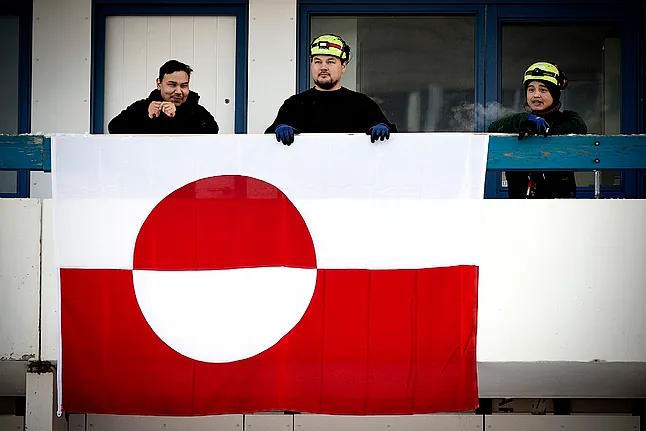
The threats of annexation by the United States have put Greenland's independence on hold. Although the majority of the 56,000 people on the island still support the idea of full self-government, the idea is losing momentum.
A businessman born and raised on the island (a fundamental distinction in Greenland) who prefers not to give his name due to the sensitivity of the debate and the crisis triggered by US expansionism sums up the situation with a strong statement: "The desire for independence of the Greenlanders has tempered due to the situation created by Donald Trump. But political parties refuse to accept it. Since we achieved autonomy in 1979, the identity of these parties has been based on the 'magical thinking' of a Greenland that would one day, always in the future, be independent and self-sufficient, and now they resist change."
The expansionism of the United States has starkly highlighted the difficulties Greenland would face in playing a role in the world. And not only in terms of the security of a territory as large as four Spains but with a third of the population of Madrid's Salamanca neighborhood, but also in the maintenance of the most basic infrastructures of the territory. Add to that the fact that half of the 'quasi-State' of Greenland's Budget comes from transfers from Denmark, because the island does not generate economic activity to sustain itself, and questioning the dreams of independence is almost inevitable.
"Since Donald Trump returned to the White House for a second time and started talking about acquiring Greenland, economic activity has slowed down," explains Dan Sivertsen, Secretary-General of the Greenland Business Association, the island's business association, in his office in the capital, Nuuk. "Companies need stability, and in the current geopolitical climate, we have seen a growing indecision in investments in the tourism and construction sectors," he adds.
This is especially important in a city like Nuuk, which has almost doubled its population so far this century and where housing is "a serious problem, almost as much as in Madrid", as explained with a mischievous smile by Steen Brandt, the number two of another association, KNAPK, the Greenlandic Fishermen and Hunters Association, which represents a sector that accounts for 25% of GDP and 95% of the island's exports.
But Greenland's economic vulnerability has been further highlighted by something much more basic: the electricity supply to Nuuk. At the rate at which the city is growing, the current hydroelectric plant will not be able to meet all the demand by 2033. However, the tender to expand its capacity by connecting it to another has been suspended due to the situation created by the United States, explains Sivertsen. This poses a serious problem. "The works will take around 10 years, so we are already behind schedule. Any delay could create difficulties in Nuuk," concludes the leader of the business association.
For the average person, however, the economic issue is less relevant than that of security. "Of course, I believe in independence. But before, I saw it as something immediate. Now, I think we should wait two decades, until we are economically self-sufficient," explains Malik, a 32-year-old fisherman, at Café Esmeralda, with Chan Chan by Compay Segundo playing in the background, while being served by Thai and Filipino waiters.
This attitude was evident in the elections of March last year, where, for the first time since autonomy was achieved in 1979, the socialist Inuit Ataqatigiit (Community of the People) came to power, in favor of independence but not immediately. Malik is one of those who supported this victory. "I used to vote for Naleraq [the populist right-wing party that advocated immediate independence], but in 2025 I changed, mainly because of the question of whether a sovereign Greenland makes sense right now," he added.
These changes are reflected in some polls showing that support among Greenlanders for breaking away from Denmark may have dropped by more than 10 points, from 67% to 56%, although in the current moment, with all the uncertainty and tensions, any analysis is risky. But what is clear is that the inhabitants of the world's largest island have more urgent matters to think about than independence. Let alone issues like who would vote in a potential referendum to break away from Denmark: only Greenlanders? Or also Danes who have been on the island for a certain period? And among the former, do those with Danish parents count to cast their vote? All this without considering the growing colony of Asian immigrants working in services because the people of Greenland, despite complaining about Danish immigration, also need to bring in labor from other countries.
Thus, independence has been tempered by geopolitics. Not because Nuuk has suddenly reconciled with Copenhagen - which recognizes Greenland's right to self-determination and sees itself as 'on the way out' - but because threats have been recalculated. In a territory of around 57,000 inhabitants, with vast distances, limited infrastructure, and a State still under construction, independence is not a symbolic act. It is a massive transfer of functions: collecting taxes, regulating, negotiating treaties, controlling investments, managing borders, maintaining public services, and, if necessary, building security capabilities. In this scenario, the threat of annexation does not cancel the national dream, but it places it under scrutiny: is the country ready to stand alone just when it attracts more attention?
This logic is compounded by the well-being factor. Almost half of Greenlanders would halt the sovereignty project if their standard of living worsens. This condition weighs especially when external threats increase uncertainty: investment, tourism, transportation, prices, and employment. Politics, in small societies, is governed by daily barometers. And geostrategy, no matter how grandiose it sounds, becomes domestic when it translates into flights, food, and heating.