The debate in Congress regarding the situation in Venezuela highlighted the contradictions, fears, and confusion among parliamentary groups and the government in the face of new international scenarios, their consequences, and the stance to take to address them.
There are no middle grounds or room for common positions. Nobody knows how to confront a situation where two aspects intertwine: on one side, the unilateral actions of the US bypassing international legality to impose its interests, and on the other, the condemnation of tyrannical regimes like that of Nicolás Maduro who flagrantly trample on the rights of their people.
Which weighs more? Spanish representatives each cling to one side of the scale without finding a balance point. The government and its left-wing partners criticize the first part of the equation, while the opposition defends the second.
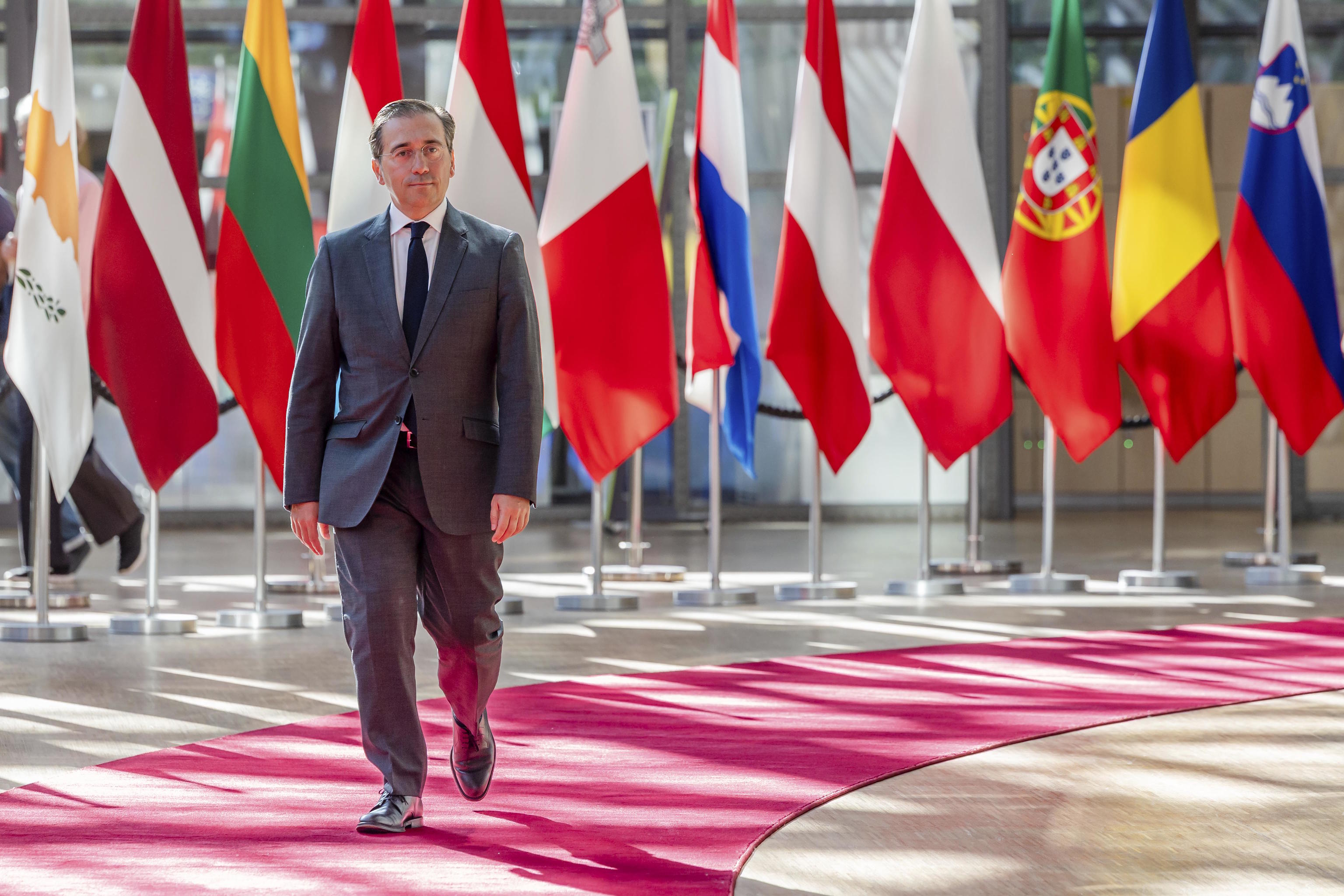
Foreign Affairs Minister, José Manuel Albares, denounces the violation of international law, the breach of the United Nations Charter, and the attempt to shape a world divided into spheres of influence, clearly alluding to Donald Trump's policies, whom he did not explicitly name yesterday.
"The situation is very serious," he said, referring not only to recent events in Venezuela but also to Gaza, Ukraine, Iran, and Greenland, territories all threatened in his view by a "predatory" US. Spain, he said, "will not resign to an order of injustice, arbitrariness, and violence."
But while boasting firmness against Washington, Spain remains undecided. Albares' reflections on European defense gain more relevance as France, Sweden, Germany, Norway, and the Netherlands decide to deploy troops in an "observation" operation in the Arctic within a Danish military exercise that clearly aims to show the US that Europeans have the capacity to patrol, control, and defend those waters and Greenlandic territory. In parallel, Defense Minister Margarita Robles, echoing the words of her Foreign Affairs counterpart, hinted at the possibility of Spain joining the military operation of its partners. However, without specifying anything and postponing the decision, contrasting with the leadership already shown by other European countries and contradicting the autonomy defended by Albares and Robles - she demanded yesterday that Europe take a firmer "political" stance against Trump.
Albares, in Thursday's monographic session planned to analyze the situation in Venezuela, actually spoke little about the Caribbean country and did not propose any concrete measures to promote a transition to democracy beyond emphasizing slogans such as "the future must be decided by Venezuelans themselves," that Spain will always stand "by a brotherly people," and insisting that the government of Pedro Sánchez has done the most for them by releasing prisoners and welcoming refugees, unlike the previous PP government, which, in his opinion, "did not lift a finger."
The minister prefers to focus on the dangers posed by Washington's new imperialist policy. In response, he proposes creating a vague Global Alliance for Multilateralism to "defend international cooperation and the peaceful resolution of conflicts" and advocates for boosting European "sovereignty" in all areas: political, economic, and also military.
His message hints at a distancing from the NATO, dominated by Americans, especially when he insists that the EU must "assume responsibility for its own security and deterrence" by creating a "European Army."
From his words, it can be inferred the design, once again, of a two-speed Europe in defense matters: "We must progress towards having our security in our own hands, starting with intermediate steps such as integrating the defense industry and forming a coalition of volunteers for Europe's security with those willing to advance faster."
The idea did not go unnoticed by the more radical left-wing groups, who openly advocated for Spain's exit from the Atlantic Alliance, the closure of US military bases, and the isolation of the United States.
Thus, in the parliamentary exchange, the name Greenland was almost more heard than Venezuela. For Europeans, and also for the Spanish government, the concern is mainly focused on what will happen with the vast icy island desired by Trump.
In contrast, the Popular Party opposition almost exclusively focused on the Venezuelan issue. The PP chose Cayetana Álvarez de Toledo, the most outspoken voice against chavismo in their ranks, to respond to Albares.
The popular deputy praised the fall of Nicolás Maduro "thanks," she emphasized, "to the US" and did not hesitate to express her wish that the next dictatorial regime to meet the same fate be Cuba's. In her view, the Spanish government shows its "hypocrisy" when criticizing Washington but tries to take credit for the releases of prisoners facilitated by US intervention.
Álvarez de Toledo criticized former President José Luis Rodríguez Zapatero, closely linked as a "mediator" to the chavista leadership for a decade. She accused him of "trafficking" with prisoners and being a "lobbyist," while pointing to Pedro Sánchez as a "whitewasher of the Venezuelan dictatorship and destroyer of Spanish democracy."
The Popular Party spokesperson reproached Albares for his criticism of US actions, labeling it as "jungle law," when, however, he did not hear similar remarks regarding the abuses and crimes of Maduro. According to the Popular Party, the government and its partners "invoke international law hypocritically."
Álvarez de Toledo insisted that the 2024 Venezuelan presidential elections were already a demonstration of the sovereignty of Venezuelans and accused the government of responding to the election results by "removing the legitimate president from the country," that is, the election winner, Edmundo González, recognized by most of the international community.
"Everything adds up," concluded the PP deputy, "to an immoral and ineffective policy that has always favored the dictatorship. You never had the will or courage. Now you want to release Delcy [Rodríguez] and lift the sanctions. The socialist government wants to recycle the chavista regime; they want everything to change so that everything remains the same."
In Álvarez de Toledo's opinion, the now "acting president" under Trump's tutelage, Delcy Rodríguez, is "Maduro's other side," while opposition leader María Corina Machado "is the undisputed leader of Venezuela." The Popular Party deputy concluded her intervention by stating her desire to see Maduro "back in Venezuela, with Delcy, Jorge Rodríguez, and Diosdado Cabello." "All four," she emphasized, "at El Helicoide."