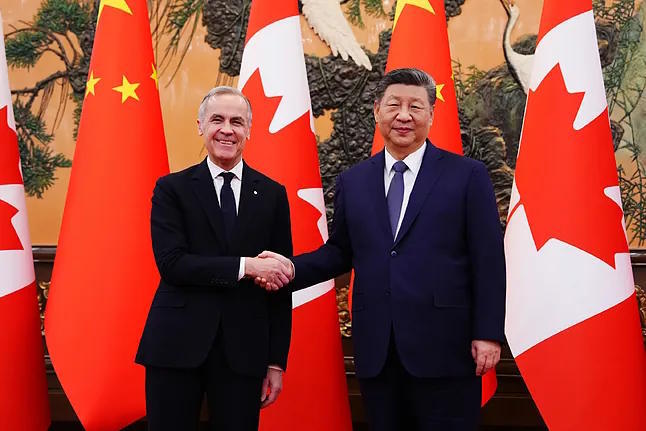
As China intensifies its efforts to court traditional U.S. allies, President Xi Jinping welcomed Canadian Prime Minister Mark Carney in Beijing, whose statements reveal how much the weight of the Asian giant has become unavoidable in an increasingly disordered geopolitical landscape, shaken by the unpredictable shifts and impulses of American President Donald Trump.
"Together we can create a new relationship that adapts to the new global reality," were Carney's first words during his meeting with Xi on Friday. The Canadian spoke of a "new strategic partnership."
It was the first visit by a Canadian leader to China in almost a decade and comes after several years of virtually frozen relations between the two countries. In the background, Canada's diversification of its trade structure to reduce its dependence on Washington, especially after the trade war unleashed last year by Trump.
"A new relationship between China and Canada could bring security and prosperity to both nations," Carney argued to Xi. "We are willing to continue our efforts to further improve relations and lead them on the path of healthy, stable, and sustainable development," responded the Chinese president.
This was the second time Xi and Carney have met in the last three months. At the end of last year, they held talks at a regional summit in South Korea, where Xi expressed his desire to "make up for lost time." That meeting opened a door that the Canadian government has now decided to walk through.
The tense scene that everyone witnessed on the sidelines of the G-20 in Bali in November 2022 seems far behind. Cameras captured Xi reproaching then-Canadian Prime Minister Justin Trudeau for details of a private conversation that had reached the press. The message was clear: trust, he said, is built with discretion and mutual respect, not with leaks. Trudeau, visibly surprised, tried to respond by appealing to the need for "open and honest dialogue." But Xi concluded with a statement that sounded like closing the case: "Without sincerity, it is difficult to talk."
Canadian media have analyzed in recent days how Carney's trip represents more than a diplomatic gesture: it is an attempt to rebuild bridges with Beijing in a moment of global tension, with the unpredictable neighbor Donald Trump. This context is key to understanding Ottawa's approach to its second-largest trading partner after years of diplomatic crises.
A day before meeting with the Chinese president, Carney was received by Prime Minister Li Qiang. They signed memorandums of understanding on various topics, including energy, construction, and food security. The Canadian wrote on social media that over 400,000 jobs in Canada were supported by the bilateral trade relationship with China.
"Here in Beijing, I am meeting with government and business leaders because we want to take advantage of that situation: open new markets and create new opportunities for Canadian workers and businesses," he wrote.
Bilateral relations between China and Canada broke down in 2018 when Canadian authorities arrested Meng Wenzhou, the chief financial officer of Huawei and daughter of the founder of the Chinese telecommunications giant, in Vancouver at the request of the U.S. In response, Beijing immediately detained Canadian diplomats and businessmen Michael Spavor and Michael Kovrig, who spent over 1,000 days imprisoned in China on espionage charges.
Now, Carney's government is trying to turn the page, while Xi's administration continues to expand its diplomatic offensive, taking advantage of Trump's bellicosity and mercantilism in foreign policy. In the last two weeks, Xi has welcomed the leaders of Ireland, South Korea, and Canada in Beijing.
Against the Trump hurricane (the capture of Maduro, threats to Greenland, and military intervention in Iran), the Chinese regime's narrative aims to portray Beijing as the great bastion of stability: without unilateral military operations in third countries and with speeches that appeal to international law.