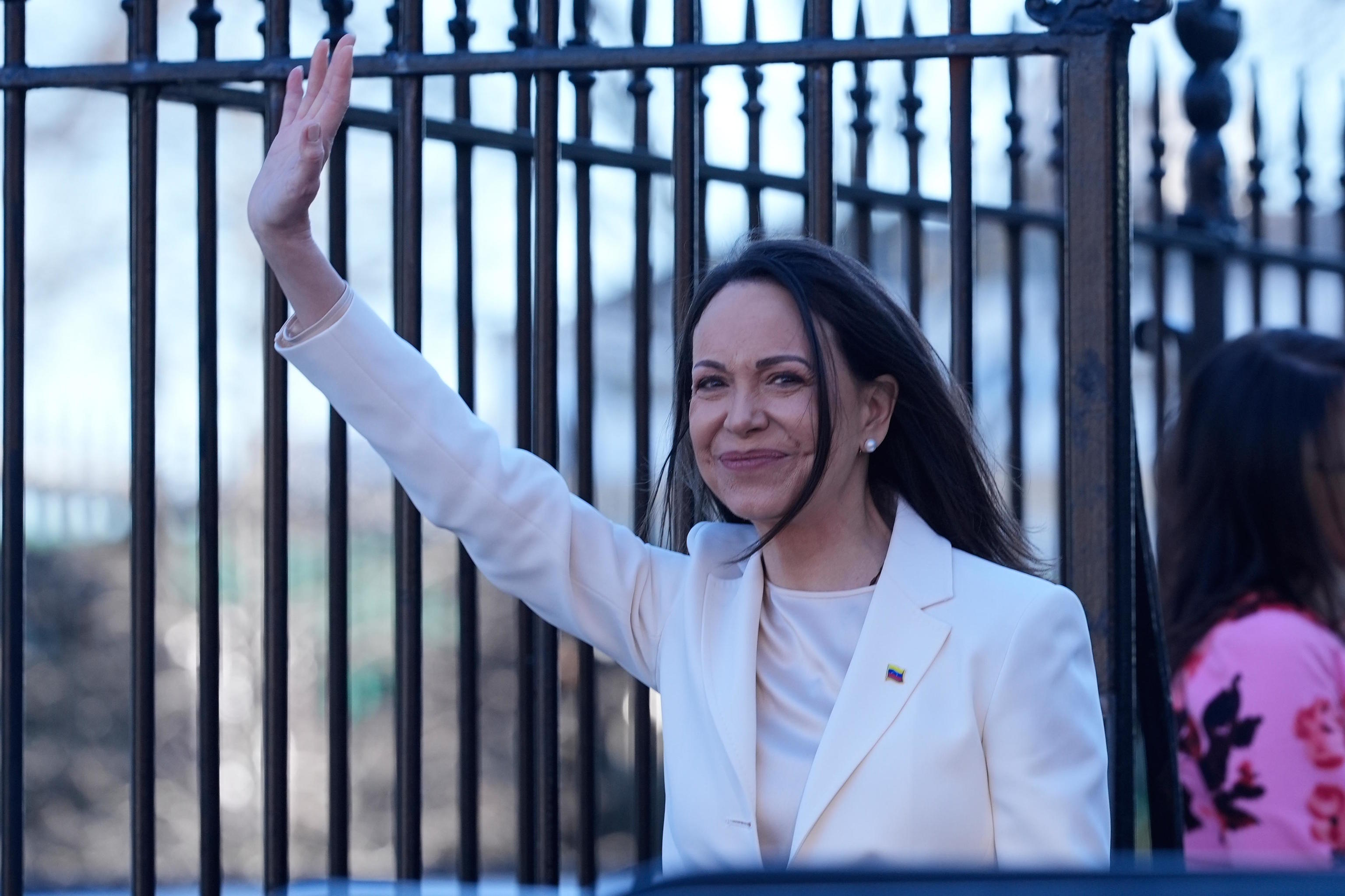
President Donald Trump received Venezuelan opposition leader María Corina Machado at the White House on Thursday. It was not her first time at the iconic building, as George W. Bush invited her over 20 years ago, but it was her most important political meeting and the first face-to-face with the MAGA leader. It was a discreet meeting, without the reception given to heads of state or government. And without the presence of the press, as Trump usually does with his most prominent guests.
The president's team has done everything possible to make it clear that it was little more than a courtesy visit and that the administration has no intention of changing course, at least in the short term. However, Machado, who presented the US president with her Nobel Prize medal "in recognition of his unique commitment to our freedoms," has given a much more optimistic version. "We count on the president for the freedom of Venezuela," she said, stating that she delivered a critical message: "Venezuela has an elected president" and she, along with Edmundo González, will continue working for "freedom, rule of law, and elections" soon.
The situation is far from comfortable. Machado's team has sought the earliest opportunity to try to convince the US government that forcing a regime change is in everyone's best interests and that they should not make Delcy Rodríguez their definitive interlocutor for Venezuela's future and its oil reserves. Or at least, if that is not achieved, to lobby for Washington to increase pressure to achieve the release of thousands of political prisoners. "I just had an extraordinary meeting with President Trump. I know there are concerns about what has happened in Venezuela. January 3 changed the history of our country forever, and for the better (...) This administration understands that, if we want Venezuelans to return, we must rebuild institutions, respect human rights, guarantee freedom of expression, the rule of law, and a new authentic electoral process," she stated shortly after meeting with senators from both parties in the Capitol. "I have insisted —and will continue to insist— that Venezuela has an elected president, and I am very proud to work alongside him."
On the other hand, there was much less enthusiasm. "The president was looking forward to this meeting and hoped it would be a positive conversation with Mrs. Machado, who represents a prominent and brave voice for much of the Venezuelan people. The president was looking forward to talking to her about the country's reality and what is happening," spokeswoman Karoline Leavitt said in a briefing once the lunch between them had started. "He is committed to a transition and hopes there will be elections someday, but we cannot offer a timeline," the spokeswoman added when asked by journalists if he was distancing himself from the process. "The president told us that he cares about the suffering of Venezuela," Machado affirmed after concluding her meetings in the Capitol. "You can be sure that he is committed to the freedom of political prisoners," she guaranteed.
Today's visit was preceded by very negative signals for Machado. In an interview with Fox News on January 5, she admitted that her last conversation with Trump was on October 10, the day of the Nobel Peace Prize announcement. Trump reiterated then that Machado was "very kind," and although his administration helped her leave the country and travel to Norway coinciding with the Nobel ceremony, the ties are not strong with the Republican leader. That is why she went to Washington this time with a medal and a commemorative plaque of the Nobel Prize, trying to ingratiate herself with Trump, who said just a few days ago that he would gladly accept the prize if she gave it to him, as he considers it one of the greatest injustices imaginable that she was awarded it and not him. "200 years ago, General Lafayette gave Simon Bolivar a medal with the face of President George Washington. Since then, Simon Bolivar never parted with it. He always kept it. 200 years later, the people of Bolivar, his heirs, give to the President of the United States, heir of Washington, the Nobel medal as a recognition for his commitment to our freedom."
Since the operation to capture Nicolás Maduro, Trump has only had good words for Delcy Rodríguez. On January 3, he said they were already in contact and that she and her team "were behaving very differently from the past," reaching out and explaining why he believes it is better for the US to work with the heirs of the previous regime. But yesterday he went even further: "We just had a great conversation, and she is a great person. She is someone we have worked very well with. Marco Rubio is dealing with her. I dealt with her this morning. We had a call, a long call (...) she is a fantastic woman," he praised the regime's number 1, downplaying the lack of democratic transition.
"The president spoke directly with her this week, as you know. Secretary Rubio and the administration have been in constant communication with Delcy Rodríguez and other members of the interim government of Venezuela. They have been extremely cooperative. To date, they have met all demands and requests," Leavitt said when asked about what seemed like a friendlier treatment with the interim leadership than with the opposition.
Trump seems to have clear priorities and a completely pragmatic approach, focused on stability and access to natural resources rather than democracy. On the same day he said he was working well with the heirs of Chavismo, Trump unequivocally dismissed Machado as a possible national leader: "She is a very kind woman but does not have the respect or support of the people."
The last time he spoke of her was after the Nobel Peace Prize was awarded, showing his displeasure at not being the winner. And in an interview with Reuters yesterday, Trump reiterated his cold stance, saying that Machado is a "very nice woman." "I have seen her on television. I think we will only talk about the basics," he said regarding Thursday's meeting. "The president's evaluation [of Machado not having the necessary support and respect] was a realistic assessment, based on what he was reading and hearing from his advisors and national security team. At this time, his opinion on that matter has not changed," the White House spokeswoman emphasized in her press briefing.
From the White House and the State Department, as well as from Congress (Machado will meet with senators and congressmen on Thursday night), the work of María Corina and Edmundo González, among others, has been acknowledged in the past. But the view seems to be that the last elections, the ones that Maduro and his government stole, are not legitimate. And that includes not only the Bolivarians but also the opposition that aimed to immediately replace the ousted regime.