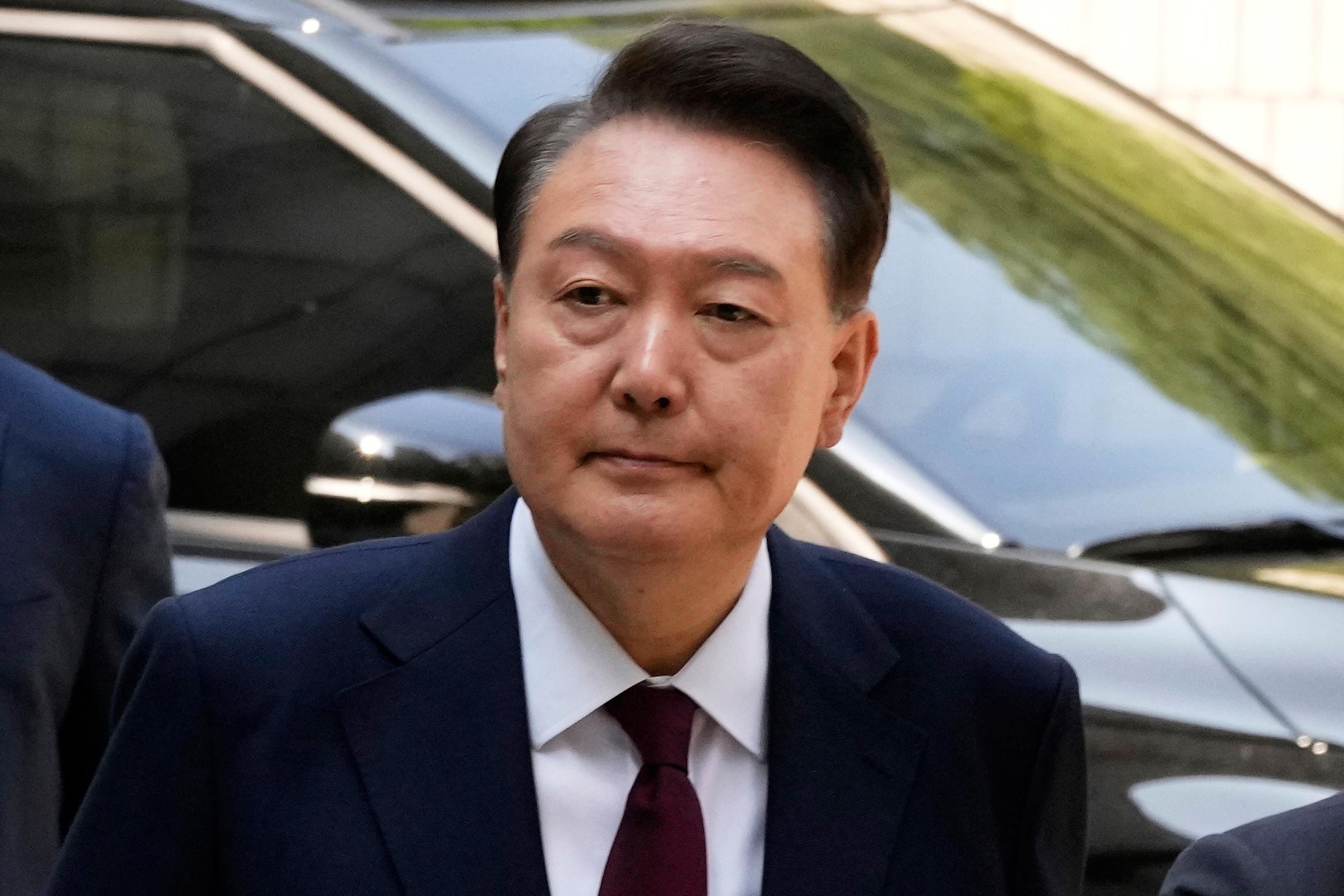
The long judicial ordeal facing former South Korean president Yoon Suk Yeol has reached its first verdict: a Seoul court has sentenced him to five years in prison for obstruction of the execution of an arrest warrant, abuse of power, and fabrication and destruction of official documents.
Yoon (65 years old) plunged South Korea into an unprecedented institutional crisis with a declaration of martial law in December 2024. This led to protesters and lawmakers forcibly entering the Parliament to push for a vote against the authoritarian decree, which was quickly declared unconstitutional by the Supreme Court.
The conservative leader was subsequently charged, removed from office, and imprisoned. He has always maintained that everything he did was part of a plan to "restore democratic order", claiming that the country was under siege by the opposition and "anti-state" forces.
The case resolved on Friday revolved around a key episode: Yoon's attempt to prevent his own arrest when investigators came to apprehend him in January of last year. Following the failed martial law, Yoon barricaded himself in his residential complex and ordered his bodyguards to prevent investigators from arresting him.
According to the prosecution, the former president ordered the Presidential Security Service to block the execution of the arrest warrant, using a state body as his personal shield. For the judges, this was not a defensive maneuver but a direct violation of the rule of law.
The special prosecutor's team, led by Cho Eun-suk, requested a ten-year prison sentence last month for obstruction of justice and other related crimes. In their final argument, Cho accused Yoon of committing a "serious crime" by "privatizing" public institutions to conceal and justify allegedly criminal acts.
Yoon was also accused of violating the rights of nine ministers who were excluded from the meeting where the plan to declare martial law was reviewed, a move that even took part of his own cabinet by surprise. Additionally, the court supported another accusation that the former president drafted a revised version of the martial law decree after its withdrawal and subsequently ordered the destruction of that document.
This is in addition to the order to disseminate press releases with false information, including messages directed at international media, as well as the deletion of phone records used by senior military officials during those critical days.
Yoon still faces another sentencing scheduled for next month for the most explosive charge: leading an insurrection. In that trial, prosecutors have gone even further and this week requested the death penalty, a request that has shaken public opinion and reopened the debate on the use of such extreme punishments in South Korea.
Prosecutor Cho argued that Yoon was guilty of inciting riots and unlawfully declaring martial law, despite the country not being in a national emergency. The former president has denied the charges against him, arguing that he was acting within his authority as a leader to declare martial law.
"It was not about suppressing the people, but an effort to preserve freedom and sovereignty, and restore constitutional order," he emphasized. The former president has insisted that the martial law was intended to highlight the systematic obstruction of his government's initiatives by opposition parties, which held the majority in the National Assembly (Parliament).
The insurrection trial will be resolved on February 19, but it will not be the end of Yoon's legal journey. The former president faces a total of eight trials related to the attempt to impose martial law, alleged corruption cases involving his wife, and the death of a marine in 2023, a matter that also implicates his administration.
Yoon's trial is being broadcast live, underscoring the exceptional nature of this moment in the process. This is not the first time this has happened. In 2018, South Koreans were able to follow on television the sentences against former presidents Park Geun-hye and Lee Myung-bak, both convicted of corruption. Now, the Asian country once again looks to the courts to gauge the strength of its institutions after one of the most turbulent episodes in its democracy.