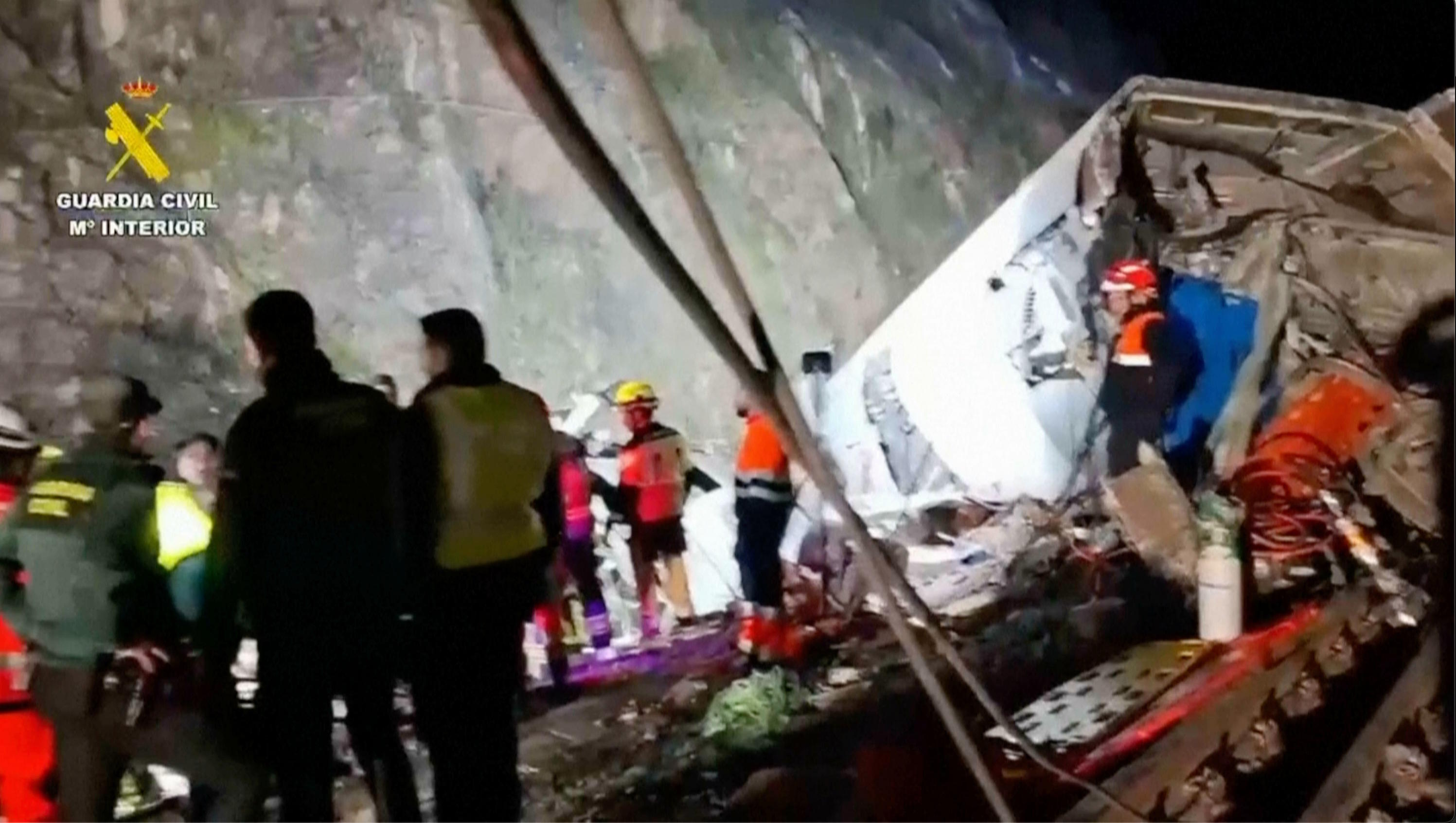
At least 39 dead, including the driver of one of the trains, 122 injured with 48 still hospitalized, is the toll of the collision around 7:40 pm on Sunday between two high-speed trains in the town of Adamuz, in the province of Córdoba, 37 kilometers northeast of the Andalusian city in Spain. Among the hospitalized are, according to the latest report from 112 Andalucía, five minors, with one in the ICU. 74 people have already been discharged.
According to initial reports, the Iryo 6189 train, which had departed from Málaga at 6:40 pm bound for Madrid-Puerta de Atocha, derailed at the entrance switches of track 1 at the Adamuz station, invading the adjacent track around 7:38 pm.
At that moment, another long-distance high-speed train from Renfe, the Alvia 2384, traveling southbound from Puerta de Atocha to Huelva, was on the same track invaded by the Iryo and collided violently with it. Reportedly, the last inspection of the derailed Iryo train took place just four days ago. The company announced this morning that it has canceled all its activities at Fitur to fully cooperate with the investigation commission.
The speeds at which both trains were traveling are unknown, but the hypothesis is that they were not at maximum speed, which could have prevented an even more catastrophic outcome, considering that at least 317 people were on board the Iryo. The most affected cars of this train were numbers 6, 7, and 8. The Alvia train collided head-on with them. The driver of the Alvia train is among the deceased in the accident, as confirmed by Renfe sources to Efe.
This morning, the Civil Guard is working at the accident site to gather evidence to identify the victims and clarify the possible causes of the accident. They have also opened an office in the capital of Córdoba for the relatives of the victims to report their disappearance and provide DNA samples for identification purposes.
The first reports already indicated a complex emergency response, suggesting a high number of victims. The 061 emergency service deployed a large operation with five mobile ICUs, a logistical support vehicle, and four Critical Care Emergency Units. A field hospital was also set up at the scene. The initial victim count pointed to two fatalities, a total of 25 serious injuries, and dozens of people trapped in the trains. Quickly, around 9:30 pm, the death toll rose to five, and videos began circulating on social media of frightened passengers stranded in the cars.
The highest authority in Spanish railway infrastructure, the Minister of Transport and Sustainable Mobility, Óscar Puente, announced that he was heading to Atocha station to then monitor the emergency operations at Renfe's command center and is currently traveling to the accident site in Adamuz. Renfe's president, Álvaro Fernández Heredia, ruled out human error, stating that the system corrects erroneous decisions and pointing to "some issue with the Iryo rolling stock or the infrastructure."
Late at night, Puente held a press conference from Atocha station confirming that the accident occurred on a straight section of track that was renovated in May. "A very unusual accident," said the minister based on the testimonies of Adif experts and technicians he met with.
The Community of Madrid also mobilized, setting up a support center for the passengers' relatives at Atocha station and sending all its Civil Protection officials to the scene to assist the users' families and address any incidents.
Regarding the causes of the collision, especially the derailment of the Iryo heading towards Madrid, there is still no conclusive information. According to internal information from Renfe, accessed by this newspaper, the "derailment" of the Iryo occurred first for unknown reasons, "invading the adjacent track" and resulting in numerous injuries and fatalities.
At that moment, the Renfe Alvia train would have arrived at the scene, activating its brakes to avoid colliding with the Iryo. According to Puente, the first two cars of the Renfe train would have been thrown off in the maneuver, and "the impact" would have been "terrible".
The Prime Minister of Spain, Pedro Sánchez, also informed that the Government was working with the competent authorities and emergency services to assist the passengers of the two derailed trains.
"The Government is working with the rest of the competent authorities and emergency services to assist the passengers," Sánchez stated through the X social network, emphasizing that he was "closely monitoring" the accident. The president announced that he would travel to Adamuz this morning to personally follow up on the investigation progress.
Rescue operations for the Renfe Alvia train bound for Huelva were ongoing at the time of this edition's closure, around 11:00 pm, with reports indicating that the Iryo train was completely evacuated, and despite the impact between the two trains, there was over 800 meters of distance between them. Due to the impact, several cars of the Alvia train fell off a four-meter-high embankment.
At that time, social media was already filled with videos of terrified passengers trapped in the cars. Access for emergency services to the Alvia train was proving to be particularly difficult, very narrow according to Emergency sources consulted by this newspaper.
The high-speed train service between Madrid and Andalusia is suspended. Sources from the railway operator Adif explain that the current operation, in coordination with the Ministry of Transport, is to assess the affected individuals. The causes of the accident are still unknown.