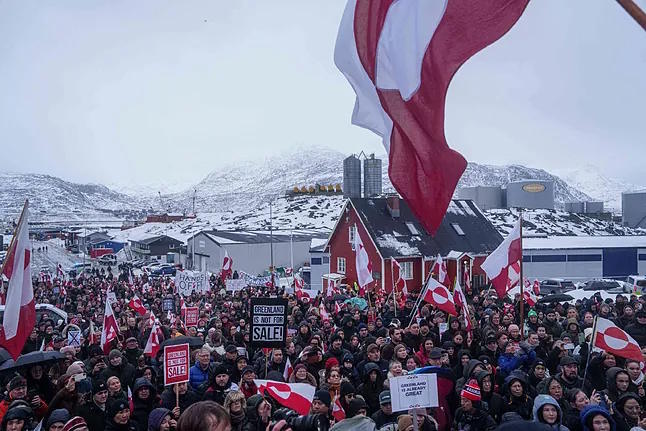
One year after the magnanimous Donald Trump took office as President of the US and ten months since he lifted the veil on tariffs and a new world order, nerves and uncertainty have resurfaced at the opening of markets this Monday. This weekend, the US President once again threatened with more tariffs against eight European countries if they do not back down in their support and sending of troops to Greenland. These countries are Denmark, Finland, France, Germany, the Netherlands, Norway, Sweden, and the United Kingdom, which have sent soldiers as a symbolic gesture to send a message to the White House that Greenland is not alone.
Currently, the Trump Administration announced tariffs of 10% starting from February 1 against products from these countries and they will increase to 25% starting in June if no agreement is reached. However, the European Union has also taken action, causing unease among investors who, on the other hand, are quite accustomed to the aggressive rhetoric of the US President. What is less common is that Brussels, tired of the constant attacks from the US and its lack of diplomacy, has threatened in return to invalidate the trade agreement reached last summer and activate the anti-coercion mechanism by which it would impose tariffs on US products worth 93 billion euros, which was approved in 2025 and was put on hold at the time due to the agreement reached with the US.
With this scenario, European stock markets start the week with losses, and with no reference from Wall Street, which is closed on Monday for Martin Luther King Day, although futures of major indices are trading lower. The EuroStoxx 50, the benchmark index where the largest European companies are listed, is losing around 1.3% and is risking the 5,950 points mark in the session. This is due to the impact that renewed trade tensions are having on the European automotive and luxury sectors. The Franco-Italian contact lens company EssilorLuxottica is the most affected in the index, with a 3.9% drop, given its deeply international nature. In fact, it has an alliance with Meta for the development of 'smart glasses' and is behind the 'RayBan' brand, also very popular in the US.
Among the major European luxury firms, LVMH (Louis Vuitton) is the most affected company, with sales down by over 2.6%; followed by Hermés, with losses exceeding 2%, and others such as Pernord Ricard or Loreal also experiencing declines. Consumer-related stocks are also feeling the impact today. This is the case for Prosus (an online commerce company based in the Netherlands), which is down by more than 1.5%; the food giant Danone, or Inditex, which is down by another 0.6%.
In the automotive sector, losses are around 4%. This is the case for BMW, Porsche, or Mercedes. Volkswagen is down by nearly 3.5% at the start of the session. The sportswear company Adidas, highly exposed to the US market, is also experiencing losses that have exceeded 4%. In Spain, with no listed automotive companies, the only references in the sector, CIE Automotive and Gestamp, are seeing drops of around 2%.
Banks are not immune to the sell-off, with Spanish banks leading the biggest declines in the Eurozone, with Banco Santander and BBVA seeing cuts ranging from 1% to 0.5%.
In Spain, the Ibex is moderating its decline, with losses of 0.6%. Notably, Puig Brands, the global perfume giant, is down by nearly 2%. Companies linked to energy and renewables are also being particularly punished, such as Enagás, Solaria, with losses around 2%; and those with greater exposure and business in the US like Fluidra and the pharmaceutical company Grifols, which are losing around 1.5% in this session.
In this context of ongoing tensions, gold has jumped by almost $100 per ounce overnight and is now trading at $4,675, 2% above Friday's levels, continuing to hit historic highs as investors seek refuge in the precious metal to balance market risks and uncertainty. But gold is not the only metal climbing the ranks. The case of silver is even more remarkable. Its price in the futures market has surged by another 5%, now above $93. Since November, it is on track to double its value.
This week marks the start of the renowned World Economic Forum in Davos, where the global economic elite will gather, and where the US President, Donald Trump, will attend and meet with his European counterparts. It is expected that he will deliver his speech next Wednesday in front of representatives from 130 countries and 400 global political leaders who will be accompanied by delegations from the world's leading companies. On the same day Trump speaks, a few hours earlier, the Spanish Prime Minister, Pedro Sánchez, will also address the forum.