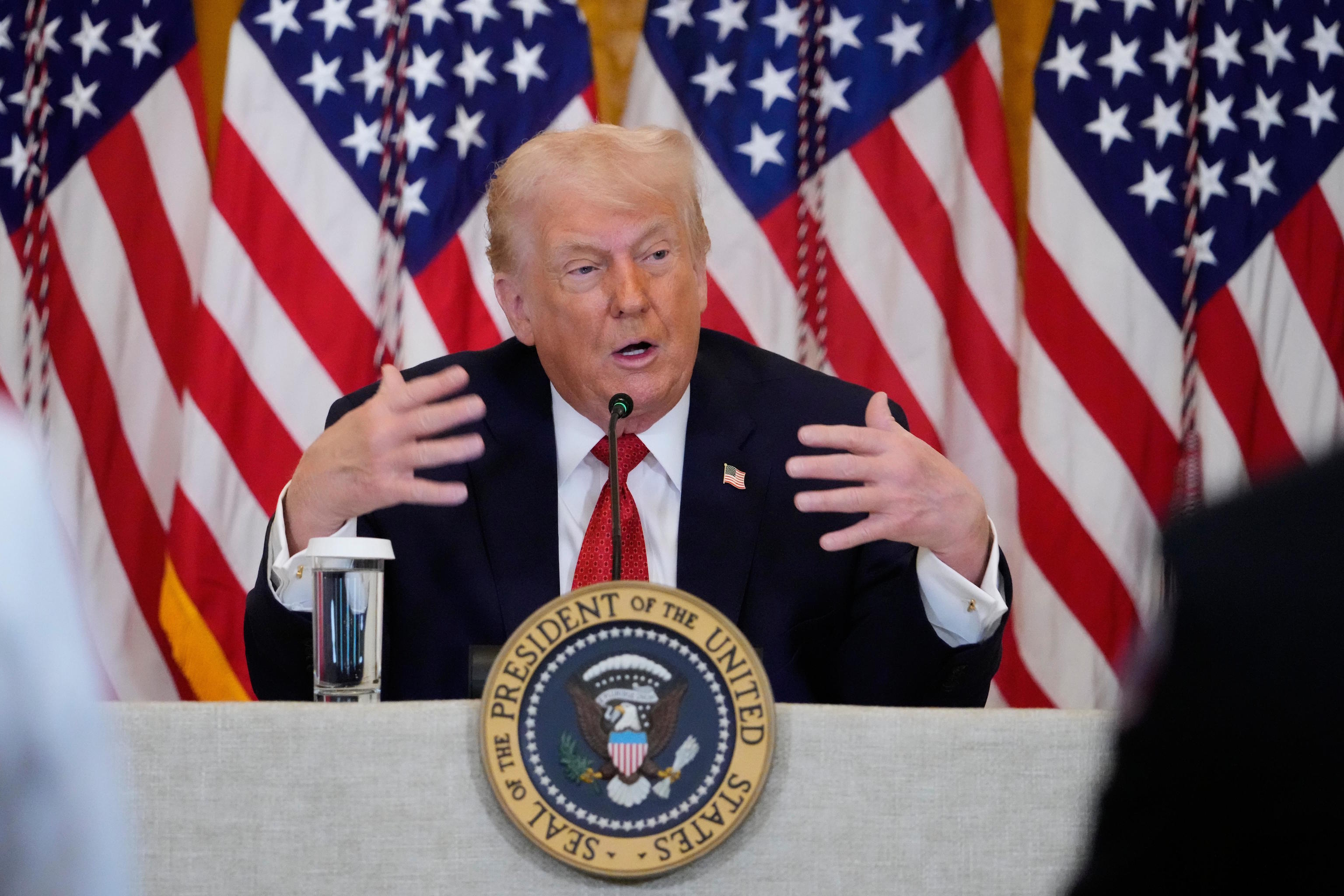
On Thursday afternoon, Kevin Hassett, the White House's economic guru and a frontrunner to be the next chair of the U.S. Federal Reserve, was asked what to expect from the speech that Donald Trump will deliver in the coming days in Davos. Hassett, without hesitation, replied that there would be "a look at the new world order that the president is creating." The expression "new world order" is not trivial. All U.S. leaders from Eisenhower to the present day have used it. Some only once; others, hundreds of times. Each imagined and understood it differently, depending on the context or the era, especially after a war or a transformative event, such as the Fall of the Wall or 9/11. They all emphasized that the United States was destined to occupy a privileged, dominant place in that global order, but none aimed per se to impose a new one or to break the board, shattering all rules and alliances. Mainly because the status quo, tailored to their needs, was more than favorable to them. Until Trump arrived - it will be exactly one year next Tuesday since he took office.
The Republican leader, the same one who won by promising to disengage from wars in distant deserts, from costly and failed attempts at "nation-building" and regime changes, is leading a total revolution in the world of international relations, resurrecting concepts like the Clash of Civilizations, imperialism, or nineteenth-century doctrines, from Monroe to Donroe, through spheres of influence. Dealing a blow to an international system based on rules; to the alliances that have marked the last 80 years; to the idea, on paper at least, that the path to prosperity lies in the rule of law, free trade, peace, and cooperation among nations.
Trump was never isolationist, but the same person who said a few months ago that investing in armies was a stupid waste of money now asks the Pentagon to increase its budget by 50%. The one who renounced his predecessors for wanting to be the world's policemen now presents himself on his social media as the acting president of Venezuela, the director of the Peace Board overseeing Gaza, has renamed the U.S. Institute of Peace after himself, has engaged to "Make Iran Great Again", and has embarked on a relentless operation to take control of Greenland. Not to mention the warnings to Panama and even Iceland.
In October 1941, Franklin D. Roosevelt denounced the plans "for a new world order" by Hitler's Germany. And his successor, Harry Truman, helped build a new order after World War II, with NATO, the Marshall Plan, and a presence on all continents. In December 1971, Richard Nixon spoke of "addressing this new world without preconceived ideas or inflexible positions. What we find imperative is that this new world order also brings with it a completely new phase of peace, justice, and progress for all members of the family of nations." Jimmy Carter spoke of "new world orders" at a dinner - a curious irony - in honor of Venezuelan President Carlos Andrés Pérez in Washington. And Ronald Reagan made it very clear, at another gala dinner for Indonesian Suharto: "In the pursuit of a fundamental solution and a general improvement of global inequalities, the only answer is that all nations, large or small, strong or weak, strive together, motivated by the firm determination to build a new world order that guarantees political, economic, and social justice."
But undoubtedly, the most famous references to the new world order are those of George H. W. Bush. In January 1991, in a speech from the Capitol, he used those words in the context of the overthrow of a dictator, Saddam Hussein, and a war, the Gulf War. And he repeated them hundreds and hundreds of times, until they became part of the collective imagination and the cultural heritage of American pop culture. "Across the world, we are engaged in a great struggle in the skies, the seas, and the sands. We know why we are here: we are Americans, part of something greater than ourselves. For two centuries, we have worked hard for freedom. And tonight, we lead the world in the fight against a threat to decency and humanity. What is at stake is more than a small country; it is a great idea: a new world order, where diverse nations unite in a common cause to achieve humanity's universal aspirations: peace, security, freedom, and the rule of law. That is a world worthy of our struggle and worthy of our children's future," the president said.
Bush, following in the footsteps of those who came before him, wanted to seize the opportunity of the USSR's collapse "to fulfill the long-cherished promise of a new world order, where brutality will not be rewarded and aggression will meet collective resistance," and in which "the United States will have a significant role in this effort. Among the nations of the world, only the United States of America has the moral and means to support it. We are the only nation on this Earth capable of uniting the forces of peace. This is the burden of leadership and the strength that has made the United States the beacon of freedom in a searching world," he affirmed.
All of that is ancient history. The world has turned many times since then. And in the last 12 months, the United States has turned many more. Trump likes to say that no one has had as many successes in such a short time in the country's history. It is indisputable that never before has anyone done so much, so quickly, so controversially, so profoundly, with so many consequences, both nationally and internationally. He has transformed his political party, created a movement, overflowed all institutions, imposed a new language and style for politics, created a school with imitators and fans in dozens of countries. The history of the United States is told by remembering the Founding Fathers, explained with Abraham Lincoln, and will be taught with a before and after Trump's arrival.
"His Path Has a Certain Logic"
"While the storm he unleashes is chaotic, his path has a certain logic. Trump truly believes that the United States is in serious trouble. From his perspective, the ineffective policies of Democrats and Republicans since the end of the Cold War have left the country divided and exposed to international dangers. A poorly designed globalization strategy emptied the middle class, dismantled the defense industrial base, and fueled China's rise. Distracted elites alienated Americans in pursuit of meaningless utopian goals. An incompetent picture of U.S. foreign policy failed to win wars, promote democracy, or build peace," wrote historian Walter Russell Mead. "Those who still consider Trump a moderate or an isolationist should watch his interviews. This president is not withdrawing from the world. His goal is to transform it."
That's why Trump is the first U.S. leader actively seeking a new framework not determined by multilateral rules and institutions, but by the law of the strongest, zero-sum game, raw power. Men like him (Putin, Xi, Erdogan, Modi), with clear ideas and capable of reaching agreements among themselves. An order of strength, influence, and spheres, not of law.
In February 2025, the president called the Speaker of the House of Representatives, Mike Johnson, proposing an exchange of paintings: one of the portraits of Thomas Jefferson from the White House in exchange for the one of James Polk hanging in the Capitol. Since then, Polk, one of the prophets of the "manifest destiny," the president who acquired Oregon, Texas, California, and much of the southwestern United States through war and conquests, accompanies his main admirer, Donald Trump, in the Oval Office.
Leaders obsessed, yesterday as today, with expanding the size of the country, whether with Mexico, Greenland, Panama, Canada, or Gaza. ### The Großraum Thought "There are two diametrically opposed models for understanding the evolution of the international order since the 1940s.
The first is Francis Fukuyama's End of History thesis. At the end of the Cold War, Fukuyama argued that the great ideological struggle of modernity - liberal democracy against communist authoritarianism - had been decisively resolved.
Liberal democracy had triumphed, and what remained of "History," in a philosophical sense, largely consisted of managing the inevitable, albeit ultimately marginal, resistance of lagging authoritarian regimes. The second model is less known in the West but has gained great influence among Chinese political theorists. It derives from the writings of the legal philosopher Carl Schmitt, who rejected liberalism as an empty ideology that fetishized debate and aspired to a dangerous universalism. Schmitt denied that history could culminate in a single, globally valid political form. For him, the post-war liberal order was not the endpoint of political evolution but a contingent product of World War II.
That order, he believed, was destined to erode as rising antiliberal powers asserted control over their own regional spheres of influence, or what he called Großraum," explains Benn Steil, Director of International Economics at the Council on Foreign Relations. For Schmitt, it is natural for there to be a dominant power in each region organizing the political space, creating a kind of balance. Trump, without ever having read the German, sees the world in a similar way. He inexplicably believes that globalization has been detrimental to the US, that the country was richer, happier, and more respected at the end of the 19th century than in the 20th.
And that is why it must return to the principles of that time: tariffs, isolation, strict control of its hemisphere. And that is why he despises, more than anyone, the order that his country built, with the UN, the WTO, the IMF, or NATO at the center, and development cooperation agencies, immigration, or asylum as pillars. "In this unpredictable world, instead of order, we can expect areas of tension, where the great powers strive to achieve exclusive spheres of influence and confront wherever they meet, both on land and at sea: China and the United States for Taiwan and the Pacific, India and China along their common border, or Europe and its eastern border with Russia. Smaller powers may struggle to find refuge under one or the other hegemony, but, as happened before 1914, they switch sides if they see a better deal. This constant reorganization carries its own risks.
Throughout history, great powers - and also medium-sized ones - have been involved in the disputes of their proteges. Wars can start by accident. But once started, they are difficult to control or end, and can consume everything in their path, like a wildfire," warns historian Margaret MacMillan in a recent essay. Schmitt considered the Monroe Doctrine precisely as the first modern example of Großraum thinking, "as it foresaw an international order based on spatial domination, rather than abstract and universal law (...)
The cost of a Monroe restoration, if it materializes, will undoubtedly be enormous. It will likely foreshadow the disintegration of NATO, the expansion of East-West armed conflict in Europe, and Chinese revanchist militarism towards Taiwan and the South China Sea," Steil alerts. Nothing is set in stone, but "I suspect that the liberal world order has witnessed its final dawn." Trump has broken the old order, but has not finished building the new. And that is where the monsters emerge.