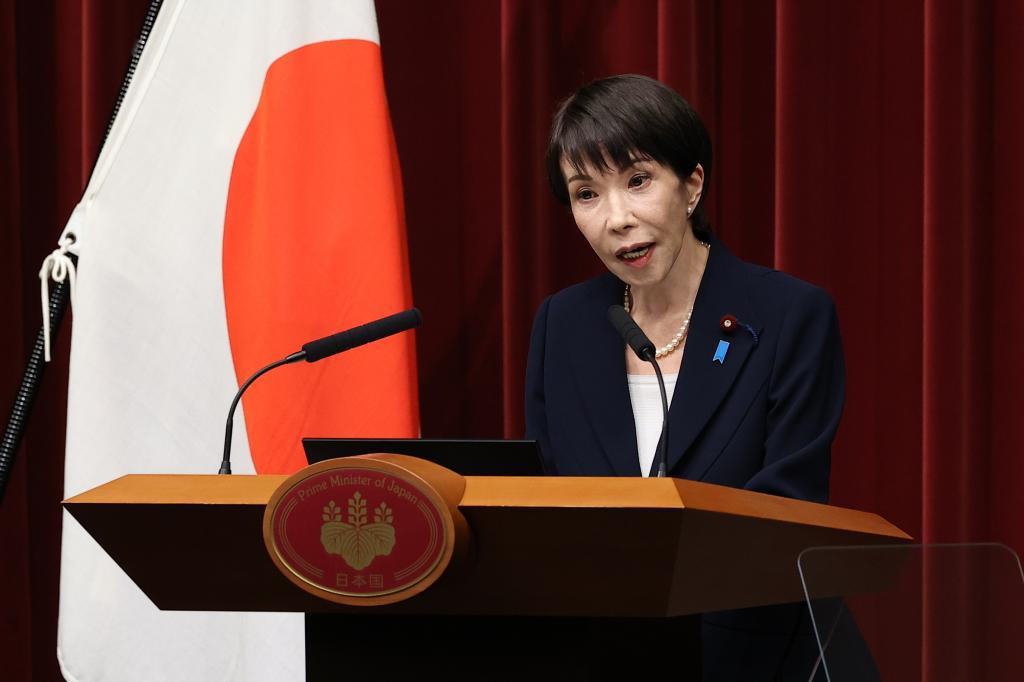
Japan's Prime Minister, Sanae Takaichi, announced on Monday that she will dissolve the House of Representatives on Friday and call for general elections to be held on February 8th. This decision reflects the government's intention to capitalize on the high level of popular support that the Japanese leader has garnered in just three months in office, with a much more nationalist rhetoric.
The conservative Takaichi (64 years old) made history by becoming the first woman to lead Japan. She heads a fragile coalition formed between the Liberal Democratic Party (LDP), the party that has governed almost continuously since the post-war period, and the reformists of the Japan Innovation Party (JIP). Her risky move to call early elections is supported by the historic approval ratings she has received in recent weeks from several polls, which could help the LDP regain the parliamentary majority it lost in the October 2024 elections.
"I am risking my political future as prime minister in these elections. I want the public to judge directly whether they will entrust me with the management of the nation," Takaichi declared after the electoral announcement. The leader won her party's primaries in October following the resignation of her predecessor, the veteran Shiregu Ishiba.
In a NHK survey published last week, Takaichi's cabinet approval rating was 62%. According to another survey published by Nikkei, 75% of voters support her administration. Analysts cited by major Japanese media outlets agree that Takaichi's strong leadership and tough stance against China have contributed to this support, despite the many economic challenges facing the country.
Currently, the LDP and JIP hold 230 seats in the Lower House, the most powerful, and with the support of three independent legislators, they barely reach a slim majority in the 465 seats. The situation is more complex in the Upper House, where the coalition controls only 119 of the 250 seats.
These numbers have limited Takaichi's government's ability to push through structural reforms without negotiating with the opposition led by the Constitutional Democratic Party of Japan (CDP), which recently formed a new electoral alliance with the Buddhist Komeito party, which until last year was the traditional government partner of the LDP.
Internally, the economic context is increasingly adverse: inflation remains strong, and the yen is at its lowest level against the dollar in a year, increasing import costs and squeezing household purchasing power. The early elections would allow Takaichi to seek a stronger mandate before economic strains take their toll. The opposition has criticized that early elections will delay the approval of Japan's fiscal budget for 2026.
On the international front, Takaichi entered the scene by forging what she has described as a "friendship" with US President Donald Trump. However, the Japanese government is currently experiencing heightened tension in its relations with China.
In November, Takaichi's statements regarding a potential scenario of Chinese military action against Taiwan - which she claimed would justify intervention by the Japan Self-Defense Forces - sparked a harsh reaction from Beijing, leading to a diplomatic and commercial offensive against its Asian neighbor.
Chinese authorities urged their citizens not to visit Japan, a significant economic blow as China is Tokyo's main source of tourism. Additionally, Beijing reimposed a ban on the import of Japanese marine products and imposed restrictions on the export of crucial rare earth minerals for the Japanese economy.
"There is a lot at stake in these elections. Takaichi's government has an ambitious agenda planned, including the revision of three key Japanese documents related to national security by the end of this year, accelerating defense spending, and managing economic issues such as inflation," explains analyst Yuko Nakano from the Center for Strategic and International Studies (CSIS).
"While the coalition led by the LDP would remain in the minority in the Upper House, achieving an absolute majority in the Lower House, the more important one, would facilitate the legislative process and allow Takaichi to assume a firmer leadership on complex national and international policy matters," she concludes.
Now, for Takaichi, the goal is clear: to transform her popularity into parliamentary stability that will steer one of Asia's great democracies in an increasingly volatile environment.