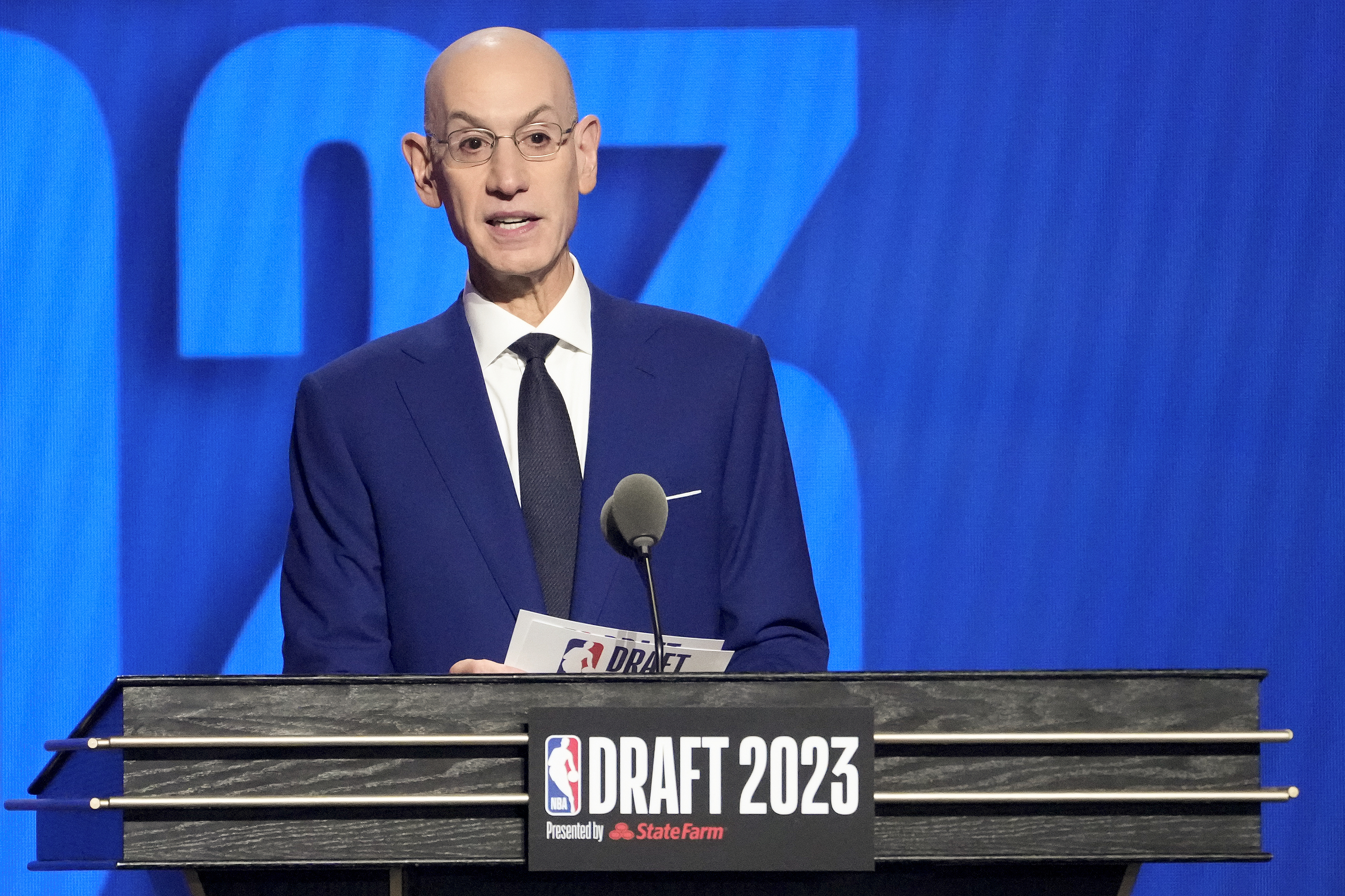
A wound between FIBA and Euroleague that was never closed. A European competition so established, exciting, and competitive yet economically ruinous year after year. The NBA's mirror so dazzling and profitable, yet so different from the traditional continental basketball. And a lot of uncertainties in the air. Baskets in Europe are going through times of rupture, the uncertainty before the storm. "It is our next frontier to cross. 2027 is an ambitious starting point, but it is feasible," admitted this Saturday in London, in a roundtable with a small group of journalists, among whom was the only Spanish representative, Adam Silver.
The NBA commissioner showcases his successful product in Berlin and London (after three consecutive years attending in Paris), with the usual regular-season games, this time Magic and Grizzlies (this Sunday, live on Amazon Prime, at 6:00 p.m.). He boasts of stars (Jokic, Doncic, Antetokounmpo, many of them European), multimillion-dollar TV deals (76 billion over the next decade with Walt Disney, NBC, and Amazon), and, with the interested hand of FIBA, sets a date for the much-touted NBA Europe landing. And he takes advantage of the trip to define the financial and sporting aspects of his future European competition. Behind the scenes, he makes moves. In the City, he is meeting these days with representatives from Barça and Madrid, among others. Silver commented on the situation of Real Madrid when asked by this media outlet: "It is one of the clubs with which we have had conversations. We have enormous respect for their operational capabilities. They have the knowledge to manage a top-level basketball club."
Because it's all about investment. And Silver already warned that the initial "will come from European clubs": "If we launch this league successfully, it will take time to be profitable. It is not a short-term thing." Bloomberg estimated earlier this year that the NBA could demand up to 1.5 billion dollars to acquire the rights to a franchise in the NBA Europe. In yesterday's meeting with the media at The InterContinental London Park Lane Hotel, the commissioner clearly pointed to football clubs without a basketball tradition, including PSG, as a clear target: "There is plenty of room for someone to be a fan of both their football team and their favorite basketball team. And that is where my focus is right now."
Clubs, mostly with capital from the Middle East. And that's where he sees the opportunity because currently, NBA rules prohibit sovereign funds from owning more than 20% of any of the 30 league teams. Something that could be different in Europe. "We are talking to families that currently invest in sports," Silver admitted. "There are more traditional investment funds with experience in sports, and other more traditional local private equity funds that see sports as an asset class," he explained.
And then there is the Euroleague, with its 13 owner clubs, trying to fortify itself. Because it is still a war. It even threatens the American league with legal action. This week it had given its members a deadline to sign a ten-year renewal of the affiliation agreement, coinciding with the one it has with IMG, its sponsor. Ten of them did, the last being Barça, although with an exit clause just in case (around 10 million euros penalty). Not so Real Madrid, which remains on the sidelines. Aware that it would be the spearhead of a long-standing desire, to belong to the NBA, of many years of its board. Neither Asvel of Tony Parker, the only one who has already announced his departure from the ship.
The French will compete, for now, in the Champions League. Which is the other European competition, sponsored by FIBA for years and where other Spanish teams like Unicaja, Tenerife, Gran Canaria, and Joventut are competing. And that would be, in that still blurry future scenario, one of the stepping stones to the NBA.
Which boasts, in the words of FIBA leaders, of democratization. Of open competition. And yet, it is outlined with 12 fixed teams, many of them with no tradition or basketball structure. Mere branches of giant football clubs (Roma, PSG, Manchester) or franchises from powerful cities with modern arenas like, precisely, Berlin and London (the location, the future construction in Valdebebas of an Arena, is one of the issues to be resolved in Madrid). The other four, theoretically, would come from the BCL based on sporting merits.
An NBA Europe that would also, in principle, respect the national team qualification windows. One of the major battlegrounds since FIBA included them in the calendar. Although for the NBA itself, respecting them seems unthinkable. Between tradition and business.