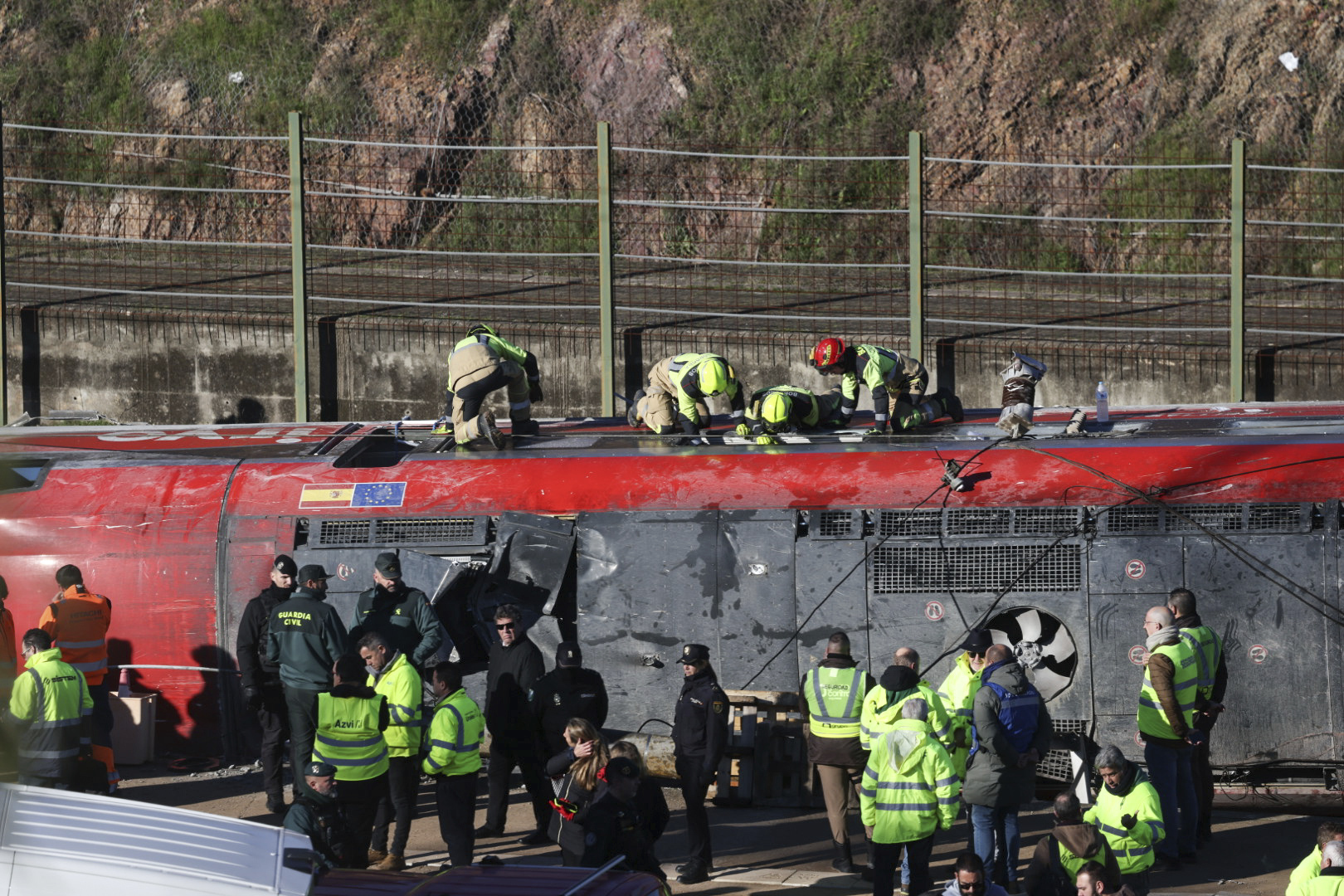
A break in the right rail of the track at kilometer 318.7 of the Madrid-Andalucía high-speed corridor is the focal point of preliminary investigations to determine the causes of the railway accident that occurred last Sunday involving an Iryo heading towards Madrid and an Alvia from Renfe heading in the opposite direction. The incident had claimed 41 lives by Tuesday, making it the worst railway accident since the liberalization of this market.
Although the train collision was the main cause of the high death toll, investigations are focusing on the factor that triggered the collision, an "unusual" accident, according to the Minister of Transport, Óscar Puente.
Both the track and the Iryo were due for maintenance. Late in the afternoon, cars 6, 7, and 8 of the Iryo's Frecciarossa 1000 derailed when the train was traveling at over 200 kilometers per hour in the Adamuz, Córdoba section, crossing into the opposite track. At that moment, an Alvia from Renfe, traveling at 205 kilometers per hour, was approaching after departing from Atocha at 6:05 in the evening. No one will ever know what would have happened if the train, manufactured by CAF, had been one minute late or early. The safety systems would have been activated, reducing the damage. However, the fact is that its driver, Pablo Barrio, had barely 20 seconds to avoid the oncoming Iryo, they collided, and the Alvia's locomotive and the first cars fell down an embankment. The Iryo ended at kilometer 317.6 with the last cars overturned and the Alvia 800 meters away. In between, the tracks were destroyed.
Along with emergency teams, residents, and the Civil Guard, technicians from the Railway Accident Investigation Commission (CIAF) immediately traveled to the scene, as well as representatives from Renfe and Iryo, the infrastructure manager Adif, and representatives from the manufacturers of the trains involved in the accident. Apart from the tragic situation, their role is to determine what caused the Iryo's last cars to derail, the factor that triggered everything else.
In the preliminary examination of the scene for an investigation that will last weeks, the focus was on reviewing the infrastructure and searching for the parts of the derailed Frecciarossa, specifically in its bogies, the articulated group of axles, wheels, suspension, and brakes located under each end of a car.
The speed at which the trains were traveling was below the 250 kilometers per hour allowed on the straight section of Adamuz where the Frecciarossa derailed. As time passed, excess speed and the failure of the Iryo's driver were ruled out as probable causes, focusing instead, according to Álvaro Fernández de Heredia, president of Renfe, on the train or the infrastructure.
By midday, the investigation had already found a rail break and broken sleepers at a specific point that caught their attention. The rails of high-speed tracks are welded to provide continuity for the train's movement and minimize friction between the infrastructure and the support for trains like the Frecciarossa, which weigh 500 tons empty, increasingly traveling on the 4,000 kilometers of the network.
Technicians involved in the investigation informed EL MUNDO that the break of over 30 centimeters in length in the rail was due to a faulty weld or a weld that deteriorated due to train traffic or weather conditions, resulting in the rail breaking, "a more than probable cause for the Iryo to derail," they stated.
Sources familiar with the progress of the investigations confirmed to this newspaper that the technicians had shifted their focus to the track as the origin of the derailment, and the infrastructure manager, conducting checks with ultrasound tests to determine the condition of the rails, was "assessing" it as a potential cause in a tense atmosphere. "There is concern," they pointed out.
Over the coming weeks, while efforts are made to access the accident site to locate the victims under the debris, clear the infrastructure, and repair it, technicians will continue their investigative work to provide an explanation that will be crucial for determining the accident's diagnosis and legal consequences. Beyond the irreparable losses caused by the tragic accident, whether the gap in the track was there due to a defective weld that led to a rail break with the passage of trains or if it was caused by Iryo's Frecciarossa is a crucial issue for a judge to establish the responsibilities to be faced with the victims.
The blow to the prestige of the Spanish high-speed rail system, which despite the incidents in 2024 remains a global benchmark, is severe. The 4,000 kilometers of network have seen increased traffic and demand in the last four years as a successful case of liberalization that is studied in all countries worldwide.
This accident will have consequences. But from a legal standpoint, the focus is on Adif, under the Ministry of Transport, and Ferrovie dello Stato, the Italian state-owned company and main shareholder of Iryo with a 51% stake.
The president of Iryo, Carlos Bertomeu, highlighted the "unusual" nature of the accident as it "did not occur on a curve, it happened on a straight section," and it occurred at "a moderate speed for the train." He also argued that the involved convoy is "a train of the latest technology," less than three years old, purchased new, and with "all of its scheduled maintenance and inspection plan completed, the last one very recently," referring to the visit to the Santa Catalina workshop in Madrid on June 15.
Bertomeu clarified that the derailment occurred in an intermediate car and not at the front of the train, which, in his opinion, reinforces the need for a "thorough investigation," as it is "an unusual accident," necessitating "full cooperation with the investigation commission to determine the cause and prevent it from happening again."
Meanwhile, Minister Óscar Puente ruled out that the rail break is a decisive indication to clarify the causes of the Adamuz (Córdoba) accident, as it remains to be determined whether that break is a cause or consequence of the derailment. It is just "one more theory among all the possibilities," being another clue found. The minister warned that it will not be easy to determine if that missing section of track was already absent before the derailment or occurred afterward.
The minister made these statements in response to information from EL MUNDO suggesting that the accident could have been caused by a rail welding failure at the point where the derailed Iryo train was.
"Speculation is inevitable, and the media will join in the speculation," emphasized Puente, noting that there are "countless incidents" in the service reported with the aim of "preventing" any serious incidents.
In fact, the Adamuz section proved to be problematic last year, accumulating seven incidents since its maintenance was updated in May 2025. Just a month later, the infrastructure manager Adif reported delays due to incidents in Adamuz that reached the Senate.
In response to questions from the PP, the Government reported that the signaling systems, which apparently were not related to the current accident, had failed. They indicated that a fault was detected in a relay card, a key component for the proper functioning of the signaling system. In the system, the relay acts as a switch that controls electrical circuits to ensure the train and infrastructure operate correctly. It can detect faults, record critical functions, and trigger alerts in risky situations.
"The affected card was replaced with a new one, thus restoring the system's operability. This intervention was also carried out within the framework of scheduled maintenance. Both actions allowed the service to be restored to normal as quickly as possible, minimizing disruptions to rail traffic and ensuring circulation safety at all times."