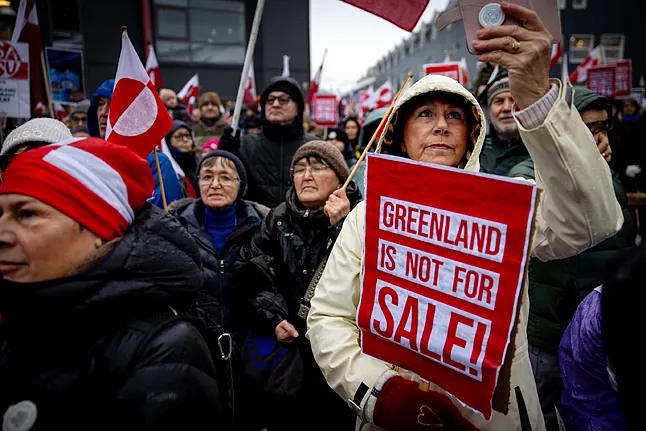
Donald Trump and the United States have "crossed a line". The threats of the tycoon to take Greenland at all costs, as explained to this newspaper by European diplomatic sources, mean that "a red line has been crossed". And it gives the impression: "He has gone crazy".
The feeling that the tycoon is out of control has multiplied in recent days. After the intervention in Venezuela to arrest Nicolás Maduro, Trump officially set his sights on the island belonging to the Kingdom of Denmark, which already alerted European capitals and EU institutions. But what happened over the past weekend, with the President of the United States directly targeting the countries that sent troops to Greenland and stating that he will impose tariffs of up to 25%, seems to have exceeded all limits. "He does not treat us with respect and is aggressive," they assert from a northern country.
And the letter that Trump sent yesterday to the Prime Minister of Norway, Johas Gahr Store, only exacerbates all these feelings. "Considering that your country decided not to award me the Nobel Peace Prize for having stopped eight wars and more, I no longer feel obligated to think only about peace, although it will always be predominant, but now I can think about what is good and appropriate for the United States," the president pointed out in the letter he sent yesterday. "It's madness," they emphasize from the diplomatic sphere. Among many other things, because the Norwegian government has little to do with the decision of that prize since the winner is selected by the Nobel Committee.
The stance towards Trump and the commitment to defending Greenland are two issues that are widely shared by the Member States. Beyond Hungary, which has in Viktor Orban a sort of infiltrator of Vladimir Putin and Trump within the European Council, the vast majority of countries are willing to take very firm steps forward.
Although it is also true, and this is very relevant, that in the Baltic nations there is a slightly less conviction. They fear that if Europe confronts Trump, the President of the United States may stop protecting these countries from Russia within the framework of NATO. In fact, this was exposed at the extraordinary meeting of ambassadors that took place on Sunday afternoon in Brussels after the escalation of Trump's threats.
The next few days, in any case, will be very relevant in the geopolitical sphere. The President of the Commission, Ursula von der Leyen, will be in Davos on Tuesday, a forum in which Trump will also participate a day later to present his vision of the world. And with all these ingredients and the situation already described in Brussels and the capitals, the EU presidents and prime ministers will meet on Thursday in an extraordinary Council. It will start at 7 p.m., so it is expected that the meeting will extend well into the night even though it is only a discussion and no concrete decisions will be made.