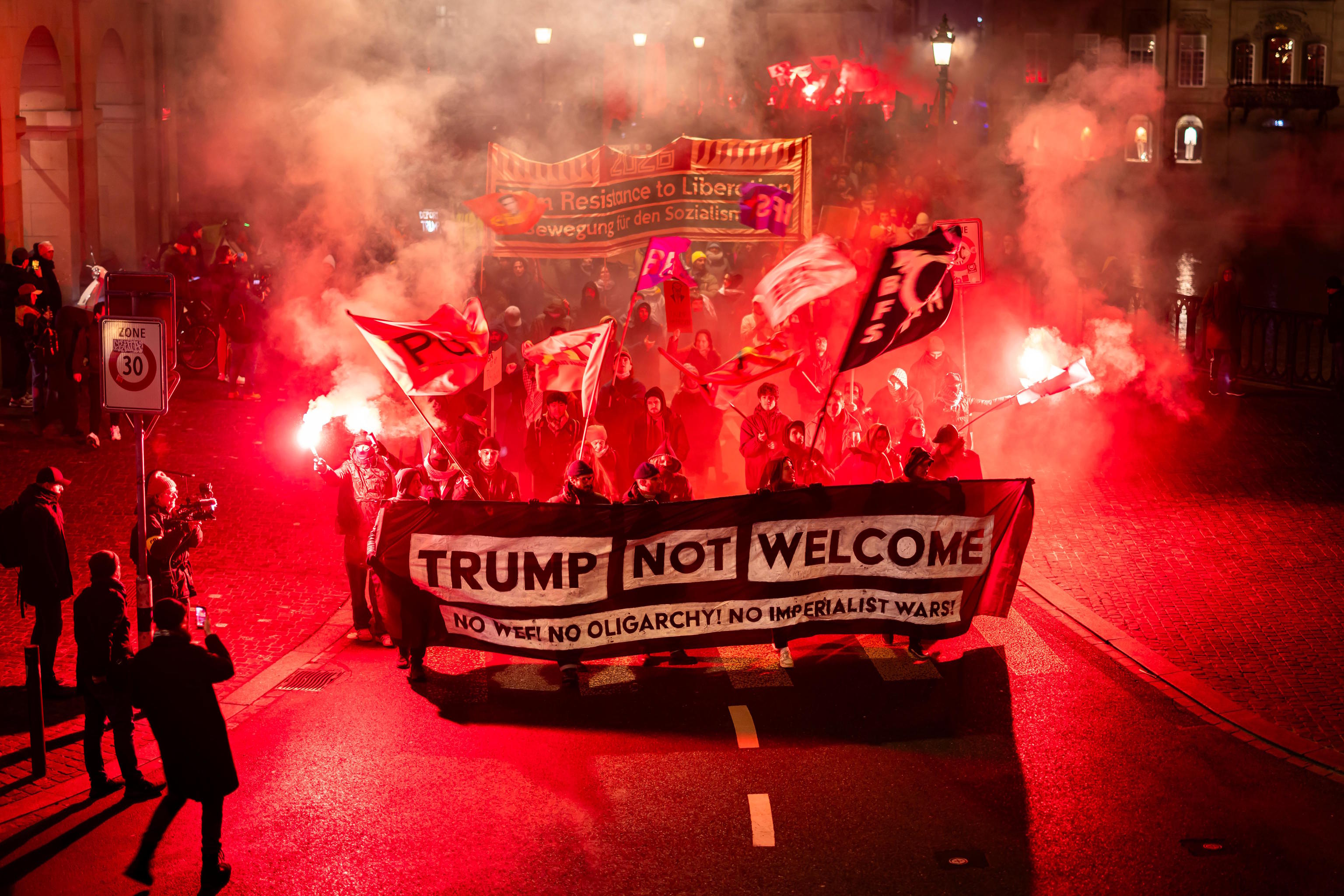
Hours before the official opening of the annual meeting of the World Economic Forum, the rooms of the Davos Congress Center and the surrounding hotels were already bustling with top executives from around the world eager to find answers to the chain of uncertainties looming over their financial statements.
The Davos Forum sets records for participation but also registers levels of pessimism not seen since the pandemic year. More than 3,000 political and business leaders - including the President of the US, Donald Trump, and the world's top entrepreneurs and bankers - will participate in over 200 sessions trying to instill optimism in a global economy that presents multiple downside risks. "Spirit of dialogue" is the motto presented for this edition by the Forum's president, the Norwegian Borge Brende. It is much needed, given the statements and diagnoses prior to the meetings. One of those already visible is the US Secretary of State, Scott Bessent, who raised the worst fears by warning the European Union that retaliating against his country over Greenland, "would be very unwise." Bessent is considered one of the moderates in the US Administration and supported Trump, stating that "Greenland is a strategic asset for our security that we will not outsource to anyone," overlooking that Greenland belongs to Denmark.
"As we enter 2026, the world is on the brink of the precipice", summarizes a report from the Forum on global risks presented as one of the bases for debate. "The turmoil caused by cyber wars, along with the use of economic ammunition to gain strategic advantages, continues to fragment societies. The rules and institutions that have long supported stability are being besieged in a new era where trade, finance, and technology are used as weapons of influence," the report states.
Geopolitical confrontation is the greatest risk, according to experts surveyed worldwide by the Forum. It is striking that Spain is the only country that reflects "social polarization" as the main problem, above geopolitical threats or disinformation, which are very prominent in other states.
Pessimism is also evident in the traditional survey conducted by the US consulting firm PwC launched at the start of the annual Forum meeting. "Global CEOs' confidence in the evolution of their companies' revenues in 2026 has dropped to the lowest level in the past five years," PwC asserts in the presentation of its 29th Global Survey based on the opinions of 4,452 presidents and delegates from around the world, including over 70 from Spanish companies.
The survey reflects that companies face a double uncertainty, both geopolitical due to trade wars, and technological due to the still uncertain profitability of introducing artificial intelligence and the increasing insecurity of cyberattacks.
Only three out of ten global CEOs (30%) assert full confidence in the growth of their revenues in the next twelve months, compared to 38% in 2025 and 56% in 2022. "CEOs are not managing to translate investments into consistent financial results due to accelerated technological change, geopolitical uncertainty, and economic pressure," according to PwC. In the case of top Spanish executives, the percentage declaring confidence in the performance of their revenues in 2026 is slightly higher (38%) than the global average, but it also represents a decline from 43% in 2025.
One in five international CEOs (20%) states that their organization is highly exposed to significant economic losses in the next twelve months due to tariffs.
Nevertheless, more than half of those surveyed worldwide plan to increase their investments abroad, and Spain is well positioned in their focus. The United States remains the main investment destination: 35% of respondents place it among their top three markets. The carrot offered by the US President that by investing in his country they avoid tariffs contributes to these results. The UK and Germany (13%) and China (11%) also stand out in the survey, with the emerging star of India, which is now on par with these other countries as interest in its market doubles year after year. Spain ranks ninth in preference, behind France. It is in the top ten favorite destinations in the world.
Trump calls on entrepreneurs in Davos to invest in the US
The President of the US, Donald Trump, plans to leverage his trip to the World Economic Forum this Wednesday to pressure entrepreneurs and bankers from around the world to invest in his country. Trump has summoned entrepreneurs and bankers from around the world present in Davos to explain to them, apart from his public intervention at the Congress Center, the importance of betting on the US economy.
The President of Banco Santander, Ana Botín, Iberdrola's Ignacio Galán, Ferrovial's Rafael del Pino, and Repsol's CEO, Josu Jon Imaz, have significant interests in the US and its sphere of influence and are attending this week's annual Forum meeting, among others.
Botín, a prominent figure at the Forum, was selected last year to ask Trump a question, to which he congratulated her on her "fantastic work." The agenda of Spanish business leaders present in Davos will focus on Trump and his extensive delegation after the last-minute cancellation of the Spanish Prime Minister, Pedro Sánchez, due to a rail tragedy.
BBVA's President, Carlos Torres, Acciona's José Manuel Entrecanales, Telefónica's Marc Murtra, and ACS's CEO, Juan Santamaría, are also attending this edition. Endesa's CEO, José Bogas,, also traveled to receive Forbes Spain's annual award in Davos.