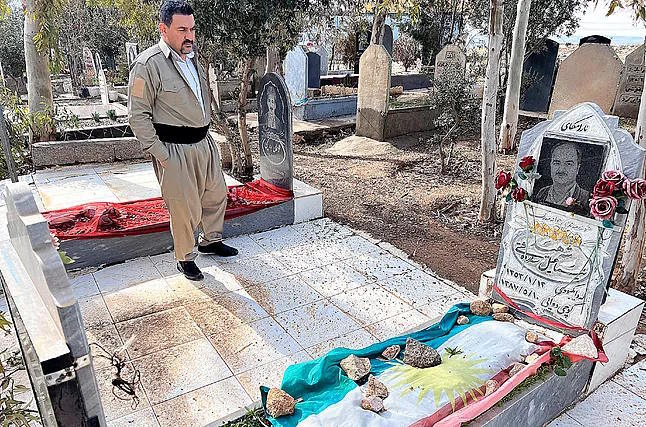
From the so-called Cemetery of Martyrs of the Kurdish Democratic Party of Iran (PDKI), you can see a few hundred meters away what used to be their headquarters, an old fortress that was also targeted by the Iranian attack in 2022, during the popular uprising that shook the Persian nation at that time.
Both the cemetery and the military stronghold -now in the hands of the authorities of Iraqi Kurdistan-, or the memorial where homage is paid to the fallen fighters of this group, are a reminder of the bloody and bitter rivalry that the Kurdish opposition has maintained with the Tehran regime since the great Ayatollah Ruhollah Khomeini took power in 1979.
The mausoleum, located within one of their camps, is dominated by panels displaying thousands of faces. "We have lost more than 7,000 peshmergas (the name of Kurdish guerrillas) since we started fighting with the Islamic Republic of Iran and we have tens of thousands in prisons," explains Mustafa Hijri.
The leader of this group speaks beneath the portraits of three particularly emblematic figures for the cause of his community: the president of the first and only Kurdish republic of modern times, Qazi Muhammad; the former secretary-general of the PDKI, Abdul Rahman Ghassemlou; and the latter's successor, Sadeg Sharafkandi.
All of them died at the hands of Tehran's forces. The first was executed by Shah Mohammad Reza Pahlavi in 1947. The other two in separate attacks (1989 and 1992) sponsored by the religious dictatorship that followed the one led by Pahlavi.
"A people who want their freedom must pay the price for that freedom," reads beneath the photograph of Ghassemlou that also decorates the area dedicated to honoring the Kurdish militiamen.
The chamber is located inside the camp occupied by the PDKI uniformed members in the Iraqi town of Koya - about 60 kilometers from the border with Iran - which they have used as a base since the 1990s.
The display includes several glass urns where the personal belongings of those called "martyrs" can be seen. From uniforms to identity documents, family photos, or watches. Jamal Akbari's, a fighter born in Iraq in 1987 who acquired Canadian nationality - which did not prevent him from returning to these mountains to die here - includes his favorite cologne and deodorant.
Rafic Miri fled from Iran to Iraqi Kurdistan, the northern region of Iraq controlled by Kurdish forces, in 2004. "I decided to take up arms after suffering the injustice that we Kurds have to endure in Iran. We have tried to gain respect through all means: diplomatic negotiation, social activism... They continue to oppress us. The only way for the Iranian regime to fall is with weapons," explains the peshmerga, dressed in the typical Kurdish outfit of baggy pants, as he walks through the cemetery.
The cemetery houses over a hundred graves. From intellectuals to group commanders or simple soldiers.
At one end are lined up the graves of the victims of the bombing on November 21, 2022. Among them is Rehana Kanani, a pregnant fighter who died in the attack along with what should have been her son, Wanyar Rahmani.
There are many other graves with the inscription "murdered." Kurdish militants estimate that in these 47 years, close to 400 members of different Iranian parties have died in Iraqi Kurdistan, in attacks organized by Tehran's forces.
The Kurdish minority in Iran - ranging from seven to 15 million people - has always been known for its opposition to the autocracies that have ruled the country in modern times, both the Shah's era and the one that followed in 1979.
The Kurds were the most significant component of the protests that took place in Iran in 2022 after the death of young Mahsa Amini, a Kurd who was arrested for not wearing the Islamic veil. The demonstrations in the west of the country led to what was called the Jin, Jiyan, Azadi (Women, Life, Freedom) movement, which Tehran once again suppressed by killing hundreds of people.
The participation of the PDKI and other Iranian Kurdish formations in these mobilizations triggered a wave of Iranian airstrikes against the positions of these armed groups in northern Iraq, resulting in several dozen dead and wounded.
Mustafa Hijri narrowly escaped the missile strike. He was supposed to receive a delegation in the "guest building," a room that was destroyed by the first rocket that fell inside the complex. Although it has been rebuilt, the small house still bears marks of shrapnel on its walls.
"After the first attack, we evacuated the children from school, and five minutes later another rocket hit there. Dozens of kids could have died," Miri points out.
The peshmerga points to another crater left by a drone inside the camp facilities, a large space with one-story cement huts, enclosed by wire fences and guarded by armed personnel.
"We have closed the school because we are afraid that Iran will attack us again now," he explains.
The PDKI is one of the seven Iranian Kurdish formations that joined forces on the 7th to call for a general strike in Iran in support of the wave of protests that began in December. A call that coincided with the peak of the massacre carried out by forces loyal to Tehran.
"This government has nothing left but to kill people," states Hijri.
The stance expressed by these groups is a gesture that contradicts the traditional rivalry of these groups, as eager to fight against Tehran as among themselves. "Unfortunately, the internal fights of the Kurds have always been great propaganda for the Islamic Republic," admits the PDKI's secretary-general.
Other parties such as the Kurdistan Freedom Party (PAK) or the Kurdistan Free Life Party (PJAK) have gone further and have responded to the brutal actions of Iranian security forces with their own armed actions.
The base led by Rebaz Sharifi, one of the most prominent commanders of the PAK, is located in mountains near Erbil.
The guerrillas welcome visitors in a tight armed formation on a clearing, also used as a training ground.
"What is the goal of a peshmerga?" one of the instructors shouts. "State and independence!," the dozens of fighters respond in unison. "Kurdistan or death!," they shout again.
Then, the uniformed members begin to march, stomping the ground, displaying machine guns and Kurdish flags.
The Kurdistan Freedom Party (PAK) claimed responsibility for several armed attacks in the Iranian districts of Ilam, Kermanshah, and Firuzkuh days ago, in which they "inflicted significant damage on regime forces", as stated by one of their spokespersons, Jwansher Rafati.
Tehran-controlled media outlets such as Tasnim and Fars have accused opposition groups operating from Iraqi Kurdistan of playing an "active role" in the recent protests. Fars stated that another group, the Kurdistan Free Life Party (PJAK), had killed eight Islamic Revolutionary Guard Corps (IRGC) members in the aforementioned Kermanshah, the main Kurdish town located in the west of Iranian territory.
"We killed several IRGC members and burned the base. Iran says that protesters are using weapons. We are the ones using them to defend the population. And most of them we buy from the IRGC, taking advantage of the rampant corruption plaguing the country," confirms Sharifi, a commander who has been with the PAK for 21 years.
Sharifi is straightforward. "We do not want democracy for Iran, we want independence for the Kurdish regions," he states.
The PAK is one of the youngest Kurdish opposition groups. It was founded in 1991, says Shafiri. The oldest, the aforementioned PDKI, was established shortly before the short-lived Kurdish Republic of Mahabad in January 1946, which was crushed by the Shah's troops at the end of the same year.
Despite their antagonism towards the religious regime, the various Iranian Kurdish political parties have serious disagreements about the possible future of the areas inhabited by their community in the predominantly Persian nation.
"Independence is a dream, but it is not realistic," says Ibrahim Alizadeh, the leader of the Communist Party Komala.
At 76 years old, Alizadeh must be one of the few leaders in the world who still proudly speaks under a huge portrait of Karl Marx. Not in vain, Komala was created under the influence of the former Soviet Union during the Cold War, although it later split into three divergent branches.
Komala fought alongside the PDKI in the major Kurdish uprising that took place in western Iran in 1979, the first of a long series, which was defeated by the new power that ousted the Shah after months of fighting and thousands of deaths.
The camp they occupy in the town of Zargwez was another target of Iranian missiles during the offensive that followed the 2022 uprising.
"This time they will also attack us. I am sure," Rebaz Sharifi had indicated.
Alizadeh is a veteran of Kurdish activism and also endured the prisons of the monarchy while studying at the university. "But the Shah never caused the massacre that we have witnessed in recent days," he points out.
Brutal repression by Tehran
The communist politician admits that the brutal and bloody reaction from Tehran has almost completely halted mobilization in the streets. An analysis shared by both Mustafa Hijri of the PDKI and Sharifi, the commander of the PAK.
The reports they have received from their supporters and relatives on the ground coincide with the details that have been leaked about the actions of the military loyal to Ayatollah Ali Jamenei. They speak of the involvement of Afghan, Pakistani, and Iraqi militias - the same ones Tehran resorted to in support of the autocrat Syrian Bashar Assad - of thousands and thousands of deaths, and unusual practices such as the "kidnapping" of corpses, which - they say - are only returned to the victims' families upon payment.
However, they all agree that protests will shake the country again in a short period of time. "Before the summer," Sharifi specifies. "They have not solved the main problem: the economic crisis," he adds.
For Alizadeh, "the Islamic Republic is living its last years of life. They will have to change. The United States is looking for a compliant government and that is why they are trying to achieve a change within the regime as they did in Venezuela. Either they do it peacefully or by force," he adds.
Despite their different ideologies, the Kurdish leaders also agree on one thing: none of them accept the hypothetical leadership of Reza Pahlavi, whom they associate with the dictatorship maintained by his father.
"The Iranians and the Kurds, especially, are not going to protest to return to what they were liberated from 47 years ago," Hijri points out in reference to the fall of the Monarchy in 1979.
Sharifi remains the one who expresses himself most forcefully. "There is no difference between Ali Jamenei and Reza Pahlavi. Both are enemies of the Kurdish people," he concludes.