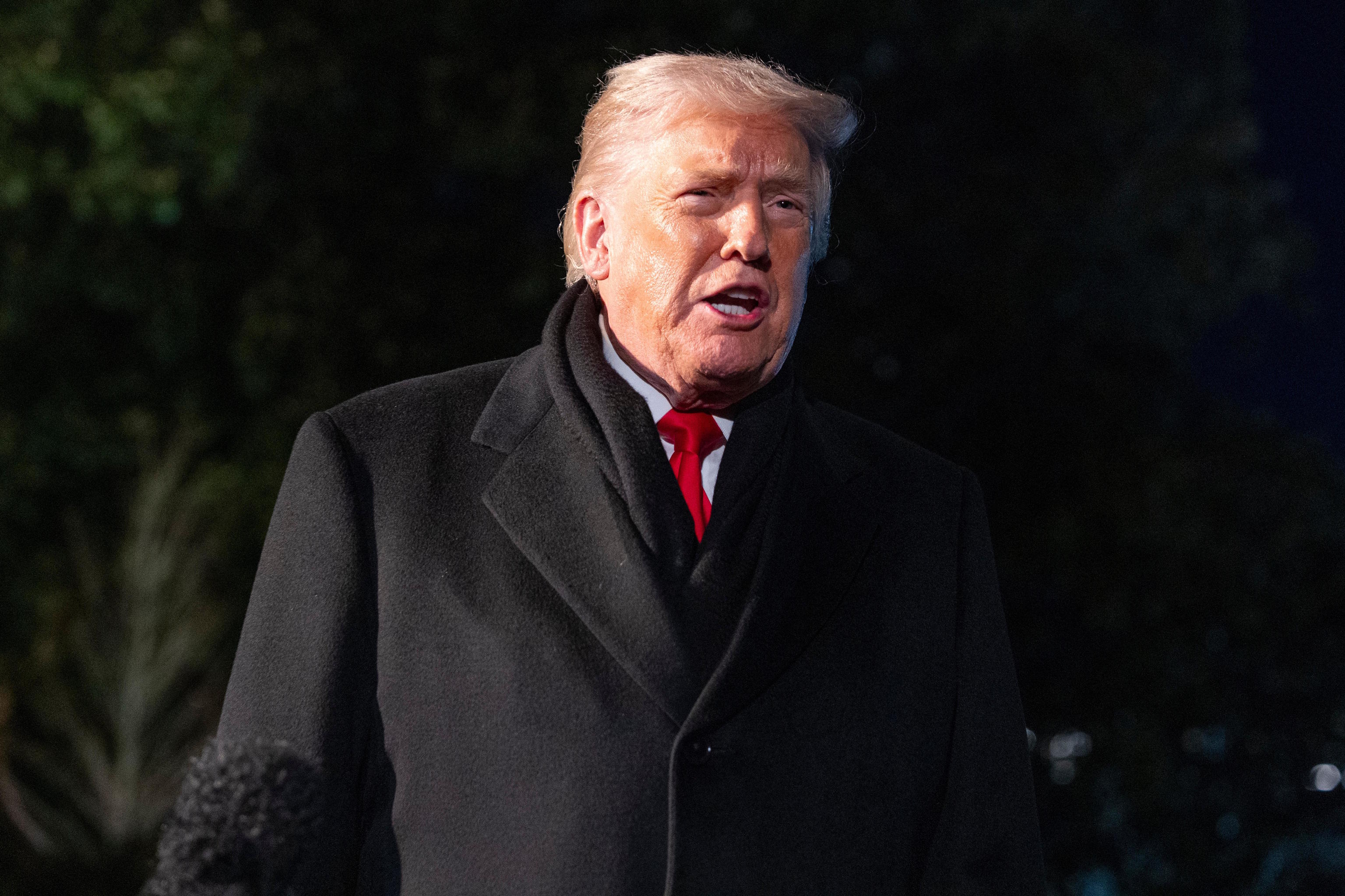
The hope that the threats of the US President, Donald Trump, will remain just a negotiating tactic is fading in the alpine town of Davos like snow melting in a meeting of the World Economic Forum with higher temperatures in every sense. Trump prepared his trip to Switzerland with a new humiliation of European leaders he is scheduled to meet on Wednesday, setting off alarms in the stock markets. Investors do not want a new clash between the world's major markets, but it is happening following last year's trade agreement.
Whether the new spiral around Greenland can be contained or not, the Davos Forum is beginning to consider the world order as buried, on which the liberalization and prosperity of many countries and attending multinationals have rested. The aspiration now is for the new order to eventually provide stability and certain rules of the game. For now, the widespread market downturn on Tuesday and the weakening of the dollar after Trump's aggressiveness towards his European allies reflect the sentiment in Davos, as many attendees, like BlackRock's president Larry Fink, manage the world's leading investment funds.
"We are heading towards a lawless world", said French President, Emmanuel Macron, addressing the audience seeking support from the global business and financial elite against Trump's style, whom he did not name but portrayed as a bully. In fact, the US leader heated up his highly anticipated speech to the elite audience in the alpine town with a new outrage towards European leaders and allies. He leaked private messages from French President Emmanuel Macron offering him a G-7 meeting in Paris, and revealed new flattery from NATO Secretary-General Mark Rutte, both present in Davos along with European Commission President Ursula von der Leyen.
Additionally, two Americans attending the annual Forum for days, Treasury Secretary Scott Bessent, and Commerce Secretary Howard Lutnick, expressed disdain for the European Union and its leaders in their public speeches. Bessent expressed astonishment at the EU's vehement response to Trump's tariff threats if his annexation of Greenland is not accepted. "Why do they assume the worst-case scenario? Contain your hysteria and take a deep breath," stated the Treasury official known to be moderate within Trump's team. Lutnick, besides questioning European policies, stated that if the EU takes action against the US, "there will be a response in return."
Bessent made it clear that there is no turning back on the Greenland issue and that they cannot yield to Denmark on a matter of US security. Therefore, both Macron and the European Commission President advocate for measures to reduce dependence on the United States. "The old world order will not return", confirmed Canadian Prime Minister, Mark Carney. He had previously faced Trump's attacks before the EU and now stands in solidarity with the Europeans in defense of Greenland's sovereignty. Von der Leyen also stated that "change in Europe must be permanent" in response to the structural shift in the US.
How to deal with Trump's new tariff threat? Macron urges Von der Leyen to use, for the first time, "powerful tools available in the EU." He refers to using the so-called anti-coercion mechanism, which allows restricting or even closing the lucrative European market to US companies and banks. "The craziest thing is that they could put us in a position where we have to take coercive measures for the first time," stated the French President. He tried to compensate for his weakened personal image - he does not even remove his sunglasses in the Forum corridors due to eye inflammation - with a strong speech.
He was also the main target of Trump's revelations of his personal messages. Macron did not mention this episode but complained about the "lack of respect" from the US. "Neocolonialism is not the solution," he emphasized. He also defended a defense tool in the form of a preference mechanism in the EU for products made in Europe. "Europeans are very naive, the only ones not protecting their industries," he protested, also criticizing the lack of real Chinese investment in Europe in exchange for their commercial invasion.
However, the French President assured that he does not advocate for a closed Europe. "Protection does not mean protectionism". But he does argue that the free trade agreements being negotiated by Von der Leyen, such as Mercosur or the imminent one with India, should be done with rationality and safeguards to avoid undermining European sectors.
The atmosphere of clash between trade blocs is causing growing concern among the global capitalist elite. "It is important to remain calm," requested Commerzbank's CEO Bettina Orlopp in Davos in an interview with CNBC. Anthony Gutman, co-CEO of Goldman Sachs International, emphasized that the conflict is "the new normal" but warned that it only leads to losing money. According to him, more tariffs "create complexity for our clients who are business leaders and have to make decisions." And this affects consumers.
"We are starting to see how some of the tariffs are reflected in certain prices, in certain items. Some sellers are deciding to pass on these higher costs to consumers in the form of higher prices, others are deciding to absorb them to boost demand, and others are taking an intermediate approach," warned Amazon's President Andy Jassy, also present in Davos.
Macron and Von der Leyen agreed that they are not seeking a spiral with the US, but simply not allowing themselves to be run over. "We cannot passively accept the law of the jungle", said Macron. Spanish Prime Minister Pedro Sánchez was expected to follow the same line on Wednesday, but he canceled his presence at the Forum due to a railway tragedy. The leader of the Spanish Socialist Party would have felt comfortable in the new European stance, more assertive against Trump, but he would have also risked once again becoming a target of the US President, who had already ruled out meeting him during the Forum.
Solutions for Greenland? Both Von der Leyen and Lithuanian President, Gitanas Nauseda, believe in offering an Arctic security pact. "The best outcome would be to agree on a shared responsibility for the Arctic and North Atlantic region. We should do our best to achieve this because it is the best card we have," stated the Lithuanian President. Meanwhile, Macron warned that "turning our backs on solving problems is happening." Russia continues its attacks on Ukraine, and according to Reuters, envoys from Vladimir Putin were received on Tuesday in the building rented by the White House for their bilateral contacts. "Medium powers must act together because if we are not at the table, we are on the menu," very graphically stated Canadian Mark Carney.